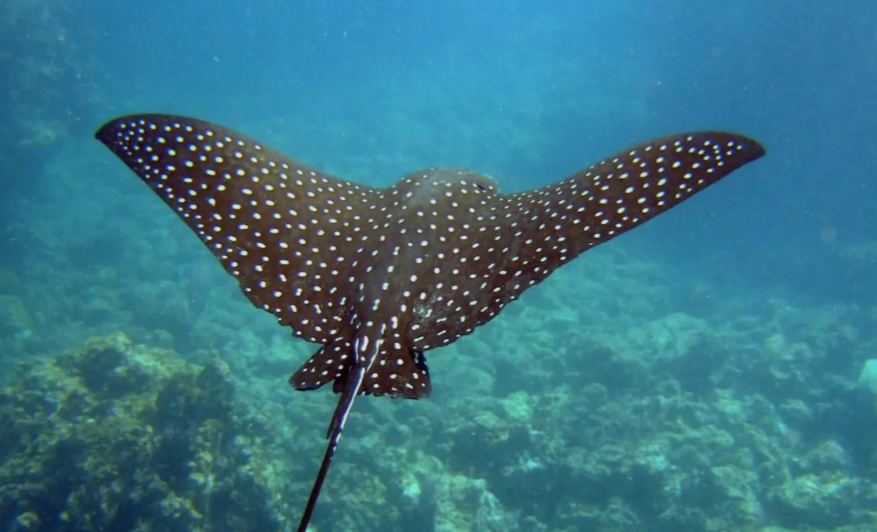
The types of stingrays make up one of the most varied groups of cartilaginous fish, with somewhere between 220 and 370 species, depending on how the group is defined. Stingrays are flattened relatives of sharks, with skeletons made of cartilage, wing-like pectoral fins and, in most species, a venomous barb on the tail. The group spans small reef dwellers, huge ocean gliders like manta rays and even freshwater giants that live in rivers. This article uses the broad definition, which includes eagle rays, butterfly rays and mobulids, since they all belong to the same order.
Most stingrays live on the seafloor, where they bury themselves in sand and mud. They find buried prey such as crabs, clams and worms using a keen sense of smell and electroreceptors that detect tiny electrical signals. A few species, like the pelagic stingray and the manta rays, live in open water. Females give birth to live young, which are fed by yolk and by a nutritious fluid called uterine milk.
A stingray’s tail spine is a defense, not a weapon, and the animal uses it only when stepped on or grabbed. Shuffling your feet in shallow water gives rays time to swim away. Their wounds are painful, and rarely life-threatening, but they should always be treated by a doctor. Many stingrays are curious and calm, and species like the southern stingray are famous for gentle encounters with divers and snorkelers.
Sadly, many rays reproduce slowly and are easy to catch in nets, so numbers are falling for a large share of species. Giants like the oceanic manta and the giant freshwater stingray are endangered, and several river stingrays are threatened by dams and the aquarium trade. Here are 50 types of stingrays, along with where each is found.
1. Southern Stingray
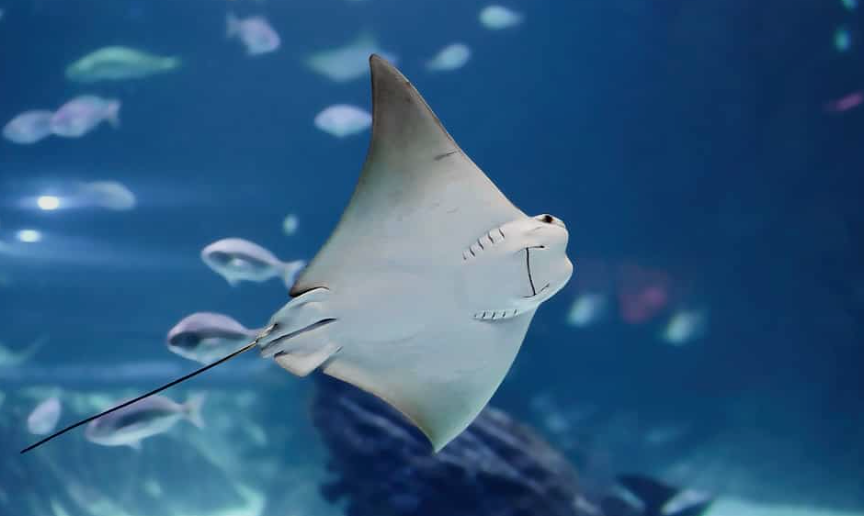
The southern stingray is one of the best-known rays in the world. It has a diamond-shaped body and an irregular row of short spines down the middle of its back. It can reach about 6.5 feet across and weigh around 200 pounds. It feeds on crabs, clams, worms, shrimp and small bony fish, using electroreceptors and smell to find prey buried in the sand.
It lives in the western Atlantic from New Jersey to Brazil, in sand flats, seagrass beds, lagoons and reefs. It is common around the Caribbean and the Gulf of Mexico. It is famous for tame encounters at spots such as Stingray City in the Cayman Islands. Females give birth to litters of two to 10 pups.
2. Atlantic Stingray
The Atlantic stingray is a small, brownish ray with a rounded disc and a long, pointed snout. It grows to about 2 feet across. It lives in shallow water and often buries itself in sand with only its eyes showing. It feeds on small crustaceans, worms and fish.
It lives along the Atlantic and Gulf coasts of North America, in estuaries, lagoons and bays. It is one of the stingrays most often seen in Florida’s shallows. It tolerates low-salinity water and sometimes enters rivers. It is one of the rays most often stepped on by beachgoers.
3. Bluntnose Stingray
The bluntnose stingray is named for its short, broad snout. It grows to about 2.5 feet across, with a brown top and a white underside. It has a well-developed fin fold on its tail. It is easy to confuse with the southern stingray.
It lives in the western Atlantic and the Gulf of Mexico, on grass and mud flats and in coastal waters. In the southern Gulf of Mexico, its numbers have fallen by about 31 percent in 32 years. Within the United States, it has some refuge from trawling in inshore waters. It is rarely reported because it looks like other rays.
4. Roughtail Stingray
The roughtail stingray is the largest whiptail stingray in the Atlantic. It can reach about 87 inches across and weigh around 660 pounds. It has a long, angular snout and large thorns on its tail and back. It is listed as vulnerable.
It lives in the North Atlantic, from Massachusetts’ Georges Bank to southern Florida and the Gulf of Mexico in the west, and from the Bay of Biscay to Angola and the Mediterranean in the east. It prefers sandy and muddy bottoms, usually deeper than other Florida rays. Its large size and slow breeding make it vulnerable to fishing. Its tail spine can be dangerous to humans.
5. Brown Stingray
The brown stingray is a very large, thick-bodied ray that was long lumped with the roughtail stingray. It has a uniform gray-brown or nearly black back and a white underside. Its disc may reach about 260 centimeters across. In Australia, it is often called the black stingray or bull ray.
It lives in the eastern North Atlantic, the Mediterranean and the Indo-West Pacific, with strong populations in southern Australia and New Zealand. It occurs from the shallows to about 800 meters deep. It is listed as vulnerable, with an estimated population decline of 30 to 49 percent over three generations in some areas. Divers often see it in the Mediterranean and around the Canary Islands.
6. Short-Tail Stingray
The short-tail stingray, also called the smooth stingray, is a huge ray of the Southern Hemisphere. It is among the largest stingrays in the world, with a thick body, a short, stout tail and a smooth upper surface. It is dark gray to nearly black. It hunts fish, crabs and shellfish.
It lives around Australia, New Zealand and southern Africa, in bays, estuaries and over the continental shelf. It often rests in the shallows near reefs and boat ramps. It tends to be less migratory than the brown stingray. In New Zealand, it is a popular sight for snorkelers.
7. Pelagic Stingray
The pelagic stingray is the only stingray that spends its life in open ocean water. It has a deep purple to blue-gray body and a long, whip-like tail. It swims in the upper levels of the sea, mostly above about 100 meters. It eats squid, jellyfish and small fish.
It lives throughout tropical and temperate oceans of the world. It is often caught as bycatch in longline fisheries. Divers rarely see it. Its tail spine is among the more dangerous of any stingray.
8. Common Stingray
The common stingray has a smooth, diamond-shaped disc that is brown, gray, reddish or olive above and whitish below. A typical adult measures about 45 centimeters across, though some reach 1.4 meters. Ancient Greeks and Romans feared its sting, and they described it in myths. It is listed as vulnerable.
It lives throughout the Mediterranean and Black Seas and in the northeastern Atlantic, from southern Norway and the western Baltic to Madeira and the Canary Islands. It lives on sandy and muddy bottoms shallower than 60 meters. It often buries itself during the day. It feeds on crustaceans, mollusks and small fish.
9. Thorntail Stingray
The thorntail stingray is a large, thick-bodied ray with rows of thorns along its tail and back. It is brownish-gray above. It lives in coastal waters and sometimes ventures into estuaries. It feeds on crabs, shrimp and small fish.
It is found in parts of the Southern Hemisphere, including the waters off Australia, southern Africa and New Zealand, though its range is poorly defined. It prefers sandy and muddy bottoms. It is caught in trawls and by recreational anglers. Little detailed biology is known compared with other large rays.
10. Yellow Stingray
The yellow stingray is a small, round ray with a yellowish body and dark spots. It is usually under 2 feet across. It prefers shallow coastal waters, and it is the stingray most often seen near Florida’s beaches. Its short tail has a strong spine.
It lives in the Gulf of Mexico and the Caribbean, along the coasts of the southeastern United States and Central America, in seagrass and sand flats and around reefs. It feeds on worms, shrimp and small fish. It often buries itself in sand. It is a common reason for beach stingray stings.
11. Round Stingray
The round stingray, also called Haller’s round ray, is a small, circular ray of the Pacific coast. It is brown or gray and sometimes has pale speckles. It has a short tail with a venomous spine, and it is well known to California beachgoers. Adults reach about 2 feet across.
It lives from northern California to Panama, on sandy bottoms and in estuaries and kelp beds. It is abundant in the shallow water of Southern California beaches, where people do the stingray shuffle. Females give birth to a few pups at a time. It feeds on worms, clams and crustaceans.
12. Round Fantail Stingray
The round fantail stingray is a nearly circular ray with a thick, ribbon-like tail. It has bold, dark markings that vary among individuals. It is a bottom dweller that rests in sand. It lives in shallow coastal waters.
It lives in the eastern Atlantic, including parts of West Africa and the Mediterranean. It is often found near reefs and sandy areas. Fishing nets catch it as bycatch. It is poorly studied compared with other rays.
13. Bluespotted Ribbontail Ray
The bluespotted ribbontail ray is a small, strikingly colored ray with electric blue spots on a yellowish-brown back. It has two blue stripes on its tail. It grows to about 14 inches across and weighs up to about 11 pounds. The spots warn that it has a venomous spine.
It lives in the shallow tropical Indo-Pacific, from South Africa and the Red Sea to Southeast Asia and Australia, on coral reefs and sandy flats. At night, groups follow the rising tide to hunt on sand flats. It hides in caves and under ledges by day. It is popular in the aquarium trade but does poorly in captivity.
14. Bluespotted Maskray
The bluespotted maskray is a small, kite-shaped ray with blue spots and a dark band across its eyes like a mask. Its disc is slightly wider than long, with a short, blunt snout. In 2016, a species complex was split into several maskrays based on DNA. It is shy and tends to bury itself.
This form lives off the southern coasts of Java and Bali in Indonesia. It is regularly seen at dive sites such as Nusa Penida. Its behavior is poorly known. It has not been separately evaluated by the IUCN.
15. Australian Bluespotted Maskray
The Australian bluespotted maskray is another member of the maskray complex. It looks very similar to its Indonesian cousin, with blue spots and a dark mask. It is a small ray with a short, blunt snout. It is shy and often rests in sand.
It lives in northern Australia and has been seen from Bali eastward to Papua New Guinea. It is probably common in northern Australia, though murky water makes diving difficult there. Hundreds of dive sites report it. It has not been assessed by the IUCN since its recent split.
16. Porcupine Ray
The porcupine ray is a heavy, round-bodied ray covered with sharp, thorny denticles. It lives in the open on reefs and sandy bottoms. It has a thick tail. Its rough skin gives it its name.
It lives in the Indo-West Pacific, in coral reefs, estuaries and sandy areas off beaches. It is a semi-pelagic species that sometimes swims in the water column. It feeds on crabs and other bottom animals. It is considered potentially dangerous because of its thorns and spine.
17. Cowtail Stingray
The cowtail stingray is a large, dark ray with a thick tail and a long, whip-like end. It can reach about 6 feet across. It lives in coastal and estuarine waters. It is often caught by fishermen.
It lives across the Indo-West Pacific, from the Red Sea and East Africa to Australia and Melanesia. It is common inshore, down to about 60 meters, in coral and sand habitats. It feeds on crustaceans and fish. Its meat is used for food in some areas.
18. Pink Whipray
The pink whipray is a medium-sized ray with a rounded, pale pinkish or tan body. It has a very long, thin tail. It lives in inshore waters and often rests in sand. It feeds on bottom invertebrates.
It lives in the Indo-West Pacific, including northern Australia and Southeast Asia, in coastal waters. It is often caught in trawls and nets. Its population is poorly known. It is often confused with related whiprays.
19. Reticulate Whipray
The reticulate whipray, also called the honeycomb stingray, has a pattern of dark honeycomb-like marks on a pale back. It is a large ray with a very long, whip-like tail. It lives on sandy and muddy bottoms. It feeds on crustaceans and fish.
It lives in the Indo-West Pacific, from the Red Sea and East Africa to Australia, in inshore waters to at least 60 meters deep. It is common near coral and sandy areas. It is caught in gillnets and trawls. Its numbers are declining in many places.
20. Leopard Whipray
The leopard whipray has a striking pattern of dark spots on a pale back. It is a large ray with a long tail. It lives in coastal waters over sand and mud. It feeds on crustaceans and small fish.
It lives in the Indo-West Pacific, including Southeast Asia and northern Australia. It is caught in many fisheries. It is considered threatened in parts of its range. Its pattern makes it attractive to divers.
21. Giant Freshwater Stingray
The giant freshwater stingray is the largest stingray in the world and one of the largest freshwater fish. It can grow to about 7 feet across and 660 pounds. In June 2022, a female caught in the Mekong River in Cambodia weighed about 661 pounds and was nicknamed Boramy, or full moon. It was tagged and released.
It lives in large rivers and estuaries of Southeast Asia, including the Mekong, Chao Phraya, Nan and Mae Klong rivers, and in Borneo. It prefers sandy and muddy bottoms and eats small fish and invertebrates. It is listed as endangered because of overfishing, dams and habitat loss. It has disappeared from parts of its range, such as central Thailand.
22. Freshwater Whipray
The freshwater whipray is a large ray with a long, thin tail and a gray-brown back. It lives in rivers and estuaries. It is a bottom dweller that feeds on fish and invertebrates. It is also known from tidal waters.
It lives in northern Australia and southern New Guinea. Its status is poorly known. Some experts group it with giant freshwater rays in other parts of Asia. Habitat changes in rivers are a possible threat.
23. Estuary Stingray
The estuary stingray is a large, dark ray of eastern Australia’s tidal waters. It has a broad, rounded disc and a short tail. It is a common sight in tidal creeks. It feeds on crabs, shrimp and worms.
It lives in estuaries and coastal lagoons from Queensland to New South Wales. It also enters brackish and fresh water. Anglers often hook it by accident. It is generally released alive.
24. Ocellate River Stingray
The ocellate river stingray is one of the most widespread South American freshwater stingrays. It has a rounded brown disc marked with large, orange-ringed spots. It lives buried in sand during the day and hunts by smell and electroreception at night. It is the most commonly imported species in the aquarium trade.
It lives in the Paraná, Uruguay, Orinoco and Amazon river basins. It prefers calm, sandy waters in rivers and lagoons. It has become established as an alien species in Singapore, the first record of a South American freshwater stingray outside the Neotropics. Females give birth to live young.
25. Xingu River Stingray
The Xingu river stingray, also called the black diamond ray, has a black disc with bold white spots. As it grows, its spots turn into circles and eventually break into white flecks. It is one of the most prized aquarium stingrays. It prefers rocky river bottoms.
It lives only in Brazil’s Xingu River basin and its tributaries, including the Iriri and Curuá. It is listed as vulnerable. Fishers catch adults for food, and collectors take juveniles for the aquarium trade. Dams, mining and deforestation have degraded its habitat.
26. Bigtooth River Stingray
The bigtooth river stingray is a large, dark river stingray with pale spots on a black back. It is one of two scientifically recognized black rays of its group, along with the Xingu ray. It lives on river bottoms and hunts invertebrates and small fish. It is prized by aquarists.
It lives in the Araguaia and Tocantins river systems of Brazil. It shares habitat with other freshwater fish and stingrays. Collectors and dams are threats. Little is known about its population.
27. Discus Ray
The discus ray is one of the largest freshwater stingrays in South America, growing to about 1.5 meters across. It has a rounded, nearly circular disc and a short tail. It rests on river bottoms and eats fish and invertebrates. It is also called the disc ray.
It lives in the Amazon and Orinoco river basins, in sandy and muddy channels. Local fishers sometimes catch it for food. Its numbers are poorly known. Its large size makes it vulnerable.
28. Short-Tailed River Stingray
The short-tailed river stingray is a big river ray that grows to about 1.5 to 1.6 meters across. It has a rounded brown disc with faint markings and a short tail. It prefers sandy river bottoms. It feeds on fish and invertebrates.
It lives in the Paraná, Paraguay and Uruguay river basins of southern South America, including Argentina. It is among the largest freshwater stingrays. It is caught for food and sometimes as bycatch. Dams and pollution affect it.
29. Porcupine River Stingray
The porcupine river stingray, also called the teacup ray, is one of the smallest freshwater stingrays. It usually reaches about 14 inches across. It has a dark brown disc with a pattern of pale spots and a spiny back. It is popular among aquarists.
It lives in the Paraná and La Plata river basins, among the most southerly river stingrays. It rests on sandy and muddy bottoms. It eats worms, insects and small fish. Its small size makes it easy to keep in large aquariums.
30. Common Stingaree
The common stingaree is an abundant, small ray of southeastern Australia. It has a rounded disc and a short, stout tail with a fin. It is a bottom dweller. It feeds on crustaceans and worms.
It lives on sandy flats and rocky reefs and ventures upstream into brackish estuaries. It is a frequent catch for recreational anglers. It is also a significant part of trawl bycatch. It is common within its range.
31. Sparsely-Spotted Stingaree
The sparsely-spotted stingaree is a southern Australian ray with a brown back and a few pale spots. It is also called the white-spotted or Dixon’s stingaree. It rests partly buried in sandy bottoms during the day. It preys mainly on crustaceans.
It lives on sandy bottoms and in seagrass beds along the southern Australian coast. It is widely distributed and abundant. It often survives capture in trawls, though pregnant females may abort their young. It is relatively aggressive when disturbed.
32. Spotted Stingaree
The spotted stingaree is a large stingaree with a pattern of small dark spots. It occurs in an eastern form and a western form that differ in appearance. It is less aggressive than the sparsely-spotted stingaree. It rests on sand during the day.
It lives in southern Australian waters. There is little fishing across most of its range. It is a bottom feeder. Its status is considered healthy.
33. Banded Stingaree
The banded stingaree is a small ray with distinct dark bands across its back. It has a rounded disc and a stout tail with a fin. It is a bottom dweller. It feeds on small crustaceans.
It lives in the coastal waters of southern Australia, including Tasmania. It prefers sandy and rocky bottoms. It is caught as bycatch in trawls. Its populations are poorly studied.
34. Giant Stingaree
The giant stingaree, also called the deepwater stingray, is a large, deepwater ray. It has a thick tail and a broad disc. It is one of only a few members of its family. It lives in deeper water than most stingrays.
It lives in the tropical Indo-West Pacific, on the continental slope. It is rarely seen. It is caught in deep trawls and fisheries. Little is known about its biology.
35. Sixgill Stingray
The sixgill stingray is an odd, deepwater ray with six pairs of gill slits instead of five. It has a long, flabby snout and no dorsal fin. Its skin is smooth, without thorns. It has a broad mouth with many small, blunt teeth.
It lives in deep water over the continental slope, mostly in the Indo-Pacific and Atlantic. It is rarely seen. Little is known about its life history. It is considered an ancient lineage within the stingrays.
36. Smooth Butterfly Ray
The smooth butterfly ray is a wide, diamond-shaped ray with very short tail and no spine. It looks like a butterfly gliding along the seabed. It often buries itself in sand. It feeds on small fish and crustaceans.
It lives in the western Atlantic, from New England to Brazil, in shallow bays and sand flats. It lacks the venomous spine of its relatives, making it less dangerous. It is often caught in trawls. Its population is of moderate concern.
37. Spiny Butterfly Ray
The spiny butterfly ray is a large, broad, bell-shaped ray with a short tail and a venomous spine. It can reach 6 feet across or more and weigh up to about 130 pounds. It is dark brown above. It is an active predator of fish, crustaceans and mollusks.
It lives in patchy populations in the Atlantic, in both the east and west, in tropical and warm-temperate waters. It swims near the bottom in shallow bays and sometimes over deep water. It is listed as vulnerable. Its meat is well regarded in some areas.
38. Spotted Eagle Ray
The spotted eagle ray is one of the most beautiful rays in the sea, with white spots on a dark back and a long, whip-like tail. It reaches about 4 to 5 feet across. It has a duck-bill-shaped snout that it uses to dig out clams and snails. It swims by flapping its wings like a bird.
It lives in warm coastal waters of the Atlantic, including the Caribbean and Gulf of Mexico. It often swims in schools in open water. Older assessments rated it near threatened, and recent reassessments have raised its risk. It is shy of divers.
39. Ocellated Eagle Ray
The ocellated eagle ray looks much like the spotted eagle ray but lives in the Indo-Pacific. It has bold, eye-like spots on a dark back. It is a large ray of the continental shelf. It crushes shellfish with its strong jaws.
It lives from inshore waters to offshore areas in Australia and the Indo-West Pacific, in depths down to about 40 meters. Marine parks give it some refuge in Australia. Incidental catches are low there. In Asia, it is caught more often.
40. Common Eagle Ray
The common eagle ray has a kite-shaped disc about twice as wide as long and a large head with a rounded snout. It can reach about 72 inches across and weighs up to 32 pounds. It swims in groups close to soft bottoms. It feeds on crustaceans and mollusks.
It lives in the Mediterranean and the eastern Atlantic, from the British Isles to southern Africa. Its numbers have fallen sharply because it is heavily fished. It is more common in the southern part of its range. It occasionally ventures offshore.
41. Bat Ray
The bat ray is a large eagle ray of the Pacific, named for its long, pointed wings. It grows to about 6 feet across and weighs up to 200 pounds. It has a rounded snout and a barbed tail. It feeds on clams, crabs and shrimp.
It lives from Oregon to the Gulf of California and the Galápagos Islands, in shallow sandy and muddy areas and kelp forests, at depths of 1 to 46 meters. It is often seen in California bays. It forms large schools. It is a popular sight for snorkelers.
42. Bullnose Ray
The bullnose ray is a western Atlantic eagle ray with no spots on its back and a blunt snout. It is brown above and white below. It has a barbed tail. It feeds on mollusks and crustaceans.
It lives along the Atlantic coast from the northern United States to Brazil, in coastal waters and bays. It is often confused with the cownose ray. It is caught as bycatch. Its numbers are not well known.
43. Cownose Ray
The cownose ray has a notched, cow-like snout and a brown back with no spots. It swims in large schools and migrates in huge groups. Adults mature slowly, at around 7 to 8 years for females. It crushes clams and oysters with plate-like teeth.
It lives in shallow coastal waters and estuaries of the Atlantic, including the Chesapeake Bay in summer. It is listed as vulnerable. Few conservation strategies exist, though Maryland has banned cownose ray-killing contests. Mating and nursery use happens in late spring and summer.
44. Giant Oceanic Manta Ray
The giant oceanic manta ray is the largest ray in the world. It typically measures 13 to 16 feet across and can reach about 23 feet. It has a dark back with a T-shaped mark and spots on its underside. It filters plankton through its gills.
It lives in tropical and subtropical waters around the world, often near offshore islands and seamounts. Mantas may travel alone or in groups of up to 50. It is listed as endangered because of overfishing for its gill plates. It visits cleaning stations on reefs.
45. Reef Manta Ray
The reef manta ray is smaller than its oceanic cousin, typically 10 to 11.5 feet across. It has a dark back and pale underside with individual spot patterns. It lives close to coasts and is often seen at cleaning stations. It feeds on plankton.
It lives in tropical and subtropical waters of the Indian and Pacific Oceans, including the Maldives, Indonesia, Hawaii and Australia. It is listed as vulnerable. Manta tourism brings large revenues to communities such as the Maldives and Ecuador. It is protected in many countries.
46. Spinetail Devil Ray
The spinetail devil ray is a large mobulid with horn-like feeding fins on its head. It has a dark back and a pale belly. It is a fast, powerful swimmer that often leaps from the water. Recent revisions consider it the same species as the Mediterranean giant devil ray.
It lives in tropical and temperate oceans around the world, mostly in open water but also near coasts. It feeds on plankton and small fish. It is vulnerable to fishing and bycatch. It is listed as vulnerable in some national assessments.
47. Sicklefin Devil Ray
The sicklefin devil ray, also called the Chilean devil ray, has a curved, sickle-shaped dorsal fin. It is a large ray with a disc width of about 1 to 3.7 meters. It is a pelagic species that dives deep. It lacks a stinging spine.
It lives in tropical and subtropical waters worldwide, in both coastal and offshore areas. It is listed as endangered and protected under CITES Appendix II. Fishing for its gill plates and meat has reduced numbers. It is hard to distinguish from other devil rays at sea.
48. Munk’s Devil Ray
Munk’s devil ray, also called the smoothtail mobula, is a smaller devil ray with a smooth tail that lacks a spine. It was described only in 1987 and named for oceanographer Walter Munk. It is famous for leaping out of the water in acrobatic jumps and somersaults. It feeds on small crustaceans and schooling fish.
It lives in the eastern Pacific, from the Gulf of California to Peru, including the Galápagos, Cocos and Malpelo islands. It occurs in both oceanic and coastal waters. It is listed as vulnerable. Gillnets are a major threat.
49. Bentfin Devil Ray
The bentfin devil ray is a mid-sized mobulid with a bent, angled front edge on its wings. It is dark above and pale below. It travels in schools and leaps out of the water. It feeds on plankton and small fish.
It lives in tropical and subtropical oceans worldwide. It is often caught in gillnets and as bycatch. It is listed as threatened in recent assessments. Devil rays are hard to tell apart in fishery catches, which makes monitoring difficult.
50. Diamond Stingray
The diamond stingray is a mid-sized ray of the eastern Pacific, with a diamond-shaped disc and a long, thin tail. It is brownish-gray above and white below. It rests on sand and mud. It feeds on crustaceans and small fish.
It lives in shallow coastal waters from California to Peru, including the Galápagos. It often shares sandy habitats with round stingrays. It is caught in artisanal fisheries. Its status is poorly known.
Sources:
- Southern Stingray, Georgia Aquarium
- Southern Stingray, Florida Fish and Wildlife Conservation Commission
- Stingray ID Guide, Florida Museum of Natural History, University of Florida
- Roughtail Stingray, Florida Museum of Natural History
- Bluntnose Stingray, Sharks and Rays
- Brown Stingray, Sharks and Rays
- Common Stingray, Wikipedia
- 5 Varieties of Stingrays Found in Florida, Scuba.com
- Spotted Eagle Ray, Florida Museum of Natural History
- Spotted Eagle Ray, Georgia Aquarium
- Common Eagle Ray, Florida Museum of Natural History
- Cownose Ray, Wikipedia
- Cownose Ray Species Status Assessment, New York State Department of Environmental Conservation
- Spiny Butterfly Ray, Florida Museum of Natural History
- Giant Oceanic Manta Ray, Wikipedia
- Mobulids of the World, Manta Trust
- Devil and Manta Rays Fact Sheet, Convention on Migratory Species
- Munk’s Devil Ray, Wikipedia
- World’s Largest Freshwater Fish Caught in Cambodia, Al Jazeera
- Giant Freshwater Stingray, Wikipedia
- Stingers in a Strange Land: South American Freshwater Stingrays in Singapore, Biological Invasions
- Xingu River Stingray, Sharks and Rays
- Potamotrygonidae, Encyclopedia of Life
- Bluespotted Ribbontail Ray, California Academy of Sciences
- Bluespotted Maskray, Sharks and Rays
- Common Stingaree, Wikipedia
- Sparsely-Spotted Stingaree, Museums Victoria
- Sixgill Stingray, Animal Diversity Web, University of Michigan