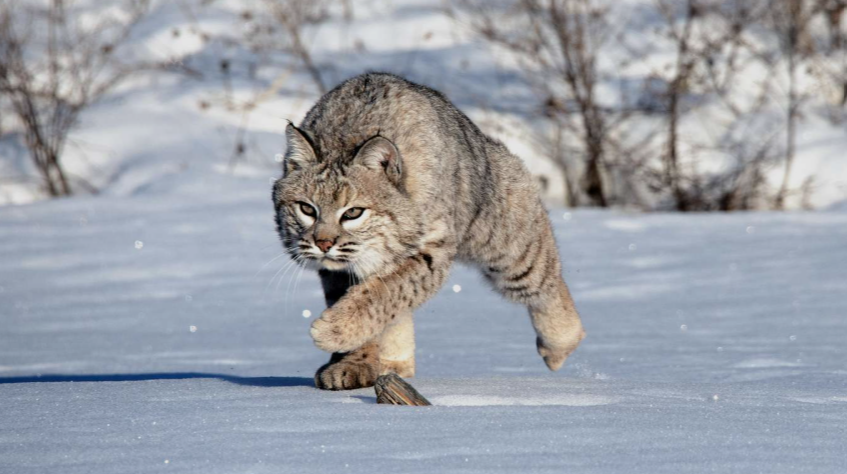
The animals that look like bobcats include their closest lynx cousins, a handful of spotted small cats from three continents and a few domestic breeds designed to copy the wild look. A bobcat is easy to describe, with a short bobbed tail, tufted ears, a ruffed face and a spotted tan to reddish coat. It is about twice the size of a house cat, and males average around 26 pounds. Its range covers southern Canada, the lower 48 states and northern Mexico, so many people have seen one without realizing it.
The most convincing look-alikes are the other lynx. There are four living species in the genus, the bobcat, the Canada lynx, the Eurasian lynx and the Iberian lynx, and all have short tails, big paws and tufted ears. Beyond the lynx, other medium-sized wild cats share individual features. The caracal has the ear tufts, the serval has the spots, and several South American cats have the spotted coat and compact build.
Domestic cats join the list too. Breeders have developed several short-tailed, tufted-eared breeds that look like miniature bobcats, though DNA testing shows they are fully domestic. Some of them were even created with a bobcat in mind. Knowing which features to check, such as the tail tip, the ears and the paws, makes it much easier to tell them apart.
The 15 animals below range from close relatives to unrelated cats that simply borrowed the look. Each description explains what makes it look like a bobcat and where it lives. If you see a wild cat, enjoy it from a distance and never approach it.
1. Canada Lynx
The Canada lynx is the animal most often mistaken for a bobcat. It has longer legs, wider feet, longer ear tufts and a more prominent black-tipped tail than a bobcat. Its back legs are longer than its front legs, which gives it a stooped look, and its paws are at least twice as big and furred on the soles, like snowshoes. Its tail is only about 5 to 13 centimeters long, and the tip is solid black all the way around.
It lives in the boreal forests of Canada and Alaska, and in parts of the northern United States such as Maine, Minnesota, Montana and Washington. It weighs about 15 to 30 pounds. Researchers confirmed two wild hybrids between Canada lynx and bobcats in Maine’s Moosehead region in 2003, and the hybrids looked like bobcats with long ear tufts and almost fully black-tipped tails. Biologists at the University of Minnesota Duluth say the main identification challenge with lynx is telling them from bobcats, and the black tail tip “dipped in ink” is the best clue.
2. Eurasian Lynx
The Eurasian lynx is the largest of the lynx, and on average the biggest of the small cats, weighing over 60 pounds in some cases. It has long legs, dense fur and big paws that work like snowshoes. Its tail is short with a black tip, and its ears carry black tufts with white spots. Its coat is tawny to cream with brown and black mottling and a bushy ruff on the neck.
It lives across northern and central Europe and Asia, in forests and mountains. It has six subspecies and takes bigger prey than its American relatives, such as deer. It was once considered extinct in the wild in Slovenia, though it has been reintroduced to several countries. Bobcats do not occur in Europe, so any lynx-like cat there is a Eurasian or Iberian lynx.
3. Iberian Lynx
The Iberian lynx is about half the size of a Eurasian lynx, weighing 9 to 15 kilograms, roughly the same as a bobcat. It has a small head, a short body and long legs. It has a flared facial ruff, long black ear tufts and a short tail with a black tip all the way around. Its coat is more obviously spotted than the Canada lynx’s.
It lives only in Spain and Portugal, in Mediterranean scrub and woodland. It is a specialist that eats mostly rabbits, with 80 to 100 percent of its diet coming from them. Its recovery is one of the greatest conservation stories for a cat, as it grew from just 62 mature individuals in 2001 to 648 in 2022, and the total reached 2,401 in 2024. The IUCN improved its status from endangered to vulnerable in 2024, though vehicles remain a major cause of death.
4. Caracal
The caracal is a reddish-tan, medium-sized cat with the most famous ear tufts of any wild cat. Its long, black tassels give it a lynx-like face, and it has bold black markings on its muzzle. It looks like a slightly overgrown house cat, about 3 feet long. Unlike a bobcat, it has a plain, unspotted coat and a longer tail.
It lives across most of non-desert Africa, the Middle East, Central Asia and parts of India. It prefers dry habitats such as savanna, semi-desert and woodlands. Researchers at the University of Minnesota note that the tufts help it pinpoint prey and may be used for communication. It is an agile hunter that can leap to catch birds.
5. Serval
The serval is a tall, leggy, spotted cat with huge ears. Its markings are bolder than a bobcat’s, and it has a smaller head and a long neck. It lacks the ear tufts of a bobcat. Its ears are very large and wide-set, and it can rotate each one independently to track small animals moving underground.
It lives in non-rainforest sub-Saharan Africa, in grasslands, wetlands and savanna. It weighs about 15 to 40 pounds and is considered the tallest of the small cats. It hunts rodents, birds and reptiles, often by pouncing. It is listed as least concern.
6. Ocelot
The ocelot is a medium-sized spotted cat with chain-like rosettes and stripes, giving it a bobcat-like coat. It is a lowland cat with a broad range. It is larger than most small cats, with a body up to about 40 inches long. Its tail is longer than a bobcat’s and has rings.
It lives in most of South and Central America and in the southwestern United States, as well as on islands such as Trinidad. It lives in forests, shrubland and savanna. Its diet is mostly small and medium mammals, birds and reptiles. It is listed as least concern globally, though it is rare at the northern edge of its range.
7. Margay
The margay is a slender, long-tailed cat with a yellowish coat dappled with brown. It looks like a smaller, more delicate ocelot. It has big eyes and a sleek body built for life in the trees. It resembles a young bobcat in coat pattern but not in tail length.
It lives in most of Central and South America, in forests, shrubland and savanna. It weighs about 5.7 to 9 pounds, slightly more than its relative the oncilla. It is an excellent climber. It is considered near threatened, and its population is declining.
8. Geoffroy’s Cat
Geoffroy’s cat is a small spotted cat of South America, almost the same size as a house cat. It has a spotted coat in gray to yellow tones, small round ears and a ringed tail. It looks like a bobcat shrunk down to pet size. A rare black form also exists.
It lives in southern and central South America, in savannas, forests, shrubland and grassland, including Argentina and Bolivia. It is one of the most common wild cats in Bolivia, where only the ocelot has a larger population. It eats small mammals, especially rodents, as well as birds, reptiles and carrion. Its population is declining, and it is listed as vulnerable.
9. Jungle Cat
The jungle cat is a tall, long-legged cat with a short tail and sandy-gray fur. It is more plain than a bobcat, but its short tail and tufted-looking ears give it a lynx-like profile. It is also called the swamp cat, since it often lives near water. Its short tail is its most bobcat-like feature.
It lives across southern Asia and the Middle East, in wetlands, grasslands and scrub. It is considered a species of least concern. It hunts rodents, birds and fish. It often lives close to people on farmland.
10. Asian Golden Cat
The Asian golden cat is a golden-brown to reddish medium-sized cat with white and black facial markings. It comes in several color forms, including spotted ones. Its tail is longer than a bobcat’s, but its size and coloring give it a similar look. It is a close relative of the bay cat.
It lives in the forests of East and Southeast Asia, from Nepal through Southeast Asia into China. It is a formidable hunter with great climbing and swimming abilities. It is rarely seen in the wild. Habitat loss and hunting are its main threats.
11. Pampas Cat
The pampas cat is a small, stocky South American cat with a tawny to grayish coat and faint stripes or spots. It has a bushy tail and tufted-looking fur, so it can look like a compact bobcat. It is part of a species complex that includes several close relatives. It is closely related to the Andean mountain cat.
It lives in grasslands, scrub and high Andean habitats in South America. It hunts small rodents and birds. It is rarely seen and little studied. It is an example of how many small cats resemble each other.
12. Pixie-Bob
The pixie-bob is a domestic cat bred to look like a wild bobcat. It has a short tail, a spotted tabby coat and tufted ears. Its tail can range from nearly nonexistent to a few inches or full length. It often has extra toes.
Breeders developed it in the 1980s to resemble the red bobcats of the coastal mountains of Washington state. Legends say it came from wild bobcats, but DNA testing shows it is fully domestic, and it is simply a cat with a tail mutation. It chirps instead of meowing. It is affectionate and dog-like.
13. American Bobtail
The American bobtail is a large, muscular domestic cat with a short, stubby tail. It has lynx-like ears, tufts of fur between its toes and mutton-chop cheeks. Its hind legs are long, which gives it a bobcat-like build. Its coat is often a wild-looking tabby.
It was developed in the 1960s after a couple adopted a stray with a short tail and bred him to a long-tailed female. It is social and playful, and many like to play fetch. It adapts well to new places. It is one of the most popular bobtail breeds.
14. Kurilian Bobtail
The Kurilian bobtail is a sturdy, muscular cat with a short pom-pom tail and a wild appearance. No two tails look exactly alike. It can grow to about 10 pounds. Its hind legs are longer than its front legs, which makes it an excellent jumper.
It is a natural breed that has lived for more than 200 years on Russia’s Sakhalin island and the Kuril Islands. It is recognized by The International Cat Association as an advanced new breed. It loves water and the outdoors. It lives 15 to 20 years.
15. Maine Coon
The Maine Coon is a large, shaggy cat with tufted ears and a bushy coat. Its tail is much longer than a bobcat’s, but its size and ear tufts give it a wild, lynx-like look. It has water-resistant fur that helps it survive cold climates. It comes in many colors.
It is a native breed of the northeastern United States and one of the most popular in the world. It is gentle, laid back and often described as dog-like. It is a good match for households with children and other pets. It is a domestic cat through and through.
Sources:
- Lynx, Encyclopaedia Britannica
- Lynx, Wikipedia
- Small Cat Spotlight: What’s a Lynx?, Panthera
- Spot the Difference: Bobcat vs. Canada Lynx, Willy’s Wilderness
- Lynx or Bobcat: Which Cat Is That?, Safari Ltd
- Lynx vs Bobcat, World Animal Rescue Network
- Canadian Lynx vs Bobcat, Hepper
- Lynx (Canada Lynx), University of Minnesota Duluth, Minnesota Mammals
- Bobcat, University of Minnesota Duluth, Minnesota Mammals
- Bobcats, University of Nebraska Wildlife Damage Management, Extension
- Felid Hybrids, Wikipedia
- Bobcat Fact Sheet, North Dakota Game and Fish
- Lynx Identification, Maine Department of Inland Fisheries and Wildlife
- Iberian Lynx, IUCN Cat Specialist Group
- Iberian Lynx Rebounding, IUCN
- Iberian Lynx Population Reaches 2,401, Portugal News
- Iberian Lynx Facts, Big Cat Rescue
- Iberian Lynx Population in 2025, Wild Side Holidays
- Caracal, University of Minnesota, Snapshot Serengeti
- Caracal, San Diego Zoo
- Caracal, Safari West
- Caracal, Encyclopedia.pub
- Bobcat vs Serval, Lions Tigers and Bears
- List of Felids, Wikipedia
- The Cat’s Meow, American Museum of Natural History
- Small Wild Cats List, Big Cats Wild Cats
- Cat Breeds That Look Like Bobcats, A-Z Animals
- Bobtail Cats Without Tails, Litter-Robot
- Exploring the Unique World of Bobtail Cats, A-Z Animals
- Cat Breeds With No Tail, Pangovet
- Short-Tailed Cat Breeds, Catster
- Pixiebob, Zooplus