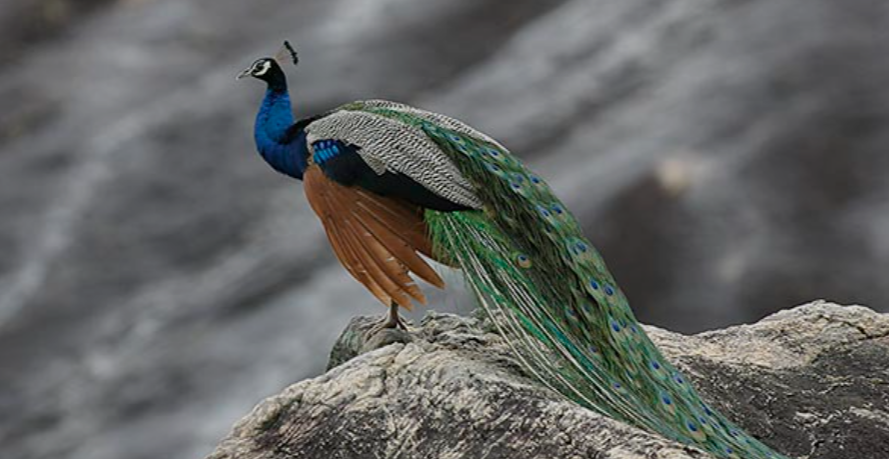
The types of peacock bird species make a shorter list than most people expect, because true peacocks are a small and remarkable group. Strictly speaking, “peacock” refers to the male, the female is a peahen and the pair together are called peafowl. Only 3 species of peafowl exist: the Indian peafowl, the green peafowl and the Congo peafowl. All three belong to the pheasant family.
The famous train of a peacock is not the true tail but a fan of elongated upper tail feathers that can number more than 150, each marked with a shimmering eyespot. A male lifts and spreads the train in a shimmering display to attract a peahen, and he shakes it to produce a rattling sound. After the breeding season, he sheds the train and grows a new one for the next year. Peahens are plainer and mostly brown, which helps them hide while nesting on the ground.
Peafowl are omnivores that eat seeds, fruit, insects, lizards and even small snakes. They forage on the ground but fly up into tall trees to roost at night, and their loud calls carry long distances through the forest. The Indian peafowl is the national bird of India, while the green and Congo species live in remote forests and are under serious pressure. Together, the three species show how widely this group has spread, from South Asia to Southeast Asia and Central Africa.
Because only 3 species exist, this article reaches 35 by also covering the 3 forms of green peafowl, the 18 color and pattern forms bred from Indian peafowl in captivity, and the 11 relatives that carry the peacock name or look like peacocks. These are the peacock-pheasants and the argus pheasants. Each description explains what the bird is and where it lives.
1. Indian Peafowl
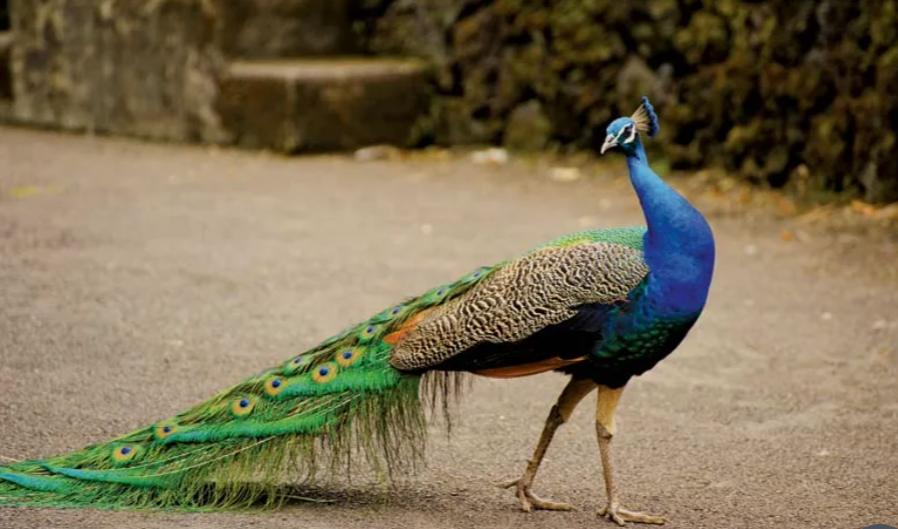
The Indian peafowl is the bird most people picture when they hear the word peacock. Males have a shimmering blue neck and chest, a fan-shaped crest and a train that can reach about 5 feet long. A full-grown male measures roughly 7 feet from beak to train tip and weighs about 9 to 13 pounds. The peahen is smaller, with a brown body and a greenish neck.
In the wild, it lives across India, Sri Lanka, Nepal, Pakistan and Bangladesh, in open forests, farmland and village edges near water. Birds gather in small groups, forage on the ground and fly into tall trees to roost. Feral populations also live in places such as Hawaii, California, Australia and the UK, and feral birds in Japan carry some green peafowl genes. The feral Indian peafowl of Japan have some green peafowl genes. The species is common enough to be of least concern, and its colors are the starting point for every captive variety below. fandom
2. Green Peafowl
The green peafowl is one of the largest members of the pheasant group and is possibly the longest wild bird alive when its train is counted. It ranks among the largest living galliforms in overall size, though lighter-bodied than a wild turkey. Unlike the Indian peafowl, the sexes look quite similar in the wild, and both have long upper tail feathers. Males are solitary and territorial, forming harems without lasting pair bonds, rather than displaying in groups. Its plumage is a metallic mix of green and gold, with blue-sheened wings. thainationalparksthainationalparks
This species lives in the forests of Southeast Asia, from Myanmar and Thailand through Laos, Vietnam and Cambodia, plus Yunnan in southern China and the island of Java. It has been listed as endangered since 2009 because of deforestation, farming and habitat fragmentation. Hunting, poaching and the pet trade add to the pressure. It prefers forest and woodland near water, and it can even hunt venomous snakes. wikipedia
3. Congo Peafowl
The Congo peafowl is the only true pheasant native to Africa, and it was discovered by science in 1936. Early stuffed specimens were mistaken for immature Asian peafowl before it was recognized as a separate species. Males are blue-green with a short, tufted crown and a bare red throat, while females are chestnut-brown with a green back. Unlike the Asian species, the male has no long train, and adults weigh around 2.6 to 3.3 pounds. doc
It lives only in the dense lowland rainforests of the Democratic Republic of Congo. It has been recorded in the Okapi Wildlife Reserve and Kahuzi-Biega National Park, among other protected areas. The wild population was estimated at between 2,500 and 9,000 adults as of 2013. Snares set for small mammals and antelope are a major threat, along with mining, farming and logging. It is considered threatened, with assessments ranging between near threatened and vulnerable. Congo Peafowl Afropavo congensis +2
4. Javan Green Peafowl
The Javan green peafowl is the nominate form of the green peafowl and is often called the most colorful of the three. Its neck and breast are a metallic golden-green, with sky-blue wing coverts. Females show clear barring on the back. It is a large, striking bird, with males carrying a long train and a tall, pointed crest. fandom
This form lives only on the island of Java in Indonesia. The remaining population survives in the eastern and western ends of the island, in protected areas such as Ujung Kulon and Baluran National Parks. It once also lived on the Malay Peninsula, but that population is gone, and attempts to reintroduce birds there failed. It is the rarest of the three green peafowl forms. cavac
5. Indochinese Green Peafowl
The Indochinese green peafowl is the most widespread and most common form of the green peafowl. Its coloring falls between that of the Javan and Burmese forms. Males often give a loud, repeated call that sounds like ki-wao, and they call at dawn and dusk from roost sites. Both sexes have long upper tail feathers, though the male’s train is longer and more spectacular. cavac
It lives from eastern Myanmar through Thailand and Laos into Cambodia and Vietnam, and in Yunnan Province in China. In Vietnam, it has vanished from the north, and its last large population is in the southeast, in Yok Don and Cat Tien National Parks. Some scientists think the birds in Yunnan may be a separate form. Hybrids with Indian peafowl have also appeared in China. cavac
6. Burmese Green Peafowl
The Burmese green peafowl is the largest and most robust of the three green peafowl forms. It lives from Myanmar toward southwestern Thailand, and it formerly occurred in Bangladesh and northern Malaysia. Its facial skin is more intensely colored than that of the other two forms. The plumage is metallic green and gold, with blue-black wings. fandom
The Irrawaddy River was proposed as the dividing line between this form on the west and the Indochinese form on the east. Birds have been sighted in northeastern India, though some consider the population there extinct. A group was reintroduced to Hlawga National Park in Myanmar. Like its relatives, it is threatened by habitat loss and hunting. wikipedia
7. India Blue Peafowl
The India Blue is the natural color of the Indian peafowl and the standard against which all other varieties are measured. The male has a deep blue neck and chest, wings barred with black and tan, and a train of green eyespot feathers. It and the green peafowl are the two naturally occurring colors, while the rest are mutations. The peahen is brownish with a greenish neck and a pale belly. blogspot
It is the form found in the wild across India and the surrounding region, and it is also the most common peafowl in captivity worldwide. Breeders keep it on farms, estates, parks and zoos in North America, Europe and Australia. It is hardy, long-lived and noisy, and it can live 20 years or longer. Every other color and pattern below started as a change in this bird.
8. White Peafowl
The white peafowl is not an albino but a bird that carries a gene for the absence of color. It was the first true color mutation to appear, and white eyespots can still be seen in the tail. Its eyes are dark, which separates it from a true albino. When the train is fanned, it looks like a spray of white lace. iamcountryside
White peafowl are bred in captivity worldwide and are popular on estates, farms and at weddings. They are not found in the wild, because the pale plumage would make them easy targets for predators. Color mutations like this rarely occur in the wild but are common in captivity thanks to selective breeding. The color masks any other pattern the bird carries. wikipedia
9. Cameo Peafowl
The cameo peafowl is a soft, muted variety in shades of brown, tan and white. Its feathers lack the twisted structure that produces iridescence, and the crest and head are chocolate brown. This gives it a flat, earthy look instead of the usual glossy blue. Chicks hatch creamy tan. iamcountryside
Cameo is a sex-linked color, so males are harder to produce than females. Cameo is among the sex-linked colors, along with purple, peach and Sonja’s Violeta. It is found only in captivity, where breeders keep it in the US, Europe and elsewhere. It is a favorite of collectors because it looks so different from the wild bird. cults3d
10. Purple Peafowl
The purple peafowl is a deeper blue than the India Blue, and it appears purplish in bright sunlight. The peahen looks like an India Blue hen but with some purple in the neck, and the chicks look just like blue chicks. The color is bright and rich, and it makes a striking display when the train is fanned. Purple is also a sex-linked color. cacklehatchery
Purple peafowl are bred in captivity across the world and are widely sold by hatcheries. They are not found in the wild. They are as hardy as their blue cousins and can be combined with patterns such as pied and black shoulder. The color is one of the most popular for ornamental flocks.
11. Opal Peafowl
The opal peafowl takes its name from its shimmering two-tone gray look. It has an iridescence similar to that of the opal stone, and the chicks hatch with pale gray down. Peahens are light gray with no shimmer, unlike the peahens of the blue or purple varieties. Males look dramatically different from an India Blue, with a pale, silvery-lavender sheen. cacklehatchery
Opal is a sex-linked color, so it shows up in a predictable pattern when breeders cross different colors. It is raised in captivity worldwide, in the US, Europe and beyond. It is not found in the wild. Opal birds are especially popular for their pale, jewel-like color.
12. Midnight Peafowl
The midnight peafowl looks like a darker, more subdued India Blue. The peacock is darker, less brilliant and a little less iridescent, while the peahen and chicks are brown. The deep tone gives it a moody, dramatic look when the train is spread. It is one of the standard recognized colors. cacklehatchery
Midnight peafowl are bred in captivity by hobbyists and farms across the world. They are not found in the wild. The color can be combined with patterns such as black shoulder or pied. They are as hardy and long-lived as other Indian peafowl.
13. Charcoal Peafowl
The charcoal peafowl is a dark, smoky variety that is much less colorful than the wild bird. Breeders describe it as having a muted, dusky body and a gray-toned train. It is one of the standard color mutations recognized in the United States. The peahen is a gray-brown color.
Charcoal peafowl exist only in captivity, where they are raised by collectors and ornamental breeders in North America and Europe. The color is less common than the blue, white or purple forms. Descriptions of the exact shade vary from breeder to breeder. It breeds true when two charcoal birds are paired.
14. Buford Bronze Peafowl
The Buford Bronze peafowl has a warm, brassy-green tone that sets it apart from the blue varieties. The peahens are darker than purple or cameo hens but lighter than India Blue hens, and they lack the shimmer. Males show a bronze-green sheen on the neck and chest, and the eyespots in the train take on a coppery look. It is one of the standard recognized colors. thehipchick
This variety is found only in captivity, mostly in the US and Europe. It is kept by collectors who value its unusual, metallic tone. It can be combined with patterns such as black shoulder and pied. Like other peafowl, it lives 15 to 20 years or more with good care.
15. Peach Peafowl
The peach peafowl has a soft, pastel look that is far from the deep blue of the wild bird. It is one of the newer color mutations, and breeders prize it for its delicate shade. Peach is one of the sex-linked colors, along with purple, cameo and Sonja’s Violeta. Peahens are pale and creamy. cults3d
Peach peafowl are only found in captivity. They are raised by breeders and sold through specialty hatcheries and private farms. Because the color is sex-linked, breeders can sometimes predict the color of chicks by sex. It remains less common than the standard blue and white forms.
16. Jade Peafowl
The jade peafowl has a greenish tone on the neck and chest that sets it apart from the blue varieties. It is another of the recognized color mutations that appeared in captive flocks. The greenish wash gives it a cooler, mossy look when it fans its train. Peahens are a lighter, muted brown.
Jade peafowl exist only in captivity, where they are bred in small numbers by specialists. They are not found in the wild. They can be combined with patterns such as pied or black shoulder to create dozens of looks. The exact depth of green varies between individual birds and breeders.
17. Taupe Peafowl
The taupe peafowl has a soft, grayish-brown cast that gives the bird a muted, elegant look. It is one of the less common color mutations and is mostly seen in specialist collections. The peahen is pale and understated. Its train still carries the typical eyespots but in a subtler tone.
Taupe peafowl are bred in captivity in the US and Europe. They are not found in the wild. Breeders usually describe the color differently, so the exact shade can vary. The variety can be combined with several patterns.
18. Violet Peafowl
The Violet peafowl, also known as Sonja’s Violeta, is a rich purplish variety. It is one of the sex-linked colors, along with purple, cameo and peach. The male has a deep, violet-tinged neck and chest that glows in strong light. The peahen is lighter and softer in tone. cults3d
It is among the rarer varieties and is kept mainly by specialists in the US and Europe. It exists only in captivity. Because the color is sex-linked, breeders plan pairings carefully to get the shade they want. It stands out in a flock thanks to its jewel-like color.
19. Oaten Peafowl
The oaten peafowl is an uncommon color form with a tan, oatmeal-like tone. It is a less familiar mutation, and it appeared in a scientific study on plumage inheritance alongside the blue, black-shouldered and cameo forms. A 1991 paper in the Journal of Heredity examined the inheritance of blue, black-shouldered, cameo and oaten plumage. That makes it one of the earliest color forms studied by geneticists. omia
Oaten peafowl are found only in captivity, and they are much rarer than most other colors. Breeders in North America and Europe keep a few birds. The variety is not common in the poultry trade. Many modern breeders focus more on the better-known colors.
20. Black Shoulder Peafowl
The black shoulder is a pattern rather than a color, and it was the first mutation to appear in peafowl. It is called black-winged in Europe. Instead of barred wings, the peacock has a solid-colored wing, which is black in the blue variety. The peahens are cream-colored in a range of shades. iamcountrysidecacklehatchery
Black shoulder birds breed true, so two black shoulders always produce black shoulder chicks. They are found only in captivity, where they are very popular. The pattern can be combined with nearly any color, such as purple, opal or midnight. Many farms and estates in the US and Europe keep them.
21. Pied Peafowl
The pied peafowl has irregular white splotches scattered over the body. An India Blue Pied looks like a regular blue bird but with white blotches in various places. No two birds look exactly alike, because the patches differ in size and placement. The effect is a patchwork look that stands out in a flock. thehipchick
Pied peafowl exist only in captivity, where they are raised by breeders in many countries. The pattern can be combined with colors and other patterns, such as black shoulder, to create dozens of combinations. It was one of the earliest mutations to be studied by geneticists. Their train feathers still show the typical eyespots, though some are white.
22. Silver Pied Peafowl
The silver pied peafowl is the most extreme of the pied patterns. The body looks mostly white with patches of color, and it is the most recent pattern mutation. Only about a tenth of the feathering carries color. Peahens look white and dark gray. backyardchickens
When two silver pied birds are bred together, about 50 percent of the chicks will be silver pied, 25 percent will be white and 25 percent will be white-eyed. The variety is found only in captivity, mainly in the US. Breeders value it for its striking look. It can be combined with colors such as purple or black shoulder. cacklehatchery
23. White-Eyed Peafowl
The white-eyed peafowl is named for the eyespots in its train, which have white centers instead of the usual dark, multicolored ones. The eyespots in the train have white spots instead of black. The effect is a lighter, more delicate fan. The rest of the body looks like an ordinary peafowl of the same color. github
It is found only in captivity and is bred in the US and Europe. The pattern can combine with others, such as black shoulder or pied, to make varieties like purple black shoulder white-eyed. That makes it popular with breeders who like to build unusual combinations. It is not found in the wild. birdwatchingtoday
24. Spalding Peafowl
The Spalding is a hybrid between the Indian peafowl and the green peafowl, and it is the most common cross in captivity. It is a mix of two species. The birds show a blend of the blue and green coloring, often with a greenish-blue neck and a train that looks like both parents. Unlike many hybrids, they are fertile, so breeders can produce whole flocks. birdwatchingtoday
Any Indian peafowl color can be crossed with green to create a Spalding in that color, giving varieties such as Blue Spalding, White Spalding and Cameo Spalding. Spaldings are found only in captivity, where they are very popular in the US. They are often hardier and larger than purebred Indian peafowl. Because of the mixed blood, they are not used in conservation breeding of green peafowl. blogspot
25. Grey Peacock-Pheasant
The grey peacock-pheasant is the most widespread and best-known of the peacock-pheasants. These small birds look plain from far away, but they rely on camouflage to avoid detection. Up close, the male shows glossy blue-green eyespots on the wings and tail, which he displays during courtship. The genus name refers to many spurs, since males often have more than one spur on each leg. Wikipedia
It is evaluated as least concern because it is so widespread. It lives from Sikkim through to central Vietnam, including Thailand. It also occurs in Bangladesh and northeastern India. It prefers dense, shady forest and thick undergrowth. thainationalparksbirdsofcolombia
26. Mountain Peacock-Pheasant
The mountain peacock-pheasant is a dark, secretive bird of the highlands. Its plumage is deep brown with glossy blue-green eyespots on the tail and wings. It is shy and difficult to see. The male displays his eyespots to impress a hen.
It lives on the Malay Peninsula, in the mountain forests of Malaysia. BirdLife International lists it as near threatened. Its habitat is limited, and logging and development at higher elevations could reduce it further. It is one of the lesser-known members of the group. birdsofcolombiabirdlife
27. Germain’s Peacock-Pheasant
Germain’s peacock-pheasant is a small, handsome bird with a green crest and glossy blue-green eyespots on its wings and tail. It is named after a French naturalist who collected in Southeast Asia. Like its relatives, it is a ground-dwelling forest bird that is hard to spot. The male shows his plumage in a fan-like display to attract a mate.
It lives in mid-southern Vietnam and far eastern Cambodia. It is listed as vulnerable. Forest loss and snaring threaten its future. Dense lowland and hill forest is its main habitat. wikipediabirdlife
28. Bronze-Tailed Peacock-Pheasant
The bronze-tailed peacock-pheasant is a chocolate-brown bird with a coppery, bronze sheen on its tail. It is one of the plainer peacock-pheasants, with less obvious eyespots than some of its relatives. It lives on the forest floor, where it forages for insects, seeds and fruit. Males perform a display to attract a mate.
It lives in the mountains of Sumatra. It is listed as least concern. Dense montane forest is its home. Its remote range makes it hard to study. birdsofcolombiabirdlife
29. Malayan Peacock-Pheasant
The Malayan peacock-pheasant is a striking forest bird with glossy blue-green eyespots across its wings and long tail. It has a crest and a pale face patch, and the male shows off his feathers in a spectacular fan. It is shy and mostly seen by camera traps. Females are plainer and a duller brown.
It lives in southwestern Thailand and on the Malay Peninsula. It is listed as endangered. Lowland forest clearing has reduced its home. Protecting what is left of that habitat is essential. birdsofcolombiabirdlife
30. Bornean Peacock-Pheasant
The Bornean peacock-pheasant is a rare forest bird, found nowhere except Borneo. The male has dark plumage with glossy blue-green eyespots and a crest. Like other peacock-pheasants, it is shy, spends its time on the forest floor and is rarely seen. Females are duller brown.
It lives on the island of Borneo. It is listed as endangered. Surveys in Kalimantan have tried to measure its numbers. Logging and land clearing threaten the lowland forest it needs. birdsofcolombiabirdlife
31. Hainan Peacock-Pheasant
The Hainan peacock-pheasant is a rare bird found on a single island in southern China. It was split from the grey peacock-pheasant and is now treated as a separate species. It looks similar to its relative but is smaller and more threatened. The male has glossy eyespots on the wings and tail. Wikipedia
It lives only on Hainan Island. It is listed as endangered. Conservationists consider its recognition as a full species important for its protection. Mountain forest on the island is its last refuge. birdsofcolombiabirdlife
32. Palawan Peacock-Pheasant
The Palawan peacock-pheasant is one of the most beautiful members of the group. The male has an iridescent blue crest and glossy, blue-green eyespots on a long tail. It is a shy forest bird that walks on the ground and flies up into trees to roost. It is also kept by aviculturists around the world.
It lives only on Palawan in the southwestern Philippines. It is listed as vulnerable. Forest clearing and trapping are the main threats. Protected areas on the island hold the best populations. birdsofcolombiabirdlife
33. Great Argus
The great argus is a large pheasant famous for the male’s enormous wing feathers. Adults can reach about 70 centimeters in body length, and males have a tail that grows to 1.3 meters. The wings carry rows of eyespots, which the male spreads in a huge display on a cleared patch of forest floor. Unusually for this group, it lacks an oil gland. pierrewildlifewikipedia
It lives in the forests of Borneo, Sumatra and the Malay Peninsula. The hen lays only two eggs. It is listed as near threatened, though some earlier assessments rated it vulnerable. Tall lowland forest is its favored habitat. Great argus +2
34. Crested Argus
The crested argus is a large, spectacular pheasant that looks much like a peafowl. It has dark-brown-spotted black and buff plumage, a heavy pink bill and blue skin around the eyes. The male has a very long tail that can reach about 5 feet. In display, the male raises a hood on the back of the neck and hisses while stomping his feet. ipfs4everland
It lives in the mountain forests of Vietnam and Laos. It is listed as near threatened because of habitat loss and hunting, and it appears on Appendix I of CITES. It is shy and rarely seen. Protecting its forest home is key to its survival. 4everland
35. Malayan Crested Argus
The Malayan crested argus is a close relative of the crested argus and is now often treated as its own species. It is one of two closely related crested argus species. It has the same spotted plumage and very long tail. Little is known about its habits. cavac
It lives in Peninsular Malaysia, in a narrow altitude band between hill forest and lower mountain forest, and little is known about its ecology there. Taman Negara National Park holds many records. It is a shy bird that is seldom seen. Its small range makes it vulnerable to forest loss. cambridgecore
Accuracy note: Only 3 true peafowl species exist, so I reached 35 by including the 3 green peafowl subspecies, 18 captive color, pattern and hybrid forms of the Indian peafowl, and 11 close relatives (8 peacock-pheasants and 3 argus pheasants). The India Blue entry overlaps with the Indian peafowl entry because it is the species’ natural color. Sources disagree on several things: the Congo peafowl’s IUCN status (near threatened or vulnerable), the great argus status (near threatened or vulnerable), and whether the Malayan crested argus counts as its own species. Descriptions of rarer colors such as charcoal, peach, jade, taupe and oaten vary by breeder, so I kept them general and they are worth checking against the United Peafowl Association. The crested argus’s range in Vietnam and Laos and a few general behavior notes come from my own knowledge rather than the sources below. As usual, I left out scientific names. I didn’t find university sources, so let me know if you’d like about 3 added.
Sources:
- Congo Peafowl, BirdLife International Data Zone
- Distribution and Conservation Status of Congo Peafowl in Eastern Zaire, WCS
- Green Peafowl, Thai National Parks
- Green Peafowl, BirdForum Opus
- Peacock-pheasants (Polyplectron), Wikipedia
- Genus Polyplectron, BirdLife Data Zone
- Grey Peacock-Pheasant, Thai National Parks
- Great Argus, Thai National Parks
- Great Argus Card, Oiseaux-Birds
- Status and Distribution of the Crested Argus in Peninsular Malaysia, Bird Conservation International
- Identifying Peafowl Varieties, United Peafowl Association
- Peafowl Colors and Patterns, Cackle Hatchery
- Are Purple Peacocks Real?, Bird Watching Today
- Feather Colour in Indian Peafowl, OMIA