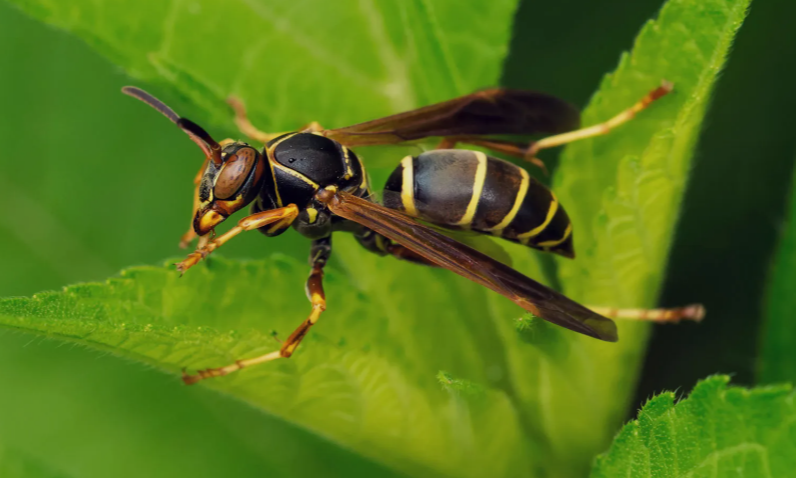
The insects that look like wasps are some of the best impersonators in the animal world. Their bold yellow-and-black or orange-and-black stripes, narrow waists and buzzing flight warn predators that they could be dangerous. This trick is called Batesian mimicry, in which a harmless species copies the warning signals of one that can sting. Birds and other predators tend to avoid anything that vaguely looks like a wasp, so even a rough disguise can pay off.
Most wasp look-alikes are flies, moths or beetles. A quick way to tell them apart from real wasps is to count the wings. Flies have just one pair, while wasps and bees have two. Flies also have short antennae and very large eyes, moths have scaly wings and feathery antennae, and beetles have hard wing covers. Real wasps have a narrow waist, folded wings at rest and a smooth, shiny body.
Many of these mimics are harmless or even helpful. Hoverfly larvae eat aphids, and the adults pollinate flowers. Others, like the clearwing moths, can be garden pests when their caterpillars tunnel into squash vines and fruit trees. A few are interesting for how they behave as well as how they look, with some imitating the buzzing sound or jerky movements of wasps.
The 17 insects below are wasp look-alikes from several different groups. Each entry explains how it imitates a wasp, how to tell it apart and where it lives.
1. Hornet Mimic Hoverfly
The hornet mimic hoverfly is the largest hoverfly in Britain, at about 2 centimeters long. It has an orange-yellow abdomen with dark bands and a dark brown thorax, and it is an excellent mimic of a hornet. It can be told from a hornet by its much larger eyes, broader body and lack of a sting. It is completely harmless to people.
It is a Mediterranean migratory species that has become more widespread in northern Europe in recent years. It is common in towns, gardens, parks and woodland edges, from May to October. Its larvae live as scavengers in the nests of wasps and hornets. The females lay eggs in those nests.
2. Marmalade Hoverfly
The marmalade hoverfly is a small, slim fly of about 9 to 12 millimeters. It has an orange abdomen with black bands of different widths, like thick-cut and thin-cut marmalade. Its wasp-like pattern deters predators. It cannot sting or bite.
It lives across Europe, Asia and North America, in gardens, meadows, parks and farmland, and it can be seen almost all year. Its numbers are boosted every late summer when huge swarms migrate from the continent to Britain. Its larvae are valuable to gardeners, as one can eat about 400 aphids before pupating. It is considered a species of least concern.
3. Yellowjacket Hover Fly
The yellowjacket hover fly is a large fly of about 16 to 24 millimeters. It has a yellow, brown and black body that closely resembles a queen southern yellowjacket. It buzzes loudly and flies in a way that seems aggressive. It is completely harmless.
It lives in the eastern United States and Canada, from Ontario and Minnesota south to Florida and Texas. It hovers in sunny spots in the understory of hardwood forests. Its larvae live in the wet, decaying heartwood of rot holes. It appeared on a 33-cent US postage stamp in 1999.
4. Giant European Hornet Hoverfly
The giant European hornet hoverfly is the largest hoverfly in Europe, growing to 22 to 25 millimeters. It is a convincing mimic of the European hornet, and its Latin name means “hornet-formed.” It is very similar to the hornet mimic hoverfly but bigger. It is uncommon.
It lives in southern and central Europe, including Spain, in woodland. Its larvae live in the decaying heartwood of deciduous trees. Observers in Spain have initially mistaken it for a real hornet. It is harmless.
5. Hornet Robberfly
The hornet robberfly is a big, hairy fly with black-and-yellow markings that make it look like a hornet. It is a predator, unlike the nectar-feeding hoverflies. It catches beetles, grasshoppers and other flies, and it can give a nip if handled roughly. It is harmless to people in general.
It lives in Europe, including Spain and the UK, in grazing land and rough ground. In the UK it is considered a species of conservation concern. It has been studied for its hunting behavior and its need for dung-rich pastures. It waits on a perch and darts out to catch prey.
6. Hornet Moth
The hornet moth is a day-flying clearwing moth about 2.5 centimeters long. It has yellow and brown bands, clear wings and yellow shoulders, giving it the look of a hornet. It is one of the best mimics among moths. Its caterpillars feed on poplar.
It is native to Europe, and it has become established in parts of North America, such as Ontario. It is often seen resting on poplar trunks in summer. Its yellow “epaulettes” distinguish it from the lunar hornet moth. It is harmless as an adult.
7. Lunar Hornet Moth
The lunar hornet moth is a large clearwing moth with a wingspan of 32 to 42 millimeters. Its wings are transparent and scaleless, narrow and elongated. It closely resembles a big hornet. It has a black head and dark shoulders, unlike the hornet moth.
It lives in Europe, and it flies in June, July and August. It is often found resting on willow trunks, where its caterpillars feed. Females are considerably larger than males. It is hard to tell from the hornet moth without a close look.
8. Squash Vine Borer
The squash vine borer is a clearwing moth of about 2 centimeters, with an orange and black body and clear hind wings. It is a bold, gaudy mimic of a bee or wasp. It flies by day and often darts around squash plants. It looks nothing like a typical moth.
It lives east of the Rocky Mountains, from Canada south to South America. It is a serious pest of squash, gourds, pumpkins and cucumbers. Females lay eggs near the base of the plant, and the larvae bore into the stem for about six weeks. Gardeners often lose vines suddenly to it.
9. Peachtree Borer
The peachtree borer is a small clearwing moth with a wingspan of about 15 millimeters. It flies by day and at twilight, and it is a mimic of a wasp. It improves its disguise by running in short bursts while vibrating its wings. It is unusual in its family because it pupates in the soil.
It lives in North America, where its larvae attack peach trees and other fruit trees, especially at the base of the trunk. It is a major orchard pest. Females lay eggs near the base of the tree. Gardeners often find gummy sap at the trunk.
10. Raspberry Crown Borer
The raspberry crown borer is a wasp-like clearwing moth that looks like a sluggish yellowjacket. It has transparent wings, long legs and a banded abdomen. It is about 1.3 centimeters long. Males have feathery antennae to detect the scent of females.
It lives mostly in the eastern half of North America, with some populations in the Pacific Northwest. Its larvae bore into the roots and canes of raspberry and blackberry plants. They spend the winter under the bark near ground level. It is unwelcome in berry patches.
11. Polka-Dot Wasp Moth
The polka-dot wasp moth is a striking, dark metallic blue moth with white polka dots on the wings and abdomen. The tip of its abdomen is bright red. Its look is a warning that mimics a dangerous wasp. It has a wingspan of about 4.2 to 5.2 centimeters and flies by day.
It is thought to be native to the Caribbean, and it is common in Florida. Its caterpillars, called oleander caterpillars, feed on oleander and are a pest of the garden plant. Females call to males with ultrasonic signals. It is harmless.
12. Wasp Beetle
The wasp beetle is a small longhorn beetle, 9 to 18 millimeters long. It has black and yellow stripes, red legs and short, constantly moving antennae like a wasp’s. It runs in a jerky way and even buzzes when threatened. It is a very good mimic, but the hard wing covers give it away.
It lives across Europe, often on hedgerow vegetation and in woodland, from April to July. Its larvae live in dead wood, especially of deciduous trees such as willow and birch. Adults visit flowers for pollen and nectar. It is totally harmless.
13. Locust Borer
The locust borer is a black longhorn beetle with bright yellow bands on its body, which look like a wasp’s stripes. It has long antennae and a wasp-like walk. It is a common sight in late summer on goldenrod flowers. It is harmless to people.
It lives in eastern North America. Its larvae bore into black locust trees and can damage them. Adults are active from late summer into fall. It is a good example of a wasp mimic that is also a tree pest.
14. Mydas Fly
Mydas flies are large, usually about 1 inch long, and many resemble wasps. They are often black, dark or tan with orange, red or yellow bands. They have clubbed antennae, unlike most flies. Some mimic blue-black spider wasps with orange spots.
There are about 80 species in North America and about 471 worldwide, mostly in dry regions. This family includes the largest known fly in the world. Larvae of some species eat scarab beetle grubs in rotting wood or soil. Adults visit flowers such as rattlesnake master and are harmless.
15. Thick-Headed Fly
Thick-headed flies, also called conopids, have a narrow waist and a wasp-like shape. They are slim, often yellow and brown, with a long body that looks like a wasp’s. They hover at flowers for nectar. They have only one pair of wings.
They live worldwide. Their larvae are parasites that develop inside bees and wasps. Females strike at their hosts in flight. They are rarely noticed but are a clever example of mimicry.
16. Wasp Mantidfly
The wasp mantidfly is a strange predatory insect that mimics a paper wasp. It has the front legs of a praying mantis and the brown-edged wings and striped abdomen of a wasp. This is a case of convergent evolution, in which unrelated animals develop similar features. It is neither a mantis nor a wasp.
It lives in North America, in meadows and fields with flowers. Males attract females with a pheromone. Females lay their eggs in crescent-shaped groupings. The larvae of mantidflies generally feed on spider eggs.
17. Pigeon Horntail
The pigeon horntail is a large, wasp-like insect with a thick body and a stiff spike at the tip of the abdomen. Females have a long ovipositor that looks like a stinger, but it is used to lay eggs in wood and cannot sting. It is a type of wood wasp, and it is related to wasps, unlike the other insects on this list. It is harmless to people.
It lives in eastern North America, in hardwood forests. Its larvae bore into dying or dead hardwood trees. Giant ichneumon wasps hunt its larvae inside the wood. It often flies to lights in summer.
Sources:
- Hoverflies: Identification and Control, Royal Horticultural Society
- Hornet Mimic Hoverfly, The Wildlife Trusts
- Is It a Bee or a Hoverfly?, Urban Bees
- Hornet Mimic Hoverfly, Wikipedia
- Marmalade Hoverfly, Wikipedia
- A Gardener’s Friend, Wildfowl and Wetlands Trust
- Yellowjacket Hover Fly, BugGuide
- Milesia virginiensis, Clemson University Home and Garden Information Center
- Virginia Giant Hover Fly, Maryland Biodiversity Project
- Milesia Crabroniformis, Wikipedia
- Two Hornet Mimics and a New Model, Robert Cannon
- Raspberry Crown Borer, University of Wisconsin–Milwaukee Field Station
- Clearwing Moth, Encyclopaedia Britannica
- Clearwing Moths, Toronto Wildlife
- Lunar Hornet Moth, Wikipedia
- Peachtree Borer Moth, Cirrus Image
- Polka-Dot Wasp Moth, Wikipedia
- Polka-Dot Wasp Moth, Butterflies and Moths of North America
- Wasp Beetle, NatureSpot
- Wasp Beetle, Wikipedia
- Mydas Flies, Missouri Department of Conservation
- Mydas Fly, Wikipedia
- Wasp Mantidfly, Wikipedia