The spiders that look like black widows are among the most commonly misidentified animals in homes, sheds and gardens around the world. A true female black widow is a glossy, jet-black spider with a round, bulbous abdomen and a red or orange hourglass shape on its underside. The genus has about 31 species worldwide, and the three main ones in the United States are the southern, northern and western black widows. Adult females have bodies about 8 to 15 millimeters long, and a leg span of up to about 4 centimeters.
Black widow venom is a powerful neurotoxin, and bites can cause severe pain, cramps and sweating. Deaths are rare, and medical care and antivenom are available. Males are much smaller than females, and young widows look very different from adults, often being tan, white and orange. This is one reason so many harmless spiders get mistaken for them.
The hourglass is the best clue, but it sits on the belly, so you rarely see it unless the spider is hanging upside down in its messy, tangled web. Many harmless cobweb spiders, called false widows, share the widow’s round body and web style. Others, like jumping spiders and wolf spiders, are dark and chunky but build no cobwebs at all. Never handle a spider you cannot identify, and seek medical attention for a bite from any suspected widow.
The 24 spiders below include widow relatives that are venomous, false widows and other dark spiders that cause false alarms. Each entry explains what makes it look like a black widow and where it lives.
1. Brown Widow
The brown widow is a true widow spider, but it looks quite different from the classic black widow. It is mottled tan, brown or gray, with an orange to yellow hourglass underneath, and its legs have bold black banding. Its egg sacs are covered in tufts, which makes them look spiky. Its venom is potent, but it injects very little, so bites are usually milder.
It likely originated in Africa and has spread to tropical and subtropical areas worldwide, including Florida, California, Texas, the Caribbean and parts of South America. It thrives on buildings, in mailboxes, under eaves and in outdoor furniture. In urban California, it has displaced the native western black widow in some places. Young western black widows are often mistaken for brown widows.
2. Red Widow
The red widow is a rare Florida spider with a black abdomen and a reddish-orange head, thorax and legs. It lacks a complete hourglass, and females usually have one or two small red marks on the abdomen. It is shy and lives in a specialized habitat. It is a true widow and venomous.
It lives only in Florida, mostly in sand pine scrub in the central and southern parts of the state, from Marion to Martin County. It builds its web in palmetto fronds. It is uncommon and rarely meets people. Habitat loss is its main concern.
3. Northern Black Widow
The northern black widow is nearly identical to the southern black widow at a glance. The key difference is a broken hourglass, made up of two red triangles that do not quite touch. It also has a row of red spots down the middle of its back. It handles cold better than its southern cousins.
It lives in the northeastern United States, the Great Lakes region and southeastern Canada, and ranges south to north Florida. It prefers woodpiles, stone walls and rural outbuildings. Bites are statistically less frequent because it lives in less crowded areas. Its venom is as serious as other black widows’.
4. Western Black Widow
The western black widow looks nearly identical to the southern black widow. Adult females are glossy black with a red hourglass, and the body is about half an inch long. It was once treated as a subspecies of the southern species. Juveniles are tan with stripes and are often confused with brown widows.
It lives across the western United States and into Canada and Mexico, in woodpiles, sheds, rock piles and dry, protected spots. It is the most common widow in the West. Its webs are irregular and sticky. Its bite is medically significant and should be treated by a doctor.
5. Redback Spider
The redback is Australia’s version of the black widow. The female has a round black abdomen with a bright red or orange stripe on her back and a scarlet hourglass-shaped mark underneath. Her body is about 1 centimeter long. It is one of the few spiders in Australia that can seriously harm humans.
It lives throughout Australia, often in sheds, garages, under houses and in outside toilets. It has also become established in Southeast Asia, Japan, New Zealand and the United Arab Emirates. An antivenom has been available since 1956, and no deaths have been reported since 1955. It is the most common cause of serious spider bites in Australia.
6. Katipo
The katipo is New Zealand’s native widow spider. Females have a round black body and slender legs, with a red stripe bordered in white on the back and a red hourglass underneath. It is the smallest widow species and delivers less venom. Its name means night-stinger in Māori.
It lives on warm, sandy beaches and dunes in the North and South Islands, as far south as Karitane and Greymouth. It hides under beach grasses, driftwood and debris. It is in decline because of habitat loss and the spread of a similar invader, the false katipo. Bites are rare, and New Zealand hospitals stock antivenom.
7. European Black Widow
The European black widow, also called the thirteen-spotted spider, is a black widow relative with red spots on its back. Its abdomen is round and black, usually with 13 red spots. It looks like a classic widow with extra decoration. Its bite is medically significant.
It lives around the Mediterranean and in parts of southern Europe, North Africa and western Asia. It builds webs in low vegetation, dry fields and rock crevices. The Mediterranean false widow is often mistaken for it. In parts of Central Asia, it is known by the local name karakurt.
8. Noble False Widow
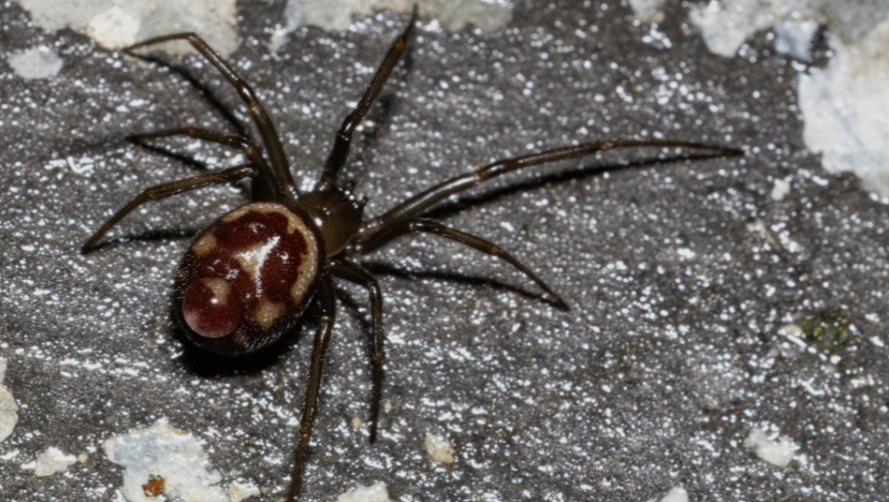
The noble false widow is the false widow most likely to be mistaken for a black widow. It is dark brown to nearly black, with a bulbous abdomen marked with cream or pale bands that resemble a skull. It has no hourglass. Females reach about 14 millimeters.
It is native to Madeira and the Canary Islands, and it has spread across Europe. It arrived in southwestern England in the 1870s and has spread widely since the 1980s. It has also reached North America, South America, Australia and New Zealand. Its bite is compared to a wasp sting and bites are rare.
9. Cupboard Spider
The cupboard spider, also called the false black widow, is a robust, dark brown to black spider about a quarter to half an inch long. It has a rounded abdomen that sometimes bears pale markings, and two dark stripes on the front of its body. It has no red hourglass. It builds irregular cobwebs in dark corners, closets and storage areas.
It lives worldwide, especially along coasts, and is common in homes. In Australia it is known as the brown house spider. Its bite has been blamed for severe local pain, nausea and vomiting in rare cases. It eats other spiders, including true black widows.
10. Triangulate Cobweb Spider
The triangulate cobweb spider is a small, dark household spider with a pattern of pale triangles on its abdomen. It is a cobweb spider that looks like a miniature widow at first glance. It weaves its web in the dark corners of houses, basements and outbuildings. It is easily overlooked.
It lives across the world, wherever people are. It is not known to bite people. It is a common household species. Its triangles distinguish it from a black widow.
11. Rabbit Hutch Spider
The rabbit hutch spider is a small false widow, just 4.5 to 7 millimeters long. Its abdomen is a rich chestnut brown or dark brown, round and shiny. It is too small to bite through human skin most of the time. Its name comes from the sheds and hutches where it lives.
It is widespread and common in Britain and northern Europe, and it has also spread to parts of North America. It lives in sheds, pet houses and clutter in gardens. Sometimes it appears on tree trunks. It is native to Europe and harmless.
12. False Katipo
The false katipo, also called the black cobweb spider, is a South African false widow that looks very like the katipo. It is uniformly black or plum-colored and does not have the red stripe of the redback or katipo. It is sometimes called the false redback in Australia. It builds messy webs.
It has spread to Australia and New Zealand, where it lives in houses and on beaches. In New Zealand, it has been displacing the katipo along the west coast of the North Island, from Wellington to Whanganui. Its bite is mild compared with true widows. Many people mistake it for a katipo.
13. Mediterranean False Widow
The Mediterranean false widow is a larger false widow that can grow bigger than a black widow. It is dark with pale markings and a round abdomen. It is often confused with the European black widow because their ranges overlap. Its bite is medically significant but not serious.
It lives around the Mediterranean region. It also turns up occasionally in the UK, imported by accident with produce. It builds a tangled web in cracks and crevices. It is more of a nuisance than a danger.
14. American House Spider
The American house spider is the most commonly seen spider in homes, and it is a cobweb spider related to widows. It is tan to brown, with a mottled round abdomen. Dark individuals can look like a small black widow. It builds tangled webs in corners, windows and garages.
It lives worldwide and is the most common type found indoors. It is no threat to humans and usually lets a hand approach without fleeing. It eats flies, mosquitoes and other insects. Its egg sacs are small, round and pale.
15. Northern False Widow
The northern false widow is a native North American false widow that is dark brown to black, with a round abdomen and pale crescent markings. It is smaller than a black widow and lacks the hourglass. It builds irregular cobwebs in sheltered places. Its bite is mild.
It lives across the northern United States and Canada, in sheds, woodpiles, rock walls and outbuildings. It is recorded in places such as New Jersey. It is a common sight where black widows are absent. Its range overlaps with the northern black widow’s.
16. Southern House Spider
The southern house spider is a large, dark brown to black spider that lives in crevices. Females are bulky and dark and are sometimes mistaken for black widows, while males resemble brown recluses. It is a crevice weaver that makes a flat, tangled, woolly-looking web. It sits at the edge of its web at night.
It lives across Florida and much of the southern United States, on buildings, barns, bridges and masonry. Females are rarely seen because they stay in their webs. It is harmless to people. It is common around windowsills and shutters.
17. Black House Spider
The black house spider is a dark, robust spider with gray hairs on the carapace. It builds messy, lacy sheet webs with funnel-like entrances in window corners and fences. The female stays in the web and keeps repairing it. It is also called the window spider.
It lives throughout Australia and Tasmania, and has been introduced to New Zealand and Japan. It is common in cities. It is sometimes mistaken for a funnel-web spider because of its color and web. It is harmless to people.
18. Black Lace-Weaver
The black lace-weaver is a very dark brown to nearly black spider with lighter markings on its abdomen. Females reach about 16 millimeters. It builds an irregular, lace-like web around a rudimentary funnel. It can be confused with a widow at a glance.
It is widespread in Britain and found in parts of the United States, including Ohio. It lives around foundations, basements and sheltered cracks. It is mostly nocturnal. It is harmless to people.
19. Bold Jumping Spider
The bold jumping spider is a small, chunky, fuzzy black spider with three white spots on its abdomen. Its mouthparts are bright iridescent green or blue, and its eyes are large. It is 4 to 18 millimeters long. It is often mistaken for a black widow because of its dark, rounded body.
It lives across North America, in gardens, fences, walls and homes. It hunts by pouncing on prey, and it builds no cobweb. It is not harmful, though it may bite if cornered. It is curious and often watches people.
20. Wolf Spider
The wolf spider is a sturdy, hairy spider in brown, gray or dark tones. Large black individuals can be mistaken for widows or recluses. It hunts on the ground and builds no cobweb. Females carry their young on their backs.
It lives in basements, garages and landscaping around the world. It is one of the most common spiders people encounter. It is not dangerous. Its eyes shine in a flashlight beam at night.
21. Dark Fishing Spider
The dark fishing spider is a large, flat-bodied, mottled brown to blackish spider. It is an active hunter that waits near water. It is much larger than a black widow when its legs are spread. It is sometimes found on exterior walls and in garages.
It lives in eastern North America, near streams, ponds and wooded areas. It can walk on water and dive to catch small fish and insects. It is not dangerous. It is a good example of a big spider that is wrongly feared.
22. Black Purse-Web Spider
The black purse-web spider has a shiny black body and fangs that point downward. It builds a silk tube on the ground that is covered with leaves, and it ambushes prey that walks over the web. It is dark and glossy, like a black widow. It is large and robust.
It lives in sandy, wooded and heathland habitats in parts of Europe and North America. It is rarely seen, as it spends most of its life in its tube. It is not aggressive. Males wander in search of females in autumn.
23. Mouse Spider
The mouse spider is a stout, shiny black Australian spider. Females are glossy and bulky, with big fangs. It lives in burrows. It is sometimes mistaken for a widow or a funnel-web.
It lives across mainland Australia. Its venom contains a toxin similar to the funnel-web’s, though serious bites are rare. It should still be treated with caution. It is not related to widows.
24. Eastern Parson Spider
The eastern parson spider is a dark, ground-dwelling spider with a pale band on its abdomen. It is longer and narrower than a mature female black widow, which has a much rounder abdomen. It hunts at night. It does not build a web to catch prey.
It lives in eastern North America, in homes, leaf litter and gardens. It often runs across floors at night. It may bite if pinched. It is harmless in most cases.
Sources:
- How to Identify False Black Widow Spiders, Orkin
- Top Spiders Often Mistaken for Black Widows, Aptive
- 5 Spiders That Resemble Black Widows, A-Z Animals
- 6 Spiders That Look Like Black Widows, But Are Not, A-Z Animals
- 8 Spiders That Look Like Black Widows, Wildlife Informer
- Widow Spiders, iNaturalist Guide
- Black Widow, University of Florida IFAS Extension
- Be Aware of Brown Widow Spiders, University of Florida IFAS Extension
- Widow Spiders, Spider Guide
- Black Widow vs. Brown Widow, Native Pest Management
- Redback Spider, Wikipedia
- Redback Spiders, University of Melbourne Australian Venom Research Unit
- Spiders in New Zealand, Health Education New Zealand
- Lethiferous Latrodectus, Te Papa Blog
- Steatoda, Wikipedia
- How Dangerous Are False Widow Spiders?, Natural History Museum
- Fact Sheet: False Widow Spiders, Natural History Museum
- False Widow Spiders, British Arachnological Society
- False Widow Spiders, Science Focus
- Triangulate Cobweb Spider, University of Arkansas Arthropod Museum
- Southern House Spider, University of Florida IFAS
- Black House Spider, Australian Museum
- Black Lace-Weaver Spider, NatureSpot
- Black Spiders in Ohio That Are Not Black Widows, Wayne’s
- Black Spiders, Leafy Place
- Spiders in Australia, Institute for Molecular Bioscience, University of Queensland