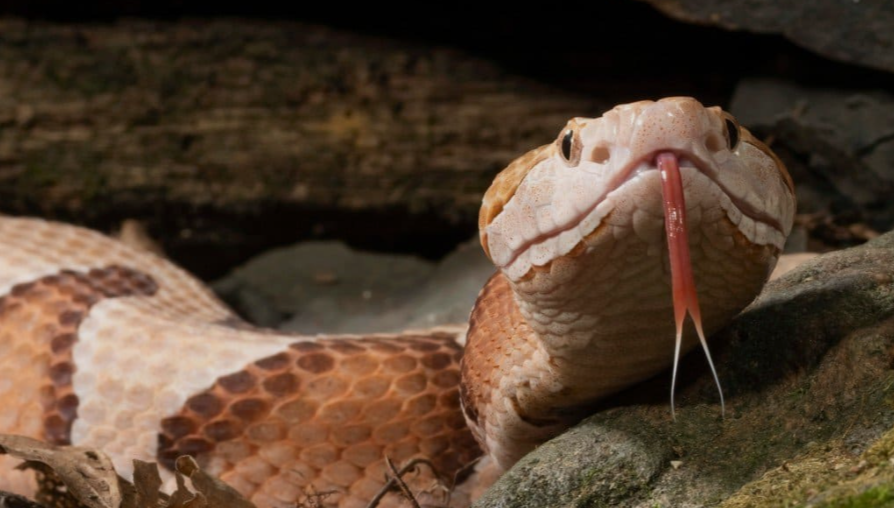
The snakes that look like copperheads are among the most commonly mistaken animals in the eastern United States, and the confusion costs harmless snakes their lives every year. The copperhead is a stout, venomous pit viper that usually measures 24 to 36 inches long, with a coppery head and a wedge-shaped skull. Its most famous marking is a series of dark brown bands shaped like hourglasses, narrow on the back and wide on the sides. From the side, they look like Hershey’s Kisses.
Copperheads live from Massachusetts west to southern Illinois and Nebraska and south through the Southeast to the Florida panhandle and Texas. They are common in woodland edges, rocky hillsides, leaf litter and even suburban yards. Copperheads cause more venomous snakebites in the United States than any other species, though their bites are rarely fatal. Newborns have a bright yellow tail tip that they use to lure frogs and insects.
Real copperheads have a few reliable features: vertical, cat-like pupils, a heat-sensing pit between each eye and nostril and keeled scales that give the skin a dull texture. Still, pupil shape can be hard to judge in dim light, and many harmless snakes flatten their heads to look dangerous. The safest approach is to keep your distance and never try to inspect a snake up close. Killing a copperhead is illegal in some states, and killing harmless look-alikes is a loss for farms and gardens that rely on their rodent control.
The 16 snakes below are the ones most often confused with copperheads, mostly harmless species, plus one venomous relative. Each entry explains what makes it look similar and where it lives.
1. Northern Water Snake
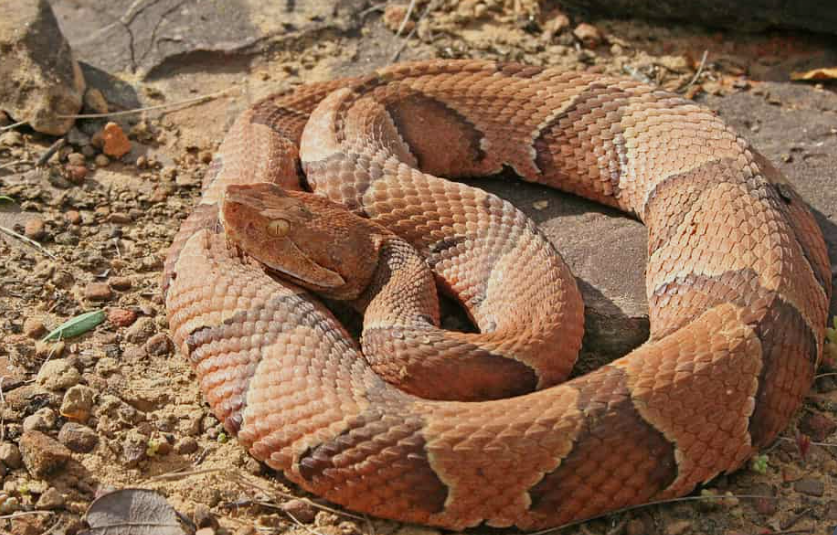
The northern water snake is the species most often mistaken for a copperhead. It is thick-bodied and brown, gray or reddish, with dark blotches or bands. Its markings are the opposite of a copperhead’s: the bands are widest on the back and narrow on the sides. It has round pupils, no heat pits and dark vertical bars on its lip scales.
It lives in rivers, lakes, ponds and marshes across eastern and central North America and often basks on rocks and logs. It bites hard if grabbed but is not venomous. Females give birth to live young rather than laying eggs. Because it shares the shoreline habitat of many people, it is frequently killed by mistake.
2. Eastern Milk Snake
The eastern milk snake has brown or reddish blotches on a tan or gray background that can look like copperhead coloring. The blotches are irregular saddle shapes, not hourglasses. It is also more slender than a copperhead and has smooth, shiny scales. A pale Y or V shape often marks the back of its head.
It ranges from Maine and southern Canada south to North Carolina and Alabama. It lives in fields, barns, woodpiles and rocky hillsides. It eats mice, which makes it welcome around farms. Its belly has a black-and-white checkerboard pattern that copperheads lack.
3. Corn Snake
The corn snake is a slim, colorful rat snake with red-brown blotches outlined in black on an orange or gray background. It is typically redder than the coppery tan of a copperhead, and the thickest part of its blotches sits on the back, not the sides. It has round pupils and a black-and-white checkerboard belly. It catches prey by constriction, not venom.
It lives in the southeastern and south-central United States, in pine woods, farm fields, old barns and abandoned buildings. It is one of the most popular pet snakes in the world. Wild corn snakes are active mostly at night but may be seen by day. It is harmless to people.
4. Eastern Hognose Snake
The eastern hognose snake is a stocky snake with a distinctive upturned snout. Its colors range from brown and gray to orange or black, and some brown individuals look enough like copperheads to cause alarm. When threatened, it flattens its neck, hisses loudly and may even play dead. Its blotchy, irregular pattern does not form clean hourglass bands.
It lives in sandy woodland, fields and floodplains of the eastern United States. Toads are its favorite prey, and it has enlarged teeth for puncturing them. It almost never bites people. It is a rear-fanged species with mild venom that is harmless to humans.
5. Black Rat Snake (Juvenile)
The juvenile black rat snake has gray or brown blotches on a light gray background. This is a common cause of mistaken identity, and the juvenile pattern is one of the top reasons these snakes are killed. Adults turn mostly black, and they are much longer, often 3 to 6 feet. A copperhead has a much wider, heavier body than a young rat snake.
It lives across the eastern and central United States, in forests, farms and suburbs. It climbs well and often enters barns and attics in search of rodents. When threatened, it may shake its tail in dry leaves, producing a rattling sound. It is a harmless and valuable rodent controller.
6. Great Plains Rat Snake
The Great Plains rat snake is light gray or tan with dark gray, brown or green-gray blotches down the back. Stripes on either side of the head meet in a point between the eyes. It looks much like the prairie kingsnake. Its scales are weakly keeled and its anal plate is divided.
It lives from Missouri and Nebraska to Colorado, south to Texas and into northern Mexico, in grassland, rocky hills and open woodland. Adults reach 24 to 36 inches. When agitated, it vibrates its tail in leaf litter, producing a sound like a rattlesnake. It has round pupils and no heat pits.
7. Eastern Racer (Juvenile)
Adult racers are plain black or bluish-gray and look nothing like copperheads, but juvenile racers are a different story. Young racers have reddish-brown crossbands on a gray background. They are slender with narrow heads, and the blotches never form an hourglass. The pattern fades into solid color as the snake grows.
It lives across the eastern United States, in fields, forest edges and open country. Racers are fast, moving at about 4 miles per hour when threatened. They eat insects, frogs, lizards and rodents. A juvenile is much shorter than an adult copperhead.
8. Diamondback Water Snake
The diamondback water snake is a large, heavy-bodied snake with a chain-like pattern of tan, diamond-shaped marks on a dark background. The pattern gives it a passing resemblance to a copperhead or cottonmouth. It has a thick head and a stout body. It is nonvenomous and has round pupils.
It lives in the Mississippi River basin and nearby areas, in rivers, bayous, swamps and lakes. It is often seen basking on branches that hang over the water. It is one of the most common snakes in its range. Many are killed because they are mistaken for cottonmouths.
9. Banded Water Snake
The banded water snake has red, brown and orange hues similar to a copperhead’s, with crossbands down its body. It has more bands than a copperhead, and they do not form hourglass shapes. Its head is more rounded and lacks the dark mask of a cottonmouth. Vertical dark lines mark its lower jaw.
It lives in streams, ponds and swamps across the southeastern United States. It often flares its head and flattens its body when threatened. It eats fish and frogs. It bites if handled but is not venomous.
10. Brown Water Snake
The brown water snake is a large snake with square, dark-brown blotches along the back on a lighter brown background. It is bulky and often bigger than copperheads. Brown water snakes often bask on tree limbs overhanging the water, which fueled the folklore that cottonmouths drop into boats. Those stories usually involve harmless water snakes.
It lives in swamps, rivers and lakes of the southeastern coastal plain. It eats fish and other aquatic animals. It is easily mistaken for a cottonmouth, and sometimes a copperhead. It is nonvenomous, though it can bite.
11. Mole Kingsnake
The mole kingsnake is a medium-sized snake with brown or reddish blotches on a gray or tan background. Its pattern and color can resemble the copperhead’s at a glance. It is smaller than most copperheads and has smooth, glossy scales. It is a secretive burrower.
It lives in the central and southeastern United States, in woodland, farmland and sandy soils. It is more likely to be seen in the open after rain, while copperheads prefer warmth. It eats rodents, lizards and other snakes. It is harmless to people.
12. Prairie Kingsnake
The prairie kingsnake is a brown, blotchy snake with a pattern much like the Great Plains rat snake’s. It is stocky and often found in open country. When alarmed, it vibrates its tail, which can sound like a rattlesnake if it is among dry leaves. Its bite is harmless.
It lives in grasslands and farm fields across the central United States, including Oklahoma, Kansas and Missouri. It has round pupils and lacks heat pits. It eats rodents, lizards, birds and other snakes. It is a good example of why most brown, blotchy snakes are not dangerous.
13. Bullsnake
The bullsnake is a large gopher snake with brown, black and yellow blotches down its back. It is far larger than a copperhead and is more often mistaken for a rattlesnake. When threatened, it hisses, flattens its head and shakes its tail. Its narrow head, round pupils and pointed tail give it away.
It lives across the Great Plains and parts of the Midwest, from southern Saskatchewan and Alberta south into Mexico. It uses grasslands, farmland and sandy areas. Gophers and mice are its main prey. It is one of the most valuable rodent hunters on the plains.
14. Southern Hognose Snake
The southern hognose snake is a small, stocky snake with a short, upturned snout and brown blotches on a tan background. It resembles an eastern hognose in behavior, flattening its neck and playing dead. Its blotches and thick body cause it to be mistaken for a copperhead. It rarely bites.
It lives in the sandy pinelands of the southeastern United States. It eats toads and other small animals. It has become scarce in parts of its range. Habitat loss and a decline in toads are concerns.
15. Brown Snake
The brown snake, also called DeKay’s brownsnake, is a tiny snake that measures about 9 to 13 inches. It is brown or gray, with two rows of small dark spots down the back. It is often confused with young copperheads because of its size and color. It is gentle and almost never bites.
It lives across the eastern and central United States, including in cities, gardens and under logs and rocks. A Texas form lives in the south-central states. It eats slugs, snails and earthworms. Gardeners value it for pest control.
16. Juvenile Cottonmouth
The juvenile cottonmouth is the only venomous snake on this list, apart from the copperhead itself. Young cottonmouths are brightly colored, with reddish-brown crossbands on a brown background and a sulfur-yellow tail tip. They look a lot like copperheads. A dark band runs through each eye, which copperheads lack.
It lives in swamps, marshes, streams and lakes of the southeastern United States, and it is the world’s only semi-aquatic viper. Adults are usually dark with little visible pattern. Many people in the Florida Panhandle use the names cottonmouth and copperhead interchangeably. Anyone who sees a banded snake near water should keep their distance.
Sources:
- Identifying Copperhead Snakes, Clemson University Home and Garden Information Center
- Identifying Copperhead Snakes, Clemson Forestry and Natural Resources
- Eastern Copperheads in New Jersey, Rutgers New Jersey Agricultural Experiment Station
- Snake ID: Northern Snakes Commonly Confused with Venomous Species, New Jersey Division of Fish and Wildlife
- Copperhead Fact Sheet, Purdue University Fort Wayne
- It’s Baby Snake Season, Virginia Department of Wildlife Resources
- Copperbelly Water Snake Fact Sheet, USDA Natural Resources Conservation Service
- Florida Cottonmouth, Florida Museum of Natural History, University of Florida
- The Cottonmouth, University of Florida IFAS Extension
- Venomous Snakes of South Carolina, University of South Carolina North Inlet
- Wild Double Take: Prairie Kingsnake and Great Plains Ratsnake, Oklahoma Department of Wildlife Conservation
- Prairie Kingsnake, Missouri Department of Conservation
- Great Plains Ratsnake, Oklahoma Snakes
- Be Good to Snakes, National Institute of Environmental Health Sciences
- Top 8 Snakes That Look Like Copperheads, A-Z Animals
- What Snakes Look Like a Copperhead?, ScienceInsights
- Bullsnake, Wikipedia