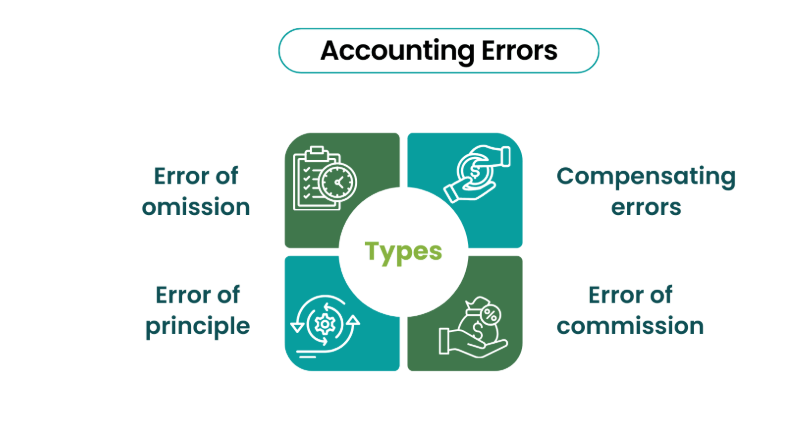
Errors in accounting refer to unintentional mistakes that occur during the recording, classifying, summarizing, or interpreting of financial transactions. Unlike fraud, which involves deliberate manipulation of financial data, accounting errors arise from human oversight, misunderstanding of accounting principles, or system failures. They can occur at any stage of the accounting cycle — from the initial journal entry all the way through to the preparation of final financial statements. Even small, seemingly insignificant errors can compound over time and lead to materially misstated financial reports if left undetected.
The impact of accounting errors extends far beyond internal bookkeeping inconvenience. Misstated accounts can distort profitability ratios, misrepresent a company’s financial position, and lead management, investors, and creditors to make poorly informed decisions. In publicly listed companies, material errors that require restatement of previously published financial statements can trigger regulatory scrutiny, shareholder lawsuits, and significant damage to organizational reputation. Studies have shown that companies that restate their financials experience an average stock price decline of between 10 and 25 percent in the period immediately following disclosure.
Accounting errors are broadly classified into two categories based on their effect on the trial balance. Errors that affect the trial balance — causing the debit and credit totals to disagree — are relatively easy to detect through routine reconciliation. Errors that do not affect the trial balance are far more insidious, as the books appear balanced despite underlying inaccuracies in how transactions have been recorded or classified. The latter category requires more sophisticated detection methods including analytical review, internal audits, and independent verification of source documents.
Preventing accounting errors requires a combination of strong internal controls, well-trained staff, clearly documented accounting policies, and regular reconciliation procedures. Segregation of duties — ensuring that no single individual controls all aspects of a financial transaction — is one of the most effective structural safeguards against both errors and fraud. Modern accounting software has reduced the frequency of arithmetic and posting errors significantly, but it has introduced new categories of risk such as incorrect system configuration, duplicate automated entries, and data migration failures. Regular internal and external audits remain the most reliable mechanism for identifying and correcting errors before they cause lasting financial harm.
Types of Errors in Accounting
Error of Omission
An error of omission occurs when a financial transaction is completely left out of the accounting records and is never entered into the books at all. This can happen when a purchase invoice is misplaced, a sales receipt is overlooked, or a bank transaction is simply not recorded by the bookkeeper. Because both the debit and credit sides of the entry are missing entirely, the trial balance continues to agree, making this type of error particularly difficult to detect through routine checks. Reconciling ledger balances against source documents such as bank statements, invoices, and contracts is the most effective way to uncover omissions.
Error of Commission
An error of commission arises when a transaction is recorded but is posted to the wrong account, even though the correct type of account may have been used. For example, a payment received from a customer named Johnson might be credited to the account of a different customer also named Johnson, or an expense might be debited to a similar but incorrect expense account. The trial balance remains unaffected because the total debits and credits still agree, yet the individual account balances are wrong. These errors can distort individual customer or supplier balances and lead to incorrect billing, payment disputes, or misstated expense categories.
Error of Principle
An error of principle occurs when a transaction is recorded using the correct amount but is posted to a fundamentally wrong type of account — typically when the distinction between capital and revenue items is confused. A common example is recording the purchase of a fixed asset such as machinery as a revenue expense, or treating a long-term loan repayment as an operating cost. This type of error violates the foundational accounting principles that govern how different categories of transaction should be treated and can significantly distort both the income statement and the balance sheet. Because debits and credits still balance, it does not affect the trial balance and requires careful analytical review to detect.
Compensating Error
A compensating error occurs when two or more separate errors cancel each other out, leaving the trial balance apparently correct despite multiple underlying inaccuracies. For instance, if one account is overstated by a certain amount and another account is understated by the same amount, the net effect on the trial balance is zero. This type of error is among the most difficult to identify precisely because the normal detection mechanism — the trial balance — shows no sign of any problem. Only a thorough account-by-account analytical review or a detailed audit trail examination is likely to expose compensating errors.
Error of Original Entry
An error of original entry arises when the wrong amount is recorded in the books from the outset, and that same incorrect figure is then correctly posted to both the debit and credit sides of the ledger. For example, if a sale of $580 is mistakenly recorded as $850 in both accounts, the trial balance will still agree but the figures are factually wrong. This type of error is particularly common in environments with high transaction volumes and manual data entry. It is typically discovered through reconciliation against original source documents such as invoices, receipts, or purchase orders.
Error of Reversal
An error of reversal occurs when the correct accounts are identified and the correct amount is used, but the debit and credit entries are recorded on the wrong sides — effectively reversing what should have been the proper entry. A sale, for instance, might be debited to the sales account and credited to the debtor’s account instead of the other way around. Interestingly, this type of error does affect the trial balance in most cases, doubling the apparent discrepancy since both sides of the entry are wrong by the same amount. Careful review of individual account movements and their logical direction is necessary to identify and correct reversals.
Transposition Error
A transposition error is a specific type of original entry error in which the digits of a number are accidentally switched during recording — for example, writing 629 instead of 296, or 1,540 instead of 1,450. These errors are extremely common in manual bookkeeping environments and can be surprisingly difficult to spot when reviewing long columns of figures. A useful diagnostic rule is that transposition errors always produce a difference between debit and credit totals that is exactly divisible by nine, which can help accountants quickly identify the source of a trial balance discrepancy. Careful proofreading and the use of accounting software with built-in validation checks are effective preventive measures.
Duplication Error
A duplication error, also called a double-entry error in the non-technical sense, occurs when the same transaction is recorded twice in the accounting system, resulting in inflated figures on both the debit and credit sides. This can happen when an invoice is inadvertently posted by two different members of staff, when a payment appears in both a manual ledger and an automated bank feed, or when a data migration process imports historical records that already exist in the system. Because both sides are doubled equally, the trial balance continues to agree, masking the error from routine detection. Regular supplier statement reconciliations and bank reconciliations are the most reliable tools for uncovering duplicate entries.
Error of Partial Omission
Unlike a complete omission where an entire transaction is left out, a partial omission occurs when only one side of a double-entry transaction is recorded — for example, the debit is posted but the corresponding credit is forgotten, or vice versa. This type of error does cause the trial balance to disagree, making it one of the more detectable categories of accounting error. It often arises from interruptions during data entry, system errors that prevent a complete posting, or misunderstandings about which accounts a transaction affects. Once the trial balance discrepancy is identified, tracing the one-sided entry through the journal and ledger records usually reveals the missing half of the entry relatively quickly.
Rounding Error
Rounding errors occur when figures are rounded up or down during calculation or recording rather than being carried to their precise decimal values, introducing small but cumulative inaccuracies into the financial records. In large organizations processing thousands of transactions, even a rounding difference of a few cents per entry can accumulate into significant discrepancies at the financial statement level. Rounding errors are particularly common in currency conversions, tax calculations, depreciation schedules, and payroll computations. While individually minor, rounding errors that go unaddressed can create compliance problems in tax reporting and cause reconciling differences that consume significant audit time to resolve.
Data Entry Error
Data entry errors are among the most frequent and straightforward accounting errors, arising from simple keyboarding mistakes such as entering the wrong amount, selecting the wrong account from a dropdown menu, or inputting an incorrect date. In automated accounting environments, these errors can propagate quickly as subsequent automated processes — such as batch postings, reconciliations, or report generation — are built on the incorrect foundation. Strong internal controls including dual-input verification, mandatory review of transactions above a certain threshold, and regular spot-checks of posted entries are effective defenses against data entry errors. The increasing use of optical character recognition and automated invoice processing has both reduced and introduced new variants of this category.
Cut-Off Error
A cut-off error occurs when a transaction is recorded in the wrong accounting period — either too early or too late — causing revenues or expenses to be reported in a period to which they do not belong. For example, an invoice received in December for services performed in November might be posted in January, shifting an expense from one financial year to the next. Cut-off errors can materially distort period-end financial statements and are of particular concern during year-end audits when the matching principle demands that income and expenditure are recognized in the period to which they relate. Maintaining a clear cut-off procedure for year-end transactions and reviewing invoices and receipts received in the days immediately following a period close are standard audit procedures for detecting this type of error.
Error in Opening Balances
Errors in opening balances occur when the closing balances from the previous accounting period are incorrectly carried forward into the new period, either through manual transcription mistakes or system migration issues. Because all subsequent transactions build on the opening balance, even a small initial error can compound through the period and cause widening discrepancies in account balances by period end. These errors can be particularly difficult to trace because they predate all current-period transactions and may not surface until a reconciliation is performed against an independent source. Verifying opening balances against signed-off prior-period financial statements at the start of every accounting period is the standard preventive measure.
Misclassification Error
A misclassification error occurs when a transaction is recorded in the correct general ledger but assigned to the wrong sub-category, cost center, department, or line item within that ledger. For example, marketing expenditure might be charged to the general administration cost center, or a capital improvement might be classified under routine maintenance rather than fixed asset additions. These errors do not affect the overall trial balance but can significantly distort departmental budgets, management accounts, cost analyses, and tax calculations. They are particularly problematic in organizations that use detailed coding structures to monitor divisional performance, where misclassification can create misleading variance reports and flawed management decisions.
Compensating Arithmetic Error
Distinct from the broader compensating error, a compensating arithmetic error arises specifically during manual calculations when an arithmetic mistake in one figure is accidentally offset by an equal and opposite arithmetic mistake in another calculation. A bookkeeper might, for example, add a column of expenses incorrectly in two separate schedules, with one overcount and one undercount of exactly the same magnitude. The result appears balanced on the surface but contains two separate arithmetic inaccuracies that mask each other. The spread of electronic spreadsheets and accounting software has significantly reduced — but not eliminated — this category of error, as formula errors and incorrect cell references can produce similar outcomes in digital environments.
Disclosure Error
A disclosure error does not involve incorrect figures in the ledger itself but rather arises when financial statements fail to present, describe, or explain information in the manner required by applicable accounting standards such as IFRS or GAAP. This might include omitting a required note about contingent liabilities, failing to disclose a related-party transaction, incorrectly describing the basis of an accounting estimate, or misclassifying a long-term liability as a current one on the balance sheet. Disclosure errors can be as materially significant as numerical errors, since they deprive financial statement users of information they need to make informed decisions. Auditors pay close attention to the adequacy and accuracy of disclosures as a distinct and critical component of the financial statement review process.