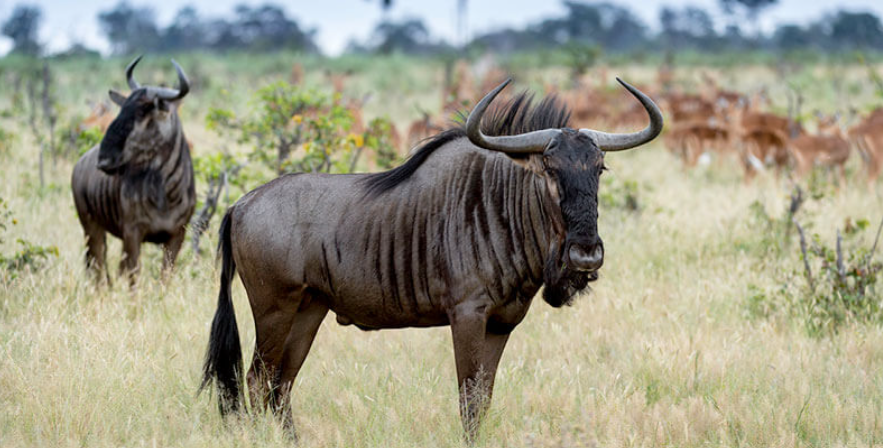
Wildebeests, also known as gnus, are large antelopes belonging to the genus Connochaetes within the family Bovidae. Native to the grasslands, savannas, and open woodlands of sub-Saharan Africa, they rank among the continent’s most ecologically influential herbivores. The name “wildebeest” derives from Afrikaans meaning “wild beast,” reflecting the animal’s raw, powerful presence on the African plains. Two recognized species exist — the blue wildebeest and the black wildebeest — along with several subspecies, and together they represent one of the last remaining large-scale wildlife spectacles on Earth.
Wildebeests are most celebrated for the Great Migration, an annual movement of approximately 1.5 million blue wildebeests across Tanzania’s Serengeti and Kenya’s Maasai Mara in a circular, rainfall-driven journey covering roughly 1,800 kilometres. Around 500,000 calves are born within a compressed three-week window each February — a synchronised strategy that overwhelms predators and maximises survival rates. The migration also involves some 300,000 zebras and 500,000 Thomson’s gazelles, making it the largest overland movement of mammals on the planet. An estimated 250,000 wildebeests die during each migration cycle from exhaustion, drowning, and predation.
Ecologically, wildebeests function as keystone grazers whose movements and feeding patterns shape entire savanna ecosystems. Their grazing reduces grass fuel loads, lowering the frequency and intensity of wildfires, while their dung cycles nutrients back into soils and their carcasses sustain large populations of scavengers and decomposers. Adult blue wildebeests weigh between 150 and 270 kilograms and can run at speeds of up to 80 kilometres per hour, while the smaller black wildebeest reaches up to 180 kilograms. Both species support some of Africa’s most important predator communities, including lions, cheetahs, leopards, spotted hyenas, and Nile crocodiles.
Wildebeest conservation faces mounting pressure from habitat fragmentation, prolonged drought, disease outbreaks, and the obstruction of migration routes by fencing and infrastructure. The black wildebeest was hunted to near-extinction by the late 19th century and today numbers only around 18,000 individuals, the majority on private and state-managed reserves in South Africa. Blue wildebeest populations are considerably larger at roughly 1.5 million, though non-migratory populations outside protected areas have declined sharply in recent decades. Climate change represents a growing systemic threat by disrupting the rainfall cycles that govern grass growth, calving timing, and the entire rhythm of wildebeest life.
Blue Wildebeest (Connochaetes taurinus)
The blue wildebeest is the most numerous and widely distributed wildebeest, found from Kenya and Tanzania south through Zambia, Botswana, Zimbabwe, Namibia, and into South Africa. It takes its name from the silvery-blue sheen of its short, coarse coat, which is marked with darker vertical stripes along the flanks. Standing up to 1.5 metres at the shoulder and weighing as much as 270 kilograms, it is the larger of the two main species and forms the overwhelming majority of the Great Migration herds. It is one of the most abundant large mammals in Africa.
Black Wildebeest (Connochaetes gnou)
The black wildebeest, also called the white-tailed gnu, is endemic to the open highveld grasslands and Karoo shrublands of South Africa and Lesotho and is readily distinguished from its blue cousin by its dark brown-black coat, forward-curving horns, and long white tail. A stiff, dark mane runs along the neck and a tuft of pale hair decorates the face, giving it a shaggy, distinctive profile. Hunted to the brink of extinction by the early 20th century, concerted conservation efforts on state and private reserves have brought its population back to approximately 18,000 individuals. It remains entirely dependent on protected and managed land for its survival.
Eastern White-Bearded Wildebeest (Connochaetes taurinus albojubatus)
This subspecies is found primarily across Tanzania and southern Kenya and is the principal participant in the Great Migration, forming the core of the vast herds that move seasonally between the Serengeti and the Maasai Mara. It is distinguished from other blue wildebeest subspecies by a pale, whitish beard hanging from the throat and chin, which is particularly prominent in adult males. The eastern white-bearded wildebeest is the most numerous migratory ungulate on Earth, and its annual river crossings — where thousands plunge into crocodile-filled waters — are among the most dramatic wildlife events in the natural world.
Western White-Bearded Wildebeest (Connochaetes taurinus mearnsi)
Occupying overlapping range with the eastern white-bearded subspecies across the Serengeti ecosystem, the western white-bearded wildebeest is differentiated by subtle variations in coat color, beard length, and body proportions that are difficult to discern in the field. It participates in the same migration cycle and is ecologically inseparable from the broader Serengeti-Mara ungulate community. Taxonomic debate continues over whether mearnsi and albojubatus represent genuinely distinct subspecies or simply regional variations within a single interbreeding population.
Nyassaland Wildebeest (Connochaetes taurinus johnstoni)
The Nyassaland wildebeest occupies the woodland-savanna transition zones of Malawi, Mozambique, and southern Tanzania — a more heavily wooded habitat than most wildebeest subspecies prefer. It tends to be slightly paler than the nominate blue wildebeest and shows subtle differences in horn shape and mane coloration. Its range overlaps significantly with miombo woodland, and increasing agricultural encroachment into this biome has placed growing pressure on its remaining populations. It is among the less-studied of the blue wildebeest subspecies.
Cookson’s Wildebeest (Connochaetes taurinus cooksoni)
Cookson’s wildebeest is one of the most geographically isolated wildebeest subspecies, restricted almost entirely to the Luangwa Valley of eastern Zambia and surrounding escarpment zones. It is somewhat paler and slightly smaller than the nominate blue wildebeest and has adapted to the seasonal rhythms of the Luangwa River system, which alternates between dramatic flooding and intense dry-season heat. The subspecies is entirely dependent on the integrity of the protected areas within the Luangwa Valley and is vulnerable to any weakening of conservation management in the region.
Southern Blue Wildebeest (Connochaetes taurinus taurinus)
The nominate form of the blue wildebeest is found across Botswana, Zimbabwe, Namibia, and northern South Africa, inhabiting classic open savanna, bushveld, and mixed thornbush environments. Historically, southern populations undertook large-scale nomadic movements across the Kalahari and Limpopo regions in response to rainfall, but the construction of thousands of kilometres of veterinary cordon fences from the 1950s onward severed these routes. Mass die-offs along fences during drought years — most notably in Botswana, where hundreds of thousands perished — represent one of the most devastating human-caused wildlife disasters in southern African history.
Kalahari Wildebeest (Connochaetes taurinus — Kalahari population)
Wildebeest populations adapted to the semi-arid savanna, fossil riverbeds, and grassland pans of the Kalahari Basin once numbered in the hundreds of thousands and undertook some of the most extensive nomadic movements of any African ungulate. Veterinary fencing and borehole-driven settlement fundamentally disrupted these movements and caused catastrophic population collapses during drought years. Small remnant populations persist in the Central Kalahari Game Reserve and adjacent areas, and there are ongoing discussions about fencing removal to partially restore natural movement corridors.
Kruger Park Wildebeest (Connochaetes taurinus — Kruger population)
The wildebeest population of South Africa’s Kruger National Park is a well-studied, largely resident population that has adapted to the park’s mixed bushveld mosaic rather than undertaking long-distance migration. Numbering between 14,000 and 16,000 individuals, it is one of the most intensively monitored ungulate populations in Africa and has contributed significantly to understanding of disease dynamics, particularly malignant catarrhal fever and bovine tuberculosis transmission. The Kruger population also serves as a valuable genetic reservoir and source population for wildebeest reintroductions across southern Africa.
Etosha Wildebeest (Connochaetes taurinus — Etosha population)
The wildebeest of Etosha National Park in northwestern Namibia occupy one of the most arid environments inhabited by any blue wildebeest population, adapting to extreme seasonal rainfall variability and the harsh conditions of the Etosha Pan basin. They undertake partial seasonal migrations within the park, moving toward the pan and its associated grasslands during the rainy season and retreating to areas with permanent water during the dry months. This population’s resilience in a challenging semi-desert environment has made it an important case study in wildebeest adaptability to climate stress.
Hwange Wildebeest (Connochaetes taurinus — Hwange population)
Found in and around Zimbabwe’s Hwange National Park, this blue wildebeest population inhabits semi-arid mixed woodland and open grassland and is heavily dependent on the park’s extensive network of artificially pumped waterholes during the long dry season. Population numbers have fluctuated considerably due to drought, elephant-driven habitat change, and varying predation pressure from one of Africa’s largest lion populations. Hwange wildebeests form part of the vast Kavango-Zambezi Transfrontier Conservation Area, which spans five countries and represents a major landscape-level conservation initiative.
Kafue Flats Wildebeest (Connochaetes taurinus — Kafue population)
The wildebeest population associated with the Kafue Flats — a vast seasonally flooded grassland in central Zambia — was once among the most spectacular in Africa, estimated at 250,000 animals in the early 1970s. The construction of Itezhi-Tezhi and Kafue Gorge hydroelectric dams fundamentally altered the natural flood regime of the Kafue River, destroying the seasonal grass flush that the wildebeest depended on for calving and feeding. Today fewer than 10,000 individuals remain, making this one of the most severe ungulate population collapses ever documented in Africa.
Liuwa Plain Wildebeest (Connochaetes taurinus — Liuwa population)
The wildebeest of Liuwa Plain National Park in western Zambia undertake a small but ecologically significant local migration across the seasonally flooded grasslands of the Upper Zambezi floodplain. This population was reduced to a single surviving female — famously named Lady Liuwa — following years of poaching and civil unrest before a recovery program managed by African Parks began reintroducing animals from neighboring regions. The Liuwa herd has since grown to several hundred individuals and represents one of the most remarkable large mammal recovery stories in recent African conservation history.
Golden Wildebeest (Connochaetes taurinus — color morph)
The golden wildebeest is not a separate species but a rare recessive color morph of the blue wildebeest, characterized by a striking pale golden-tan coat resulting from reduced melanin pigmentation. First recorded in the wild in the Limpopo region of South Africa, it has since been selectively bred on private game ranches where its unusual and commercially attractive appearance commands a significant premium. Biologically identical to the standard blue wildebeest in all behavioral and ecological respects, it nonetheless attracts considerable interest from wildlife breeders, photographers, and game ranch operators.
King Wildebeest (Connochaetes taurinus — king color morph)
The king wildebeest is another selectively bred color variant of the blue wildebeest, distinguished by a pale, washed-out coat with reduced striping and a lighter mane than the typical form. Like the golden variant, it has been developed primarily on South African private game ranches as a high-value trophy and photographic animal. The breeding of exotic color variants has raised concerns among conservation geneticists about the introduction of atypical genetics into wild populations through accidental or deliberate crossbreeding.
White Wildebeest (Connochaetes gnou — white color morph)
Occasionally, leucistic or partially depigmented individuals appear within black wildebeest populations, producing animals with a noticeably pale or whitish coat against the typical dark background of the species. These white or near-white individuals are extremely rare in the wild and are occasionally observed in managed populations where unusual color traits may be preserved through selective breeding. Their striking appearance makes them highly visible within a herd and potentially more vulnerable to predation, though no detailed studies of white morph survivorship have been conducted.
Pleistocene Giant Wildebeest (Connochaetes — fossil forms)
Fossil evidence from sites across eastern and southern Africa reveals that the genus Connochaetes was considerably more diverse during the Pleistocene epoch, with multiple species and size variants — some substantially larger than any living wildebeest. These ancient forms coexisted with a rich megafaunal community including giant buffalo, early horses, and multiple hominin species across the African savannas. Their decline and extinction, beginning around 1 million years ago and continuing into the late Pleistocene, is linked to shifts in climate, vegetation structure, and increasingly intensive human hunting pressure.
Maasai Mara Wildebeest (Connochaetes taurinus — Mara population)
The wildebeest that spend the dry season months — typically July through October — in Kenya’s Maasai Mara National Reserve represent the northern extension of the Serengeti migration population but have been studied as a functionally distinct seasonal community. Their presence in the Mara transforms the ecosystem, drawing enormous concentrations of predators and scavengers and stimulating grass regrowth through intensive grazing. Growing pressure from tourism infrastructure, human settlement along the Mara River, and reduced dry-season water availability in the Mara River pose increasing threats to the northern leg of the migration.
Ngorongoro Wildebeest (Connochaetes taurinus — Ngorongoro population)
The wildebeest population resident within Tanzania’s Ngorongoro Crater is a geographically isolated community that does not participate in the broader Serengeti migration, confined instead to the crater floor by its steep walls. Numbering around 7,000 to 8,000 individuals, this population lives at high density within the crater alongside large populations of lions, spotted hyenas, and other predators, resulting in intense predation pressure. Genetic isolation over many generations has made the Ngorongoro wildebeest population a subject of ongoing study regarding inbreeding, disease vulnerability, and long-term viability.
Amboseli Wildebeest (Connochaetes taurinus — Amboseli population)
The wildebeest associated with Kenya’s Amboseli ecosystem undertake short-range seasonal movements between the Amboseli basin and surrounding savanna and woodland areas in response to rainfall and grass availability. This population has been the subject of long-running ecological research linked to Amboseli’s famous multi-decade studies of elephant and ungulate communities. Increasing competition for water and grazing land with Maasai pastoralists and their livestock represents the primary conservation challenge for wildebeest and other wildlife in the Amboseli landscape.
Selous Wildebeest (Connochaetes taurinus — Selous population)
The wildebeest of the Selous Game Reserve — Africa’s largest game reserve, recently renamed Nyerere National Park — inhabit a mosaic of miombo woodland, open grassland, and riverine vegetation in southern Tanzania. This population is less studied than the famous Serengeti herds but represents an important component of the greater Selous-Niassa Wildlife Corridor ecosystem, one of the largest intact wildlife landscapes remaining in Africa. Poaching, habitat encroachment, and the development of large-scale infrastructure projects in and around the reserve pose the most significant threats to this population’s long-term stability.