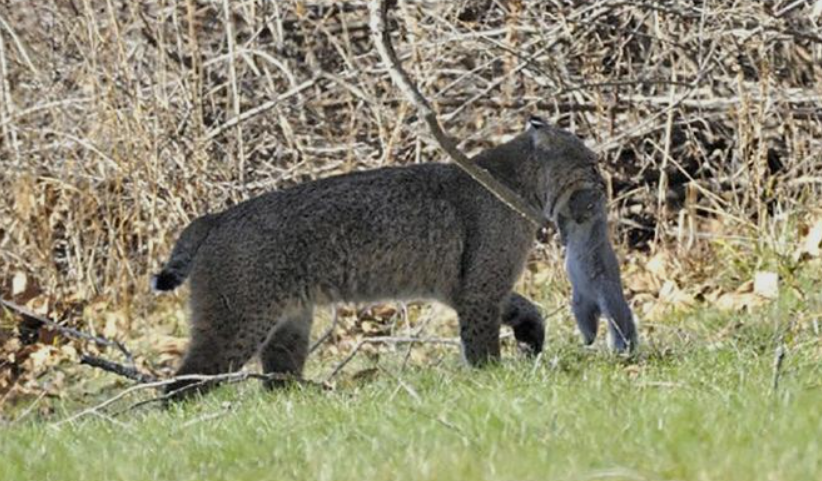
The different types of bobcats are regional forms of one adaptable wild cat that lives across much of North America, from southern Canada down into central Mexico. Bobcats are named for their short, bobbed tail, which measures only about 4 to 7 inches long and has a black tip on the upper side. They are roughly twice the size of a large house cat, with most adults weighing between 13 and 30 pounds.
A bobcat’s coat is usually tan, reddish-brown or gray, marked with dark spots and streaks that help it vanish into brush and rock. Black-tipped ear tufts, a ruff of fur around the face and long legs add to its look. Males are noticeably larger than females, and bobcats in colder northern regions tend to be heavier than those in the warm south.
Bobcats thrive in forests, swamps, deserts, mountains and even suburban edges. They are mostly solitary and active at dawn and dusk, and a single cat may patrol a territory ranging from about 1 square mile to more than 30. Rabbits and hares make up much of their diet, though they also take rodents, birds and occasionally deer.
Because bobcats live in such varied habitats, scientists have long described regional forms that differ in size, coat color and range. Many of these differences are subtle, but they show how well the species adjusts to local conditions. Here are the 13 types of bobcats, along with where each is found.
1. Eastern Bobcat
The eastern bobcat is the classic form that ranges across much of the eastern United States, from the Great Lakes region and the Appalachians toward the Atlantic coast. It has a reddish-brown to grayish coat with distinct dark spotting along the legs and belly. Adults are medium-sized, and males usually weigh about 20 to 30 pounds.
Hardwood forests, rocky ridges and mixed farmland all suit this cat well. It feeds mainly on cottontail rabbits, squirrels and mice, and it often rests in hollow logs or rock crevices during the day. Eastern bobcats are secretive and rarely seen, even in areas where they are fairly common. Their numbers have rebounded in many states after declines in the early 20th century.
2. Florida Bobcat
The Florida bobcat lives in Florida and nearby parts of the Southeast, including southern Georgia and the Gulf Coast. It is one of the smaller forms, with a short, sleek coat that is often darker and more heavily spotted than northern types. Many adults weigh only 15 to 25 pounds.
This cat uses cypress swamps, pine flatwoods, hammocks and the edges of the Everglades. It hunts rabbits, rodents, birds and sometimes reptiles, and it is a capable swimmer when water blocks its path. The warm climate means it needs no thick winter fur. Florida bobcats are active throughout the year and can often adapt to the margins of growing towns.
3. Texas Bobcat
The Texas bobcat occupies Texas and neighboring areas, reaching into Oklahoma, Louisiana, Arkansas and northeastern Mexico. It tends to have a paler, buff to sandy coat that blends with dry grasses and scrub. Its size is small to medium, with many adults weighing between 15 and 25 pounds.
Open brushland, mesquite country, river bottoms and rocky canyons are all typical habitat. Cotton rats, jackrabbits and ground-nesting birds make up much of its diet. Because Texas offers such a range of landscapes, these bobcats live in both humid eastern woods and arid western scrub. Ranchers sometimes see them near livestock areas, though they usually target smaller prey.
4. Mexican Bobcat
The Mexican bobcat is found across central Mexico, reaching from the Pacific side toward the interior highlands. It is generally a smaller, lighter-built cat with a coat that can range from tawny to grayish-brown. Its spotting is clear, and its legs are often finely barred.
This type lives in thorn scrub, dry forest, canyons and mountain foothills. It preys on rabbits, rodents, lizards and birds, and it often hunts near rocky outcrops. The Mexican bobcat has received far less study than its northern relatives, so many details of its biology are still poorly documented. It represents one of the southern extremes of the species’ wide range.
5. Oaxaca Bobcat
The Oaxaca bobcat lives in southern Mexico, particularly in and around the state of Oaxaca, near the southern limit of where bobcats occur. It is a small, short-coated form suited to warm conditions. Its coat is usually a rich tawny or reddish tone with dark spots.
Habitats there include tropical dry forest, scrubby hills and mountain slopes. The cat feeds on small mammals, birds and reptiles, adjusting to whatever is abundant. Researchers know relatively little about its population size, and it shares its range with other wild cats such as the ocelot. Habitat clearing for agriculture is one of the main pressures it faces.
6. Baja California Bobcat
The Baja California bobcat is restricted to the long Baja Peninsula in northwestern Mexico, extending from the border region southward. Its pale, sandy coat helps it blend with desert rock and scrub, and its body is lean and fairly small. Spots are present but often faint on the lighter fur.
Desert washes, chaparral hills and coastal scrub are its main habitats. Rabbits, kangaroo rats and other desert rodents form the bulk of its meals, and it can go long periods with little free water by relying on prey for moisture. The narrow peninsula isolates this population somewhat from mainland cats. That isolation is one reason it was once treated as a separate form.
7. California Bobcat
The California bobcat occurs throughout California, extending into parts of western Nevada and southern Oregon. It is a medium-sized cat with a buff, tawny or grayish coat and well-defined spots. Most adults weigh somewhere between 15 and 25 pounds.
It lives in oak woodlands, chaparral, coastal hills, mountain forests and even the edges of large cities such as Los Angeles. It hunts rabbits, woodrats, ground squirrels and quail. Studies in Southern California have shown that bobcats there are affected by roads and development, and some individuals suffer from rodenticide exposure. Even so, the cat remains widespread across the state’s varied terrain.
8. Pacific Northwest Bobcat
The Pacific Northwest bobcat inhabits western Oregon, western Washington and southwestern British Columbia. It is typically darker and more richly marked than bobcats from drier regions, which helps it hide in shadowy, damp forests. The coat is dense and often more brown than tan.
Its habitat includes coniferous forests, clear-cuts, brushy edges and the foothills of the Cascades. Mountain beavers, snowshoe hares, voles and birds are common prey. Heavy rain and cool temperatures are normal conditions for this cat. It tends to avoid the deepest snow and may move to lower elevations in winter.
9. Pallid Bobcat
The pallid bobcat is named for its pale coat, which can be a washed-out tan or light gray with faint spotting. It lives in the interior West, including the Rocky Mountain states, the Great Basin and parts of southern Canada. The fur is relatively long and thick, helping it cope with cold winters.
Sagebrush country, juniper hills, rimrock and mountain foothills make up its typical landscape. It preys on jackrabbits, cottontails, pocket gophers and grouse. Its light color blends with dry grass and bare rock, which helps it ambush prey. Home ranges in these sparse environments can be quite large.
10. Southwestern Bobcat
The southwestern bobcat is found in Arizona, New Mexico, and neighboring parts of Utah, Colorado, Nevada and northern Mexico. Its coat is typically pale, ranging from sandy buff to light gray, with spots that are often subtle. It is a medium to small bobcat built for hot, dry conditions.
Desert scrub, rocky canyons, pinyon-juniper slopes and riparian corridors are favorite haunts. Packrats, rabbits, ground squirrels and quail are staples of its diet. In the driest areas it tends to hunt at night to avoid daytime heat. Cats living near desert streams can reach higher densities than those in open flats.
11. Great Lakes Bobcat
The Great Lakes bobcat, sometimes called the Minnesota bobcat, lives across the upper Midwest, including Minnesota, Wisconsin and Michigan, as well as adjacent parts of Canada. It is one of the larger forms, with a thick, dense coat built for harsh winters. The fur is often grayish-brown, and the feet are well furred, which helps it move over snow.
Northern forests, bogs, cedar swamps and farmland edges provide its habitat. Snowshoe hares, deer carcasses, mice and grouse are important foods, and deep snow can make hunting difficult. In very snowy years, bobcats may be pushed south or toward areas with shallower snow. The species has to compete here with the larger and better snow-adapted Canada lynx at the northern edge of its range.
12. Maine Bobcat
The Maine bobcat, also called the northeastern bobcat, ranges across Maine, New Hampshire, Vermont and parts of eastern Canada such as New Brunswick and Nova Scotia. It is generally considered the largest type, and big males may approach or exceed 30 pounds. Its thick, grayish coat and heavy build suit the cold, snowy north.
Mixed forests, rocky ledges and brushy clearings provide cover, and it hunts snowshoe hares, squirrels, mice and, occasionally, small deer. Deep snow limits its movement, so these cats often stay along packed trails and in sheltered stands of evergreens. Populations have been affected by winter severity and by changes in forest cover. They remain a sought-after sighting for wildlife watchers in New England.
13. Bangs’s Bobcat
Bangs’s bobcat is an older named form that appears in many traditional subspecies lists and is usually placed in the central and eastern United States, around the Ohio Valley and Midwest. It is a medium-sized cat with a tawny to reddish coat and the typical spotting of an eastern bobcat. Its measurements fall between those of the larger northern forms and the smaller southern ones.
It lives in wooded hills, river bottoms, farmland edges and brushy thickets. Rabbits, rodents and ground-feeding birds make up most of its diet. Modern studies have often blended this form into neighboring populations, so you will see it described differently depending on the source. It remains a useful name for anyone exploring how bobcats vary across the American heartland.
Key Takeaways:
– Bobcats are adaptable wild cats: They belong to the species Lynx rufus and are recognized by their short, black-tipped tails, tufted ears, and spotted coats.
– Bobcats occur across North America: They are found throughout much of the United States, southern Canada, and parts of Mexico, occupying diverse habitats.
– Different regions have distinct bobcat populations: Bobcats vary in coat color, body size, and other physical characteristics depending on their geographic location and environment.
– They thrive in various habitats: Bobcats inhabit forests, deserts, grasslands, scrublands, and mountainous regions, provided they have sufficient prey and suitable cover.
– Bobcats are skilled hunters: Their diet includes rabbits, rodents, squirrels, birds, and other small animals. They typically hunt alone and rely on stealth to catch their prey.
– Habitat and climate influence their appearance: Bobcats living in colder northern regions may develop thicker coats, while those in warmer, drier areas often have lighter-colored fur that blends with their surroundings.