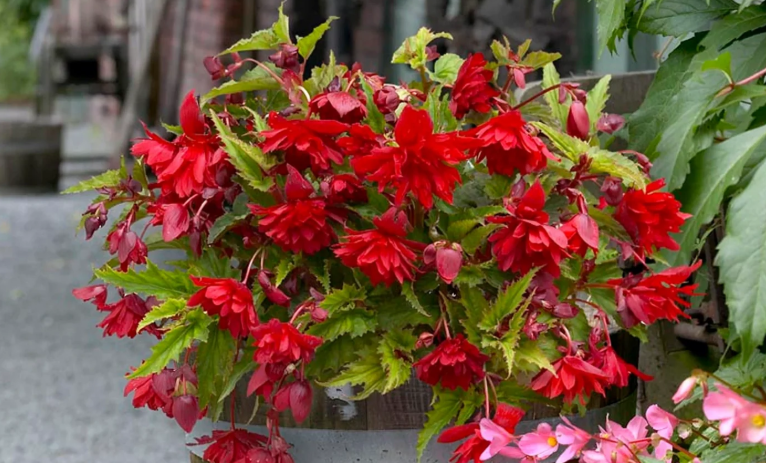
Begonias are among the most diverse ornamental plants you can grow, with more than 2,000 recognized species and an enormous number of hybrids and cultivars. They range from compact bedding plants covered in flowers to dramatic houseplants grown primarily for their colorful foliage. Some trail beautifully from hanging baskets, while others form upright canes several feet tall.
Gardeners generally encounter begonias in several broad horticultural groups, including wax, tuberous, cane-like, rhizomatous, rex, shrub-like, trailing, and thick-stemmed types. These classifications are useful because they help explain how a begonia grows and what it is primarily grown for, although the boundaries can overlap considerably.
Most begonias prefer bright filtered light or partial shade rather than harsh afternoon sun. Depending on the variety, they can be grown as bedding plants, container plants, hanging-basket specimens, greenhouse plants, or indoor houseplants. The 50 types below show just how much variety exists within the genus.
1. Rex Begonia (Begonia rex)
Rex begonia is one of the best-known foliage begonias and the parent of thousands of colorful hybrids. Its large leaves can combine silver, green, purple, pink, burgundy, and metallic shades, often with dramatic spirals, bands, spots, or contrasting veins.
Rex begonias are primarily grown for their foliage rather than their relatively modest flowers. They make excellent indoor container plants when provided with bright, indirect light, good humidity, and well-drained soil.
2. Polka Dot Begonia (Begonia maculata)
Polka dot begonia has become one of the most recognizable begonias among houseplant collectors. Its elongated green leaves are decorated with distinctive silvery-white spots, while the undersides often show a contrasting reddish or burgundy color.
This is a cane-type begonia, meaning it develops upright stems that resemble bamboo canes. With good conditions, it can become considerably taller than many compact begonias and produces clusters of small flowers.
3. Angel Wing Begonia
Angel wing begonia is a popular name for cane-like begonias with elongated, wing-shaped leaves. The foliage may be green, bronze, silver-spotted, or heavily patterned, while flowers can appear in pink, red, white, or coral shades.
These begonias are particularly useful when you want a larger indoor plant with both attractive foliage and flowers. They appreciate bright filtered light and benefit from occasional pruning to keep the stems bushy.
4. Dragon Wing Begonia
Dragon Wing begonias are vigorous hybrids valued for their attractive foliage, branching habit, and long-lasting flowers. Their arching growth makes them useful in containers, hanging baskets, and landscape beds.
Flowers are commonly red or pink, contrasting with glossy green foliage. Unlike many delicate foliage begonias, Dragon Wing types can perform well in outdoor containers and shaded garden areas.
5. Wax Begonia (Begonia semperflorens)
Wax begonias are among the most widely planted begonias for flower beds, borders, containers, and window boxes. They have glossy, rounded leaves that may be green or bronze and produce abundant flowers in shades of pink, red, and white.
They are generally compact and easy to grow, making them particularly useful when a dependable bedding plant is needed. Wax begonias are also known as semperflorens begonias because of their tendency to flower for long periods under suitable conditions.
6. Tuberous Begonia (Begonia × tuberhybrida)
Tuberous begonias are famous for their exceptionally large, showy flowers. Depending on the variety, blooms can be single, double, ruffled, or rose-like and may appear in red, pink, orange, yellow, and white.
Unlike fibrous-rooted begonias, these plants develop underground tubers. In climates where they cannot remain outdoors year-round, gardeners can lift and store the dormant tubers for another growing season.
7. Nonstop Begonia
Nonstop begonias are a popular group of tuberous hybrids bred for abundant, colorful flowers. The plants remain relatively compact while producing large double blooms that can provide months of seasonal color.
They are especially attractive in containers and shaded or partially shaded beds. The flowers can come in numerous colors, making the series useful when you want a coordinated display of tuberous begonias.
8. Begonia boliviensis
Begonia boliviensis is a tuberous species known for its narrow, elongated leaves and masses of pendulous flowers. The blooms are often orange, red, pink, or coral and hang gracefully from the plant.
Its naturally trailing habit makes it particularly effective in hanging baskets and containers. It is also an important parent of many modern trailing and tuberous begonia hybrids.
9. Hardy Begonia (Begonia grandis)
Hardy begonia is one of the more unusual members of the genus because it can survive winters in considerably cooler climates than many tropical begonias. It produces attractive heart-shaped foliage and clusters of pink flowers.
This species is particularly valuable for woodland gardens, shaded borders, and perennial beds. In suitable climates, it can naturalize and return year after year rather than being treated strictly as a seasonal bedding plant.
10. Iron Cross Begonia (Begonia masoniana)
Iron Cross begonia is named for the distinctive dark marking across the center of its textured green leaves. The pattern creates one of the most recognizable foliage effects among rhizomatous begonias.
It grows from a creeping rhizome and is primarily cultivated as a foliage plant. Bright indirect light and moderate humidity help maintain strong leaf color and healthy growth.
11. Eyelash Begonia (Begonia bowerae)
Eyelash begonia is a small rhizomatous species with attractive green leaves marked with darker patterns. The leaf margins are decorated with fine hairs that give the plant its common name.
Its compact size makes it particularly useful for small pots, terrariums, shelves, and shaded indoor displays. Pinkish-white flowers can appear above the foliage when growing conditions are favorable.
12. Maple Leaf Begonia (Begonia cleopatrae)
Maple leaf begonia has lobed leaves that resemble the foliage of a miniature maple tree. The leaves can show green and brown tones on the upper surface with reddish coloring underneath.
It is a rhizomatous begonia that works especially well as a foliage specimen. The unusual leaf shape makes it an interesting addition to a collection containing more conventional heart-shaped or wing-shaped begonias.
13. Begonia manicata
Begonia manicata is a rhizomatous species with attractive green foliage, prominent veins, and reddish or cranberry-colored margins. Its leaves can develop a distinctly textured appearance as the plant matures.
It is valued primarily for foliage but can also produce attractive pinkish flowers. Like many rhizomatous begonias, it performs best with filtered light and a growing medium that drains freely.
14. Begonia versicolor
Begonia versicolor is prized for its velvety foliage. The leaves have dark green coloring with contrasting silvery areas and prominent reddish hairs along some of the veins.
This is a collector’s begonia rather than a conventional bedding plant. It is particularly attractive in an indoor plant collection where its unusual leaf texture can be appreciated up close.
15. Begonia prismatocarpa
This small rhizomatous begonia comes from tropical Africa and is notable for its miniature growth habit. Its relatively small leaves and colorful flowers make it suitable for terrariums and other humid growing environments.
The flowers can show yellow and orange tones, providing a contrast to the plant’s delicate foliage. Its compact size makes it a good choice when larger cane and tuberous begonias are impractical.
16. Begonia venosa
Begonia venosa is a thick-stemmed begonia with an appearance quite different from the delicate foliage associated with rex begonias. It develops thick stems and rounded, leathery leaves covered with a fine pale coating.
The species is particularly interesting for gardeners who appreciate unusual plant architecture. Its relatively succulent appearance also makes it one of the more distinctive begonias for a bright indoor collection.
17. Begonia heracleifolia
Often called star begonia, Begonia heracleifolia develops deeply divided, star-shaped leaves. The foliage can form an attractive mound, making the plant useful as a container specimen.
It belongs to the rhizomatous group and is grown mainly for its foliage. The unusual leaf shape gives it a very different appearance from round-leaved wax begonias and heart-shaped rex types.
18. Begonia metallica
Begonia metallica, also known as Begonia incarnata in some horticultural references, is a shrub-like begonia recognized for its metallic-looking foliage. Its olive-green leaves can have a noticeable sheen that gives the plant a silvery appearance.
It can become substantially larger than many compact indoor begonias, making it useful when a more substantial foliage plant is desired. Small pale flowers provide an additional ornamental feature.
19. Begonia scharffiana
Often called elephant-ear begonia, Begonia scharffiana has broad leaves with a somewhat fuzzy texture. The foliage is particularly attractive when viewed close up because of its hairs and soft surface.
The plant can develop a bushy appearance and produces light-colored flowers. It is best suited to warm, humid growing conditions and bright filtered light.
20. Begonia listada
Begonia listada is a small foliage begonia prized for its striped leaves. The dark green foliage is marked by a lighter central stripe, while the undersides can show contrasting reddish tones.
Its compact habit makes it useful for shelves, terrariums, small containers, and plant displays. This is another begonia where the foliage is generally the main attraction.
21. Begonia amphioxus
Begonia amphioxus is an unusual collector’s species with narrow, pointed leaves covered in contrasting spots. The dramatic pattern can make the plant look almost painted.
Because of its distinctive foliage, it is especially popular among begonia enthusiasts who collect unusual species. It generally appreciates warm temperatures, high humidity, and bright indirect light.
22. Begonia luxurians
Begonia luxurians has exceptionally divided leaves that resemble the foliage of a tropical palm. Instead of broad, solid leaves, each leaf is separated into numerous narrow leaflets.
This unusual appearance makes it one of the most striking foliage begonias. It can become a larger plant than many rex and rhizomatous varieties and is particularly impressive as an indoor specimen when given enough space.
23. Begonia dregei
Begonia dregei is a small branching species with attractive foliage and a somewhat shrub-like growth habit. It has contributed to the development of some horticultural begonia hybrids.
The plant is useful for collectors because it combines a relatively delicate appearance with interesting growth characteristics. Small flowers can appear above the foliage when conditions are favorable.
24. Begonia fuchsioides
Begonia fuchsioides is named for its resemblance to fuchsia plants. Its flowers hang from the stems and create an attractive display against the green foliage.
The plant has a naturally graceful appearance and can work particularly well in containers. It is an interesting option for gardeners who want a begonia that emphasizes flowers without relying on the enormous blooms of tuberous types.
25. Begonia pearcei
Begonia pearcei is a tuberous species known for its attractive foliage and bright yellow flowers. The combination of patterned leaves and yellow blooms makes it stand out from many begonias that produce pink, red, or white flowers.
It has also been useful in begonia breeding. The species demonstrates how begonias can combine interesting foliage with unusual flower colors.
26. Begonia socotrana
Begonia socotrana is an unusual species native to the island of Socotra. It has played an important role in the development of winter-flowering begonia hybrids.
Its pink flowers and seasonal flowering behavior make it particularly interesting to horticulturists and collectors. It is also part of the history behind modern hiemalis and related winter-flowering begonias.
27. Elatior Begonia
Elatior begonias are hybrid flowering plants developed for their abundant blooms. They are commonly sold as indoor flowering plants and can provide strong color when grown in bright, indirect light.
The flowers may be single or double and are available in numerous shades. Unlike many foliage-focused rex begonias, Elatior types are usually purchased primarily for their flowers.
28. Reiger Begonia
Reiger begonia is another name commonly associated with modern winter-flowering begonia hybrids. These plants are valued for their ability to produce abundant flowers while remaining relatively compact.
They are especially popular as gift plants and indoor flowering specimens. With appropriate light and careful watering, a healthy plant can provide an extended display.
29. Cocktail Vodka Begonia
‘Cocktail Vodka’ is a colorful begonia cultivar recognized for its attractive flowers and ornamental presentation. It represents the enormous diversity of modern hybrid begonias, where breeders combine different species and growth characteristics.
Cultivars such as this demonstrate why begonia identification can become complicated: horticultural begonias are often hybrids rather than simple wild species, and many have been selected primarily for ornamental traits.
30. ‘Escargot’ Begonia
‘Escargot’ is a famous rex-type begonia named for its distinctive spiral leaf pattern. The foliage curls inward in a shape reminiscent of a snail shell.
Its leaves typically combine silver, green, and darker tones, creating an almost three-dimensional appearance. It is one of the most recognizable choices for gardeners who want a dramatic foliage houseplant.
31. ‘Looking Glass’ Begonia
‘Looking Glass’ is a rex begonia prized for its highly reflective silver foliage. The leaves can appear almost metallic, with green margins and contrasting veins.
This cultivar works especially well in indoor collections because the silver foliage catches filtered light. It is primarily grown for its leaves rather than its flowers.
32. ‘Black Mamba’ Begonia
‘Black Mamba’ is a dramatic rex begonia selected for dark, richly colored foliage. The leaves can appear nearly black or deep burgundy under the right lighting conditions.
It provides a strong contrast when placed beside silver, green, or brightly colored begonias. Like other rex types, it is best treated as a foliage plant and protected from harsh direct sunlight.
33. ‘Red Bull’ Begonia
‘Red Bull’ is a rex-type cultivar grown for its bold reddish foliage. The large leaves provide strong color even when the plant is not flowering.
It works particularly well as a focal point in an indoor plant display. Pairing it with green-leaved plants can make its intense foliage color even more noticeable.
34. ‘Escargot Swirl’ Begonia
‘Escargot Swirl’ represents the spiral-leaved style that has become especially popular among rex begonia collectors. The leaves twist around a central area, creating a strong visual focal point.
Its foliage can combine silver, green, purple, and burgundy shades. The compact growth habit also makes spiral rex begonias suitable for tabletops and plant shelves.
35. ‘Iron Cross’ Begonia
‘Iron Cross’ is the familiar horticultural form associated with Begonia masoniana. Its bright green leaves carry a prominent dark central marking that resembles an iron cross.
The unusual pattern is its main ornamental feature. It is particularly effective in shaded containers where the foliage can be viewed at close range.
36. ‘Tiger Paws’ Begonia
‘Tiger Paws’ is a compact begonia cultivar known for patterned leaves and a relatively manageable growth habit. Its foliage combines darker markings with green tones and can develop an attractive textured appearance.
This type is especially suitable for indoor collections where space is limited. It can also be used in terrarium-style displays when conditions are sufficiently humid.
37. ‘Little Brother Montgomery’ Begonia
‘Little Brother Montgomery’ is a rhizomatous hybrid with star-shaped foliage featuring silver, green, and bronze tones. Its leaves are often more important ornamentally than its flowers.
The compact plant is well suited to containers and shaded indoor displays. It is a good example of how hybrid begonias can be bred for unusual foliage patterns rather than simply larger flowers.
38. ‘Pewterware’ Begonia
‘Pewterware’ is a rhizomatous begonia with attractive silvery foliage and reddish undersides. The combination creates strong contrast when the leaves are viewed from different angles.
It can reach around 18 inches in favorable conditions, making it larger than some miniature rhizomatous begonias but still manageable as a container plant.
39. ‘Avatar’ Begonia
‘Avatar’ is a rex begonia recognized for its silver and pale green foliage accented with purple and pink tones. The leaves have a decorative, highly patterned appearance.
It is an excellent example of the ornamental foliage for which rex begonias are famous. Grow it in bright indirect light to help maintain strong color without exposing the leaves to intense afternoon sun.
40. ‘Joy’s Jubilee’ Begonia
‘Joy’s Jubilee’ is a colorful rex cultivar with green outer foliage surrounding a more intensely colored center. The leaf edges can be noticeably ruffled, adding texture to the plant.
It makes a strong tabletop or windowsill specimen and works particularly well alongside plain green foliage plants. The flowers are secondary to the colorful leaves.
41. ‘Raspberry Swirl’ Begonia
‘Raspberry Swirl’ is another rex begonia valued for its spiraling foliage. Its leaves combine green and silver around a raspberry-colored central area.
The dramatic leaf pattern makes it suitable as a focal plant in a container collection. It is best grown in bright, indirect light with consistent but not excessive moisture.
42. ‘Curly Fireflush’ Begonia
‘Curly Fireflush’ is a decorative rex cultivar with curled and highly colored foliage. Pale green, burgundy, and lilac tones can combine across the leaves.
Its ruffled foliage provides texture as well as color, making it particularly attractive in mixed houseplant displays. It is another example of how modern rex cultivars are selected primarily for leaf appearance.
43. ‘Emerald Wave’ Begonia
‘Emerald Wave’ is a rex cultivar featuring strongly patterned leaves with emerald green and deep plum tones. The foliage has a swirling appearance that gives the plant considerable visual depth.
It remains relatively compact and is well suited to containers. As with other rex begonias, avoiding harsh direct sunlight helps prevent foliage damage.
44. ‘Froggy’ Begonia
‘Froggy’ is a compact rex-type begonia with olive-green foliage decorated with dark markings. The leaves have an unusual pattern that can resemble a web or network.
Small flowers may appear, but the foliage is the main reason to grow this cultivar. Its manageable size makes it useful for indoor plant shelves and smaller containers.
45. Begonia ‘Lucerna’
‘Lucerna’ is a classic cane-type begonia associated with the long history of angel wing and cane begonia cultivation. It develops upright stems and attractive spotted foliage.
Cane begonias are especially useful when you want a begonia that grows vertically rather than forming a low mound. With pruning, they can also be encouraged to produce a fuller, more branched appearance.
46. Begonia ‘Benitochiba’
‘Benitochiba’ is a striking foliage cultivar known for its deeply divided leaves and unusual coloring. The foliage gives the plant a very different appearance from the broad, rounded leaves of wax begonias.
It works well as a container specimen where the unusual leaves can be displayed prominently. Bright filtered light helps preserve the contrast and coloration of the foliage.
47. Begonia ‘Marmaduke’
‘Marmaduke’ is a decorative foliage begonia with mottled leaves that combine green, bronze, brown, and lighter tones. Its irregular coloration gives each leaf a slightly different appearance.
This type is particularly useful for gardeners who want a foliage plant with a more natural, variegated appearance rather than the geometric patterns found on some rex cultivars.
48. Begonia ‘Gryphon’
‘Gryphon’ is a large, dramatic foliage begonia known for its deeply divided, maple-like leaves. The foliage can combine green, silver, and darker tones, creating a bold tropical appearance.
It can be used both indoors and outdoors in warm climates, especially in containers and shaded landscape areas. Its larger leaves make it particularly useful when a substantial foliage presence is desired.
49. Begonia ‘Big’
The BIG series of begonias was developed for strong landscape performance, combining attractive flowers with ornamental foliage. Different members of the series are available with green or bronze leaves and flowers in colors such as red, pink, and white.
These begonias are especially useful for gardeners who want a more vigorous bedding or container plant. Trials have found several BIG begonias to be strong performers under suitable growing conditions.
50. Begonia ‘Bonfire’
‘Bonfire’ is a vigorous flowering begonia valued for its colorful flowers and attractive foliage. Depending on the selection, the plant can have an upright or cascading habit, making it useful in containers and hanging baskets.
Its bright flowers make it especially effective when grown as a seasonal accent. Give it filtered light, regular moisture, and well-drained soil for the best performance.
How to Choose the Right Begonia
With so many choices, the best begonia depends largely on whether you want flowers, foliage, or both. Wax and many bedding begonias are excellent for long-lasting seasonal color, while tuberous begonias are better suited to gardeners who want large, spectacular flowers.
For foliage, rex and rhizomatous begonias offer some of the greatest variety. Cane begonias are a better choice if you want an upright plant that can eventually become quite large, while trailing and tuberous types are especially attractive in hanging baskets.
Best Begonias for Flowers
If flowers are your priority, consider:
- Tuberous begonias
- Nonstop begonias
- Wax begonias
- Dragon Wing begonias
- Elatior begonias
- Reiger begonias
- Begonia boliviensis
- Begonia fuchsioides
- Hardy begonia
These types can provide anything from small, continuous flowers to very large, showy blooms.
Best Begonias for Foliage
For spectacular leaves, some of the strongest choices include:
- Rex begonia
- ‘Escargot’
- ‘Looking Glass’
- ‘Black Mamba’
- ‘Red Bull’
- ‘Avatar’
- ‘Raspberry Swirl’
- Iron Cross begonia
- ‘Gryphon’
- Begonia luxurians
- Begonia amphioxus
- Begonia listada
Rex begonias are especially notable because thousands of cultivars have been developed from the original Begonia rex and related breeding.
Best Begonias for Shade
Begonias are naturally associated with forest and understory environments, which is why many types perform best with filtered light rather than intense midday sun. However, shade does not mean complete darkness; most begonias still need enough indirect light to maintain healthy growth and flowering.
Good choices for bright shade include wax begonias, rex begonias, rhizomatous begonias, cane begonias, hardy begonia, and many tuberous varieties.
Growing Begonias Successfully
The exact requirements vary considerably between species and hybrids, but most begonias appreciate well-drained soil, consistent moisture, and protection from intense afternoon sun. Overwatering can be just as problematic as drought because many begonias are susceptible to root and stem problems when kept constantly wet.
Indoor begonias generally perform best in bright, indirect light. Outdoor begonias can be excellent container and bedding plants, particularly in warm climates or during the summer growing season. Some types can be overwintered indoors, while tuberous begonias can be stored as dormant tubers in climates where they cannot survive winter outdoors.
Final Thoughts
The huge variety of begonias means there is a type for almost every ornamental gardening situation. You can choose a compact wax begonia for a flower bed, a tuberous begonia for enormous blooms, a cane begonia for height, a trailing type for a hanging basket, or a rex begonia when spectacular foliage is the main goal.
The 50 begonias above are only a small sample of the diversity available. With more than 2,000 species and thousands of cultivated hybrids, begonias offer an almost endless combination of leaf shapes, colors, textures, flowers, and growth habits. That diversity is what makes them such rewarding plants for both beginning gardeners and serious collectors.
References
- University of Florida IFAS Extension — A Beginner’s Guide to Begonias: Classification and Diversity.
University of Florida IFAS Extension — Classification and Diversity of Begonias
One of the best sources for your article. It explains the major begonia classifications, including fibrous-rooted, rhizomatous, and tuberous begonias, while also discussing the enormous diversity of species and hybrids. - North Carolina State University Extension — Begonia Plant Toolbox.
NC State Extension — Begonia Plant Toolbox
Useful for individual species and cultivar descriptions. It includes cane begonias, rex types, rhizomatous begonias, tuberous begonias, wax begonias, hardy begonia, and several named cultivars. - University of Minnesota Extension — Begonia.
University of Minnesota Extension — Begonia
Excellent for explaining the four commonly recognized garden groups—wax, tuberous, cane, and rhizomatous begonias—as well as their growth habits, foliage, flowers, and landscape uses. It also discusses newer cultivars evaluated in university trials. - Royal Horticultural Society — Begonias as Houseplants.
RHS — Begonias as Houseplants
A strong horticultural reference covering fibrous-rooted, cane-like, rhizomatous, and semi-tuberous begonias. It also provides examples such as Begonia rex, B. metallica, B. masoniana, and Begonia × hiemalis, making it useful for discussing popular ornamental types. - Clemson University Extension — Begonia.
Clemson University Extension — Begonia
Particularly useful for popular wax begonia cultivars and series, including Ambassador, Cocktail, Prelude, and Pizzazz. It also discusses hybrid begonias and the characteristics breeders select for. - American Begonia Society — Registered Cultivars.
American Begonia Society — Registered Begonia Cultivars
This is an excellent reference when discussing named cultivars and their registration. The American Begonia Society has served as the International Registration Authority for begonia cultivars since 1955 and maintains a large registry containing cultivar names, types, parentage, hybridizers, origins, and publication information.