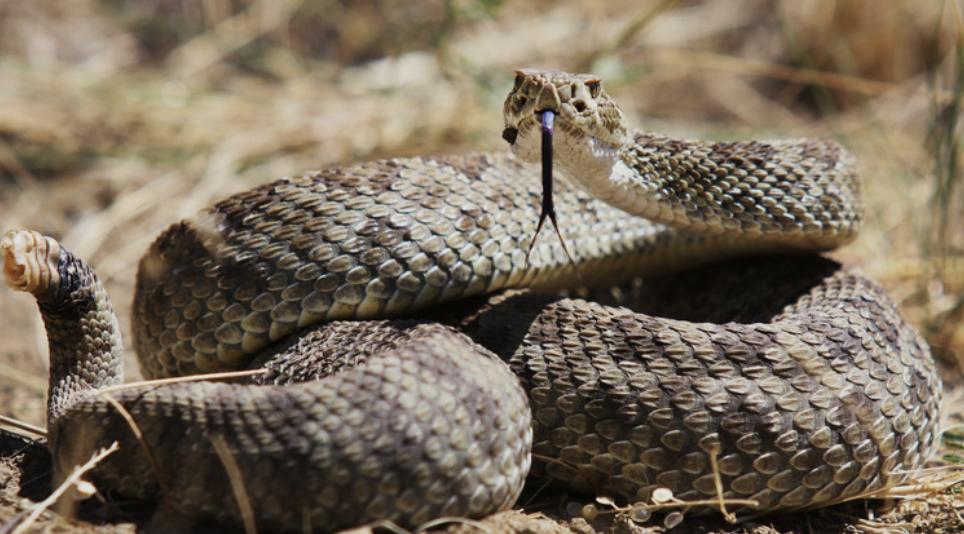
The snakes that look like rattlesnakes are some of the most commonly killed harmless animals in North America. A real rattlesnake has a segmented rattle on its tail, a broad triangular head, vertical cat-like pupils and heat-sensing pits between its eyes and nostrils. Many harmless snakes have blotchy, diamond-like patterns that match a rattlesnake’s, and some even copy its behavior. Their copying is a bluff, but a very convincing one.
When cornered, these mimics hiss, flatten their heads into a triangle and vibrate their tails. A tail shaken in dry leaves can sound remarkably like a real rattle, even though there is no rattle on the tail at all. The mimicry works because predators avoid anything that acts like a dangerous snake. Unfortunately, it also fools people, and many of these snakes are killed by mistake.
Telling the real thing from a look-alike is harder than most people think. Head shape is a poor guide because harmless snakes often flatten their heads when threatened. Pupils change with the light, and a rattlesnake’s vertical pupils can look nearly round in dim light. Even a missing rattle is not proof, since baby rattlesnakes have only a silent button. The most reliable clue is the tail, which ends in a blunt rattle on a rattlesnake and a thin, tapering point on a mimic.
The 16 snakes below range from famous rattlesnake impersonators to a venomous snake that is often mistaken for one. Each entry explains what makes it look dangerous and where it lives. Whichever snake you meet, keep your distance, never try to handle it, and get medical care right away if you are bitten.
1. Gopher Snake
The gopher snake is the classic rattlesnake mimic of the western United States. It has large brown blotches down its back that look much like a rattlesnake’s markings, and it can grow long, slender and powerful. When frightened, it coils, hisses loudly, flattens its head and vibrates its tail rapidly. The performance is so convincing that it is often called a “blow snake” for its loud hissing.
Telling it apart takes a careful look at the tail and head, which is why a safe distance matters. A gopher snake has no rattle, and its tail tapers to a plain point instead of ending in a thick, blunt tip. Its head is narrower than a rattlesnake’s, its pupils are round and its body is more slender. It is a constrictor that eats rodents, and it can live about 15 years. Researchers have noticed that tail vibrating seems to fade on islands without rattlesnakes, which supports the idea that the behavior is true mimicry.
2. Bullsnake
The bullsnake is the gopher snake of the Great Plains and the central United States. It is a large, heavy-bodied, blotchy snake with a rattlesnake-like pattern of dark brown or black blotches on a yellow or tan background. When disturbed, it hisses, flattens its head and vibrates its tail against dry leaves, brush or soil. Some bullsnakes can even make a loud, hissing sound by forcing air across a flap in the throat, which adds to the bluff.
Its tail and head give it away once you can see them. Its tail ends in a thin, pointed tip with no rattle, and the head is rounder and blunter than a viper’s. It lives in prairies, farmland and open country, and it is a valuable ally of farmers because it eats rodents. Bullsnakes are often killed by people who mistake them for rattlesnakes. The species has been recorded across states such as Illinois, where it lives in sandy areas.
3. Pine Snake
Pine snakes are big, strong snakes of the southeastern United States, with several forms including the northern, Florida and black pine snakes. They have a bold blotched pattern on a light background, and they hiss loudly and vibrate their tails when threatened. Their size and patterns lead many people to think they are rattlesnakes. They live in sandy soil in pine forests, where they burrow for prey.
The Louisiana pine snake is a separate species found in west-central Louisiana and eastern Texas, and it is one of the rarest snakes in the country. It has lost much of its habitat as longleaf pine forests have disappeared, and it is listed as threatened under the Endangered Species Act. Pine snakes eat rodents, and they are powerful constrictors that dig into pocket gopher tunnels. Because they are scarce and vulnerable, killing one by mistake does real harm to the species.
4. Eastern Hognose Snake
The eastern hognose snake has an Oscar-worthy defense routine. When threatened, it flattens its neck like a cobra’s hood, raises its head, hisses loudly and makes mock strikes, usually with its mouth closed. It has a thick body with squarish brown blotches, and its size and patterns lead people to confuse it with a pygmy rattlesnake. Its upturned, pointed snout is the easiest way to identify it.
If the bluff fails, it rolls onto its back with its mouth open and its tongue hanging out, and it plays dead. It may even release foul-smelling musk to complete the act, and if you turn it upright it simply flips over again. It lives from New Hampshire south to Florida and west to Minnesota, Nebraska, Kansas, Oklahoma and Texas, where it prefers sandy soils and eats mostly toads. Illinois naturalists describe it as common wherever deep sand deposits occur. It is harmless to people, so it is a great shame that it is so often killed.
5. Western Hognose Snake
The western hognose snake is a smaller, stout version of its eastern cousin. It is up to 35 inches long, with a strongly upturned snout and blotched, rattlesnake-like markings on a tan background. When threatened, it flattens its head, hisses and sometimes strikes with its mouth closed. It also plays dead by rolling over, mouth open, and staying limp.
It lives across the central United States, northern Mexico and southern Canada, in prairies and sandy areas, and has been found at elevations of up to 8,200 feet. It is common across most of its range, though it is endangered in Iowa and threatened in Illinois and South Dakota. Wildlife biologists at Fort Hays State University point to its bluffing as one of the most fascinating defense behaviors in North America. It is rarely willing to bite, so it is no danger to anyone.
6. Eastern Fox Snake
The eastern fox snake is a large, boldly marked snake of the Great Lakes region. It has a yellowish to light brown background with dark brown blotches that alternate along its back, and a coppery head. It is one of the most frequently cited rattlesnake look-alikes, and many people also mistake it for a copperhead. It vibrates its tail in leaves and hisses when disturbed.
It lives around the Great Lakes and west to Minnesota, South Dakota, Nebraska and Missouri, in marshes, farm fields and shorelines. It eats small mammals such as voles and mice, as well as eggs and young birds. Wisconsin wildlife officials note that fox snakes are frequently killed because they are mistaken for copperheads, even though copperheads do not live in or near the state. It is a helpful rodent controller and completely harmless.
7. Eastern Milksnake
The eastern milksnake is one of the most commonly misidentified snakes in the Northeast. It is a small, slender snake with reddish-brown blotches outlined in black on a gray or tan background. It is mistaken for the copperhead and the timber rattlesnake, and it sometimes imitates them by shaking its tail. A light V or Y shape on the top of its head is a useful clue.
It lives from southeastern Maine to central Minnesota and south to Tennessee and western North Carolina, and it is common in places like Connecticut. It hides under logs, rocks and boards, and it is often found in barns and basements where it hunts mice. Connecticut wildlife officials say most reports of “venomous” snakes from homeowners turn out to be milksnakes. Its head is narrow, not a wide triangle, and it is harmless.
8. Northern Watersnake
The northern watersnake is a common snake of lakes, ponds and streams across the eastern United States. It has a large rounded head and a pattern of black to reddish-brown blotches that may form crossbands, and it can grow to almost 4 feet. Its pattern leads people to take it for a copperhead, a cottonmouth or a rattlesnake. When cornered, it flattens its body and head and bites furiously.
It is extremely common around water throughout states like Maryland, and it often basks on river banks and branches. A useful rule is geography, since there are no known cottonmouth populations north of the Missouri River in Missouri. Its crossbands are also the opposite of a cottonmouth’s, being narrow at the base and wide in the middle of the back. It has round pupils and no heat-sensing pits, and its bite, though painful, is not venomous.
9. Diamondback Watersnake
The diamondback watersnake is a heavy-bodied, 2.5-to-4-foot snake with a diamond-shaped, net-like pattern on its back. The pattern is what leads people to think it is a rattlesnake, especially a diamondback. It basks on branches that overhang streams and ponds, and it drops into the water when disturbed. It hunts fish and other animals.
It lives in the central United States, south to northern Mexico, around slow rivers, swamps and lakes. Naturalists at Southeastern Louisiana University note that its pattern leads it to be mistaken for rattlesnakes, and it is not venomous. Rattlesnakes live on land and rarely stay in the water. If a big diamond-patterned snake is swimming, it is almost certainly a watersnake.
10. Black Ratsnake
The black ratsnake, also called the western ratsnake in the middle of the country, is a large, mostly black adult snake. Young ones look nothing like their parents, since hatchlings are light gray with dark blotches that resemble a rattlesnake’s pattern. They shake their tails and flatten their heads when disturbed. Adults darken as they age, and the blotches fade.
Its nicknames include “pilot black snake,” based on the old belief that it leads timber rattlesnakes to their winter dens, and “chicken snake” for its fondness for eggs and birds. It lives in forests, canyons, open fields and farmland across the eastern and central United States. It is an excellent climber and an effective killer of rodents. Hatchlings can be hard to tell from young Great Plains ratsnakes, so it is best to leave them alone.
11. Great Plains Ratsnake
The Great Plains ratsnake is a medium-sized gray or tan snake with squarish brown blotches outlined in black. It has a brown stripe through the eye and a spear-point mark on top of its head. It is 24 to 36 inches long, though some reach 60 inches. When alarmed, it shakes its tail vigorously, and in dry leaves the buzz sounds remarkably like a rattlesnake, which often leads to mistaken identity.
It lives in rocky, open woodland and prairie, from Colorado and Kansas to Texas and Missouri. It hunts at night for rodents, bats and birds, and it is an excellent climber. Kansas State University notes that adults are hard to tell from prairie kingsnakes, and its slightly ridged scales and divided anal plate are the distinguishing features. It is relatively uncommon in many places, but it may be more abundant than we think because it is nocturnal.
12. Glossy Snake
The glossy snake is a slender, smooth-scaled snake of the plains and the Southwest. It is tan or gray with brown blotches, and it looks a lot like a small rattlesnake from a distance. It spends much of its time underground or hunting at night. It may vibrate its tail when disturbed.
It lives in sandy and open habitats, including prairies and deserts, with records in places like Kansas. It feeds on lizards, small mammals and other snakes. Its smooth, shiny scales set it apart from the rough, keeled scales of a rattlesnake. It is harmless, but it is rarely seen, which makes it easy to misidentify.
13. Prairie Kingsnake
The prairie kingsnake is a medium-sized snake of 30 to 50 inches, with a light brown or tan body and a row of reddish-brown spots down its back. It looks very much like a Great Plains ratsnake, and both can be mistaken for rattlesnakes. When harassed, it shakes its tail, and in dry leaf litter the sound can be remarkably like a rattle. It also releases a foul-smelling musk if handled.
It lives throughout the midwestern and southeastern United States, in prairies, old fields and grassy areas, where it eats small mammals, frogs, birds and eggs. It is common but very hard to find, though it is often seen on roads at dusk in spring and fall. Like other kingsnakes, it can eat venomous snakes without being harmed. Its smooth scales and single anal plate set it apart from a ratsnake.
14. Mole Kingsnake
The mole kingsnake is a brown, secretive snake with a row of reddish-brown blotches, and it is a close relative of the prairie kingsnake. It looks enough like a small rattlesnake that many people kill it by mistake. It spends much of its time underground, burrowing in loose soil. It shakes its tail when it is disturbed.
It lives in the southeastern United States, including states like Georgia, in woodlands, fields and farmland with loose, sandy soils. It eats rodents, lizards and other small animals, and it is rarely seen. Its smooth scales and round pupils separate it from a pit viper. It is harmless to people.
15. Night Snake
The night snake is a small, slender snake of the western United States. It is gray or tan with dark brown blotches, so it resembles a baby rattlesnake. It has vertical pupils, which is unusual for a harmless snake and leads many people to think it is dangerous. Its mild venom is meant for small prey like lizards, and it is not a danger to people.
It is active at night in rocky desert, grassland and scrub, and it feeds on lizards and their eggs. Texas has its own form, the Texas nightsnake. It has no rattle, and its tail is thin and tapering. Because it is nocturnal and shy, most people only meet it by accident.
16. Copperhead
Unlike the other 15, the copperhead is a venomous snake, though it is not a rattlesnake. It is a pit viper with hourglass-shaped bands in shades of tan and brown, a coppery head and a thick body. It does not rattle, but it can vibrate its tail in leaves when alarmed, and its pattern is often confused with rattlesnake markings. It can bite if it is provoked, so it should always be treated with respect.
It lives across most of the eastern United States, as far north as Massachusetts, and it prefers rocky, forested uplands. It is found in the same areas as the northern watersnake, but unlike that snake it does not live in the water. It has heat-sensing pits, vertical pupils and a wide head, and it is rare to uncommon in places like Ohio. Keep your distance and call a professional if one is near your home.
Sources:
- Gopher Snake, Wikipedia
- Pituophis, Wikipedia
- Difference Between a Rattlesnake and a Gopher Snake, Think Wild
- Gopher Snake or Rattler?, Deschutes Land Trust
- Gopher Snake or Rattlesnake, Laguna Beach Archives
- What Snake Looks Like a Rattlesnake?, Wildlife Conservation Blog
- Eastern Hog-nosed Snake, Illinois Natural History Survey, University of Illinois
- Eastern Hognose Snake, What’s That Snake?
- Eastern Hognose Snake, USA Snakes
- Western Hognose Snake, Wikipedia
- Meet the Critters: The Western Hognose Snake, Fort Hays State University
- Hognose Snake, WorldAtlas
- Eastern Fox Snake, What’s That Snake?
- Foxsnake, Wisconsin Department of Natural Resources
- Eastern Milksnake, Connecticut Department of Energy and Environmental Protection
- On Myths and Milksnakes, Orianne Society
- Northern Watersnake, Maryland Department of Natural Resources
- Doppelfangers, Missouri Department of Conservation
- Diamond-backed Watersnake, Southeastern Louisiana University
- Western Ratsnake, Oklahoma Snakes
- Great Plains Ratsnake, Missouri Department of Conservation
- Great Plains Rat Snake, Kansas State University Herpetology Lab
- Great Plains Ratsnake, Center for North American Herpetology
- Wild Double Take: Prairie Kingsnake and Great Plains Ratsnake, Oklahoma Department of Wildlife Conservation
- Prairie Kingsnake, Oklahoma Department of Wildlife Conservation
- Prairie Kingsnake, Indiana Herpetological Atlas
- Lake and Pond Snake Identification, Solitude Lake Management
- How NOT to Identify a Venomous Snake, Medium
- Ohio’s Snakes: Venomous or Not?, Fairfield County Parks