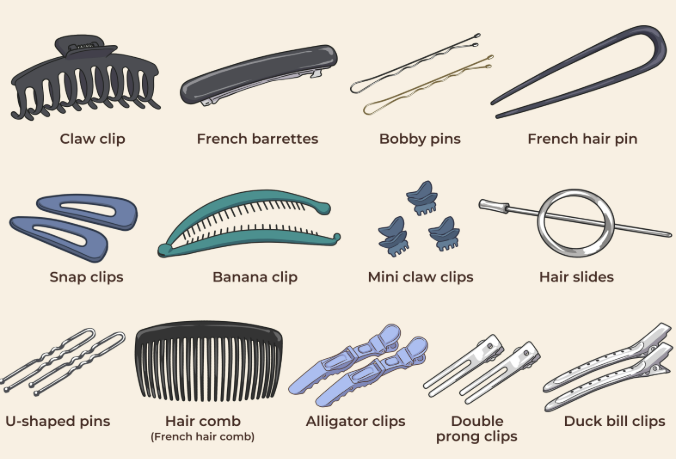
Hair clips are versatile hair accessories designed to hold, secure, or decorate hair while enhancing both functionality and style. They are used by people of all ages and hair types to create countless hairstyles, from simple everyday looks to elegant updos for weddings, parties, and professional settings. Available in a wide range of sizes, materials, and designs, hair clips combine practicality with fashion, making them an essential part of personal grooming and hairstyling.
The earliest hair clips date back thousands of years, with ancient civilizations such as the Egyptians, Greeks, Romans, Chinese, and Japanese using decorative pins, combs, and clasps crafted from bone, wood, ivory, bronze, silver, and gold. Over time, advances in manufacturing introduced lightweight metals, durable plastics, acrylics, resins, and eco-friendly materials that made hair clips more affordable, comfortable, and widely available. Today, hair clips are produced in countless shapes, colors, and finishes to suit virtually every hairstyle and occasion.
Modern hair clips serve many purposes beyond simply keeping hair in place. Some are designed for quick everyday styling, while others are specifically intended for sectioning hair during cutting, coloring, curling, or blow-drying. Decorative clips adorned with pearls, rhinestones, flowers, bows, or gemstones are commonly worn as fashion accessories, while professional salon clips emphasize strength, grip, and ease of use. Choosing the right clip often depends on hair thickness, texture, hairstyle, and personal preference.
Whether securing loose strands, creating intricate braids, or adding a decorative touch to formal hairstyles, hair clips remain among the most popular and practical hair accessories available. Their combination of convenience, affordability, and endless design options ensures they continue to evolve with changing fashion trends while remaining indispensable tools for hairstylists and everyday users alike.
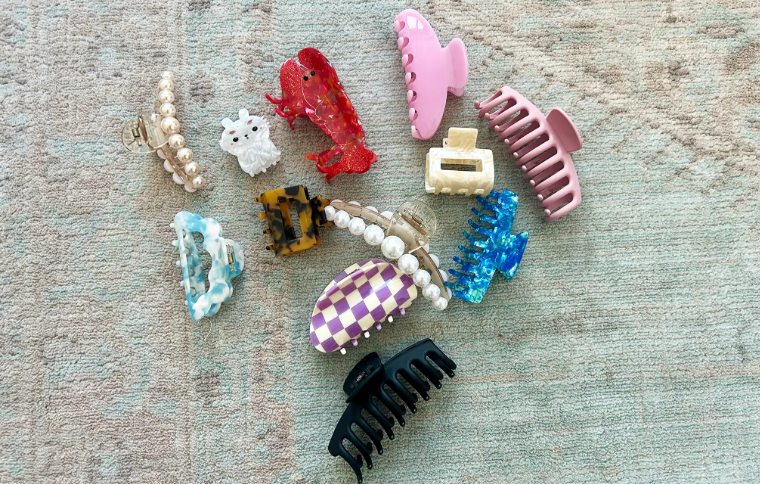
Types of Hair Clips
1. Alligator Hair Clip
The alligator hair clip was developed in the United States for professional hairstyling and salon use. It features long, serrated jaws with a spring-loaded hinge that resembles the mouth of an alligator, providing a strong grip on both wet and dry hair. Because the teeth securely hold large or small sections without slipping, these clips are widely used during hair cutting, blow-drying, curling, coloring, and styling. Professional stylists value alligator clips for their durability, flexibility, and ability to work with virtually every hair type.
2. Banana Clip
The banana clip became a major fashion accessory in the United States during the 1980s. Its long, curved design opens along one side and snaps closed to gather hair into a full, voluminous ponytail. Typically made from lightweight plastic or acrylic, banana clips distribute hair evenly to create a lifted appearance with minimal tension. Although especially popular during the 1980s and 1990s, banana clips have experienced a strong revival as retro hairstyles have returned to fashion.
3. Barrette Clip
The barrette is one of the oldest and most recognizable hair clips, originating in France, where the word barrette means “small bar.” It consists of a decorative upper piece attached to a spring-loaded or snap closure that securely fastens sections of hair. Barrettes are available in countless materials, including metal, plastic, wood, pearls, crystals, and fabric-covered designs. They can be simple everyday accessories or elaborate statement pieces suitable for weddings and formal events.
4. Bobby Pin Clip
Although technically a pin rather than a traditional clip, the bobby pin was invented in France during the 1920s to help women secure the fashionable “bob” hairstyle. The U-shaped metal pin uses tension between its two sides to hold hair discreetly in place. Bobby pins remain one of the most versatile hairstyling tools, capable of securing buns, twists, braids, curls, and intricate updos while remaining nearly invisible within the hair. They are available in multiple sizes and colors to blend with different hair shades.
5. Butterfly Clip
Butterfly clips gained enormous popularity in the United States during the 1990s. These small plastic clips feature two hinged wings that resemble a butterfly and are decorated in numerous colors and patterns. They are commonly used to secure tiny sections of hair, create playful hairstyles, or decorate braids and ponytails. Their lightweight design and ease of use have made butterfly clips especially popular among children and young adults, though they continue to appear in nostalgic fashion trends.
6. Claw Clip
The claw clip was developed in France before becoming one of the world’s most widely used hair accessories. It features two interlocking curved jaws connected by a spring hinge that securely grips hair without requiring elastic bands. Claw clips are available in various sizes, making them suitable for short, medium, and long hair. They are particularly valued for creating effortless buns, French twists, and half-up hairstyles while minimizing hair breakage and scalp tension.
7. Crocodile Hair Clip
The crocodile hair clip originated in professional European salons as an improved version of the alligator clip. It features longer serrated teeth and a double-hinged mechanism that allows the clip to expand more widely while maintaining exceptional grip. Crocodile clips are especially useful for holding thick, curly, or textured hair during coloring, sectioning, blow-drying, and precision cutting. Their superior holding power has made them a staple tool among professional hairstylists around the world.
8. Duckbill Hair Clip
Duckbill hair clips originated in Europe, particularly in France, where professional hairstylists developed them for precision styling and sectioning. Their long, flat shape resembles a duck’s bill, allowing them to hold large sections of hair without leaving noticeable creases. Duckbill clips are widely used during blow-drying, finger waving, roller setting, curling, and vintage hairstyling. They are also popular among makeup artists because they can keep hair away from the face without disrupting the hairstyle.
9. French Barrette
The French barrette was developed in France as an elegant improvement over the traditional barrette. It features a durable metal clasp with a spring-loaded mechanism that securely holds hair while remaining comfortable to wear. French barrettes are available in simple everyday styles as well as luxurious versions decorated with pearls, crystals, wood, resin, or precious metals. They are commonly used to secure ponytails, half-up hairstyles, and elegant chignons.
10. Jaw Clip
Jaw clips were first introduced in Europe before becoming globally popular for their practicality and comfort. Similar to claw clips, they feature two curved jaws connected by a strong spring hinge that firmly grips the hair. Jaw clips are available in miniature, medium, and oversized versions to suit different hair lengths and thicknesses. They are frequently used for quick updos, messy buns, and casual everyday hairstyles because they provide a secure hold with minimal effort.
11. Snap Hair Clip
Snap hair clips originated in Germany during the early 20th century as a simple, inexpensive fastening solution for children’s hairstyles. Made from a single curved piece of spring steel or coated metal, the clip opens and closes with a distinctive snapping action. Snap clips securely hold small sections of hair away from the face and are commonly used by children, although decorative versions featuring bows, flowers, glitter, or gemstones are also popular with adults.
12. Sectioning Hair Clip
Sectioning hair clips were developed in professional beauty salons in the United States to improve efficiency during hair cutting, coloring, straightening, and blow-drying. Typically made from lightweight plastic or aluminum, these clips are designed to separate large portions of hair while keeping them securely out of the way. Their strong springs and ergonomic design make them indispensable tools for hairstylists and barbers working on precision hair treatments.
13. Double-Prong Hair Clip
Double-prong hair clips originated in professional European salons and are widely used for roller sets and curl styling. Constructed from metal, these clips feature two parallel prongs that firmly secure curls against the scalp without crushing or flattening them. Hairstylists often use double-prong clips while setting pin curls, finger waves, and roller styles because they hold hair securely while allowing it to dry naturally into well-defined curls.
14. Contour Hair Clip
Contour hair clips were developed in Japan, where manufacturers focused on creating accessories that conform to the natural shape of the head. Their gently curved design provides a more comfortable fit while distributing pressure evenly across the hair. Contour clips are commonly used to create elegant half-up hairstyles, French twists, and sophisticated updos. Available in plastic, metal, and decorative finishes, they combine functionality with a sleek, modern appearance.
15. Decorative Hair Clip
Decorative hair clips have existed for centuries, with early versions appearing in Ancient China, Japan, Greece, and Egypt, where they were crafted from precious metals, gemstones, ivory, jade, and carved wood. Modern decorative clips are produced worldwide using materials such as acrylic, resin, pearls, rhinestones, fabric flowers, enamel, and crystals. While they can secure the hair, their primary purpose is to enhance a hairstyle with color, sparkle, or artistic detail. Decorative clips are especially popular for weddings, parties, festivals, and other formal occasions where they serve as both functional accessories and fashion statements.
16. French Clip
The French clip originated in France, where it was developed as a durable and elegant fastening mechanism for decorative hair accessories. It features a metal clasp with a tension bar that opens and closes smoothly, providing a secure grip without pulling the hair. French clips are commonly attached to ornamental barrettes made from resin, wood, metal, or embellished materials. Their strong yet comfortable hold makes them ideal for securing thick sections of hair, half-up hairstyles, and sophisticated updos.
17. Beak Hair Clip
Beak hair clips were developed in Europe for professional salon use and are named for their pointed shape, which resembles a bird’s beak. Their narrow, elongated design allows hairstylists to section hair with precision during cutting, coloring, highlighting, and blow-drying. Beak clips provide a firm grip while remaining lightweight and easy to reposition. They are especially useful when working with detailed hairstyles that require separating small sections of hair.
18. Teacup Hair Clip
The teacup hair clip originated in South Korea, where compact and minimalist hair accessories became fashionable. Smaller than a standard claw clip, it is designed for securing small portions of hair rather than an entire hairstyle. Teacup clips are ideal for half-up styles, bangs, side sections, and decorative accents. Their compact size and stylish appearance have made them particularly popular among people with fine or medium-thickness hair.
19. Octopus Hair Clip
The octopus hair clip was developed in Japan, where designers sought to create clips with enhanced holding power for thick and long hair. It features multiple curved teeth arranged around a strong spring hinge, resembling the tentacles of an octopus. This design distributes pressure evenly while securely gripping large volumes of hair. Octopus clips are excellent for creating buns, twists, and casual updos that remain comfortable throughout the day.
20. Crescent Hair Clip
Crescent hair clips originated in France as decorative accessories inspired by the graceful shape of the crescent moon. Their gently curved design follows the natural contour of the head, making them comfortable to wear while adding a sophisticated appearance. Crescent clips are often crafted from polished metal, acrylic, resin, or wood and may feature pearls or crystals. They are commonly worn with elegant updos, side-swept hairstyles, and formal evening looks.
21. Floral Hair Clip
Floral hair clips have their origins in Japan, where flowers have long been incorporated into traditional hairstyles, particularly in kanzashi ornaments worn with kimonos. Modern floral clips are produced worldwide using silk flowers, fabric, resin, foam, or preserved natural flowers. They are especially popular for weddings, beach vacations, festivals, and spring celebrations. Floral hair clips add a romantic, feminine touch to braids, buns, ponytails, and loose hairstyles.
22. Bow Hair Clip
Bow hair clips originated in France, where ribbon bows became fashionable decorative accessories among European aristocracy during the 18th century. Modern bow clips consist of fabric, velvet, satin, leather, or grosgrain bows attached to snap clips, barrettes, or alligator clips. Available in countless colors and sizes, they are popular with children and adults alike. Bow clips complement casual hairstyles as well as school uniforms, holiday outfits, and formal attire.
23. Pearl Hair Clip
Pearl hair clips gained popularity in Europe, particularly during the Victorian era, when pearls symbolized elegance and refinement. Contemporary pearl clips feature imitation or genuine pearls mounted on metal, resin, or acrylic bases to create timeless accessories suitable for special occasions. They pair beautifully with bridal hairstyles, evening gowns, and classic updos while also adding sophistication to everyday looks. Their enduring appeal has made pearl clips one of the most recognizable decorative hair accessories in modern fashion.
24. Rhinestone Hair Clip
Rhinestone hair clips originated in Europe, particularly in Austria, where high-quality crystal embellishments became popular in jewelry and fashion accessories during the late 19th and early 20th centuries. These clips feature sparkling rhinestones attached to metal or acrylic bases, creating an elegant accessory that catches and reflects light. Rhinestone hair clips are especially popular for weddings, proms, evening parties, and formal occasions, adding glamour to buns, curls, ponytails, and half-up hairstyles.
25. Banana Jaw Clip
The banana jaw clip was developed in South Korea as a modern variation of the traditional banana clip. It combines the elongated curved shape of a banana clip with the spring-loaded jaws of a claw clip, providing a stronger and more comfortable grip. This design securely holds thick or long hair while creating a fuller ponytail or elegant twist. Banana jaw clips have become increasingly popular because they are easy to use and reduce strain on the scalp.
26. Geometric Hair Clip
Geometric hair clips emerged in Scandinavia, particularly Denmark and Sweden, where minimalist fashion inspired simple yet stylish accessories featuring circles, triangles, rectangles, hexagons, and other clean-lined shapes. Manufactured from metal, acrylic, resin, or wood, these clips emphasize modern design over elaborate decoration. Geometric hair clips complement contemporary hairstyles and are commonly worn in both casual and professional settings.
27. Resin Hair Clip
Resin hair clips became popular in Italy during the late 20th century as advances in synthetic resins made it possible to create lightweight, durable, and colorful accessories. Resin can be molded into countless shapes and patterns, including marble effects, tortoiseshell finishes, floral designs, and translucent colors. These clips are resistant to moisture and everyday wear, making them both fashionable and practical for daily use.
28. Tortoiseshell Hair Clip
Tortoiseshell hair clips originated in Europe, where genuine tortoiseshell was historically used to produce luxury combs and hair accessories. Because harvesting real tortoiseshell is now prohibited in most countries to protect endangered sea turtles, modern versions are made from high-quality acetate or resin that replicates the distinctive amber-and-brown marbled appearance. Tortoiseshell clips remain timeless fashion accessories suitable for both casual and formal hairstyles.
29. Bridal Hair Clip
Bridal hair clips have their origins in Europe, where jeweled hair ornaments became an important part of wedding attire among royalty and nobility. Modern bridal clips are crafted from silver, gold, pearls, crystals, rhinestones, lace, or handcrafted flowers to complement wedding dresses and veils. Available in numerous styles ranging from vintage-inspired to contemporary designs, bridal hair clips are commonly used to decorate chignons, braided updos, loose curls, and half-up hairstyles while adding elegance and sparkle to a bride’s overall appearance.
30. Magnetic Hair Clip
Magnetic hair clips are a relatively recent innovation developed in Japan, where manufacturers sought to create accessories that are easy to fasten while minimizing hair breakage. Instead of relying solely on springs or clasps, these clips use small embedded magnets to secure sections of hair gently yet firmly. Magnetic clips are particularly useful for people with fine or delicate hair because they reduce pulling and are easy to open and close. Their sleek design and convenient operation have made them increasingly popular in modern hairstyling.
Conclusion
Hair clips have evolved from simple functional fasteners into stylish accessories that combine practicality with fashion. From professional salon tools like alligator, duckbill, and crocodile clips to decorative options such as pearl, rhinestone, floral, and bridal clips, each type serves a unique purpose while accommodating different hair textures, lengths, and styling preferences.
Whether used for everyday convenience, professional hairstyling, or special occasions, the right hair clip can make hairstyling easier while enhancing the overall appearance of a hairstyle. With continuous innovations in materials, designs, and fastening mechanisms, hair clips remain indispensable accessories that blend comfort, durability, and timeless style.