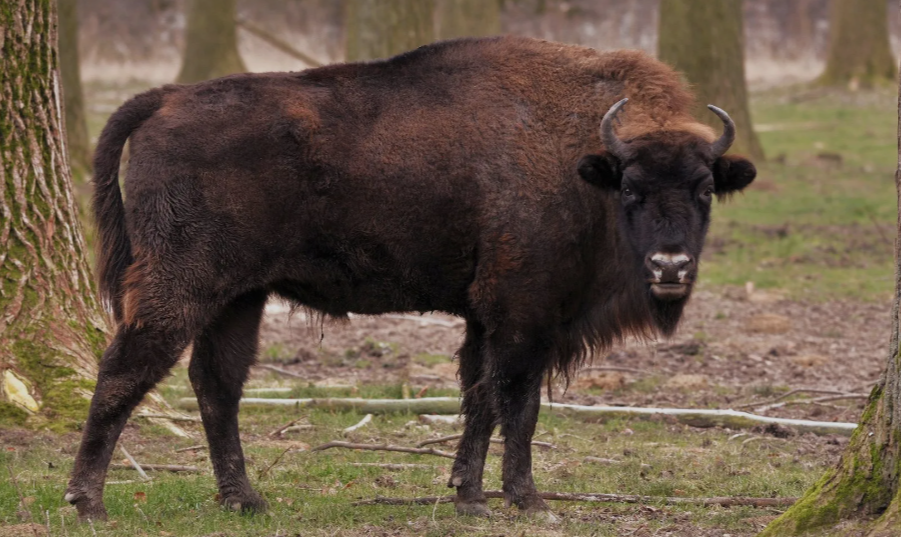
The types of bison species include two living species and several extinct relatives that once roamed the grasslands, forests and frozen steppes of the Northern Hemisphere. Bison are the largest land mammals in North America and Europe, with big bulls weighing close to 2,000 pounds and standing about 6 feet tall at the shoulder. Their most obvious feature is a high, muscular hump over the front legs, which powers the sweeping head movements they use to push snow aside in winter. Despite their bulk, they can run at around 35 miles per hour.
Bison are social grazers that live in herds led mostly by experienced cows. They spend their days eating grasses, sedges and other plants, and they rest in wallows, dusty hollows where they roll to shed insects and loose hair. Those wallows hold rainwater and shelter small plants and animals, which is why scientists call bison a keystone species. Their grazing and trampling shape whole prairie ecosystems.
Strictly speaking, only two bison species survive today, the American bison and the European bison, also called the wisent. Each has living subspecies or regional forms, and the family tree includes several extinct species known mostly from fossils. Because of this, most lists of bison types combine living forms with their extinct relatives, and this article does the same.
Almost all of these animals have a story of loss or near-loss. Hunting, habitat clearing and the end of the last Ice Age wiped out some forms completely and pushed others to the edge of extinction. The 10 types below show where each one lives or lived, and what makes it special.
1. Plains Bison
The plains bison is the most familiar bison in the world and the one most people picture when they think of the American West. Conservation work in Canada and the United States has brought the population to somewhere between 350,000 and 400,000 animals. Adult bulls weigh up to about 2,000 pounds, with a rounded hump, a shaggy brown cape over the shoulders and a lighter coat on the hindquarters. The species was named the national mammal of the United States in 2016, a title that reflects its place in American history. thecanadianencyclopedia
The plains bison once ranged across the Great Plains, from the Canadian prairies down into Texas and northern Mexico. A last wild remnant of fewer than 30 animals survived in what became Yellowstone National Park, and that herd still lives there today. Large herds also graze in Custer State Park in South Dakota, Theodore Roosevelt National Park in North Dakota and Elk Island National Park in Alberta. All the wild plains bison in Canada descend from roughly 81 animals that were captured in the 1870s and 1880s. Wikipediasararegistry
2. Wood Bison
The wood bison is the largest native land animal in North America, with bulls that can top 2,000 pounds. It is darker in color than the plains bison, and larger and heavier overall. Its hump is squarer than the rounded hump of its southern cousin, and its coat is darker with less distinct hair on the head and forelegs. It lives mostly in boreal forest, meadows and wetlands rather than open prairie. ozarkbisons
Wood bison live in northern Canada, and the biggest group is in and around Wood Buffalo National Park on the border of Alberta and the Northwest Territories. About 60 percent of the overall population lives in that park and the surrounding area. Total numbers sit between 5,000 and 7,000 animals. In the 1920s, thousands of plains bison were moved into the park, which caused heavy interbreeding with the local wood bison. A pure herd was later rediscovered and used to start new populations, including recent reintroductions in the Yukon and Alaska. Plains bison and wood bison: COSEWIC assessment and status report 2013 +2
3. European Bison
The European bison, or wisent, is the continent’s heaviest land mammal. It is slightly smaller than its American relative. It has a lighter build, a smaller hump and a less shaggy coat, and it eats more leaves, bark and shoots than the grass-loving American bison. Adult bulls can weigh nearly 2,000 pounds, and they live in woodland or forest-edge habitats. encyclopedia
The story of the wisent is one of the great conservation comebacks. By 1923, just 54 animals living in zoos made up the entire species. Every wisent alive today descends from only 12 founding animals. The first captive-bred wisent was released into the Bialowieza Forest in 1952. Today the largest wild herds live in Poland, where about 2,492 animals were counted at the end of 2021, and smaller herds roam Belarus, Romania, Germany, the Netherlands, Spain and Denmark. A herd also arrived in Kent, England, in March 2022. Bison, European +4
4. Caucasian Bison
The Caucasian bison, also called the mountain bison, was a regional form of the European bison that lived in the high forests of the Caucasus Mountains. It is thought to have been slightly smaller than the lowland wisent, with a darker, curlier coat that suited the cold mountain climate. Like other wisent, it browsed on leaves, bark and shoots and grazed in alpine meadows during summer. It was a shy animal that kept to remote, forested slopes.
The Caucasian bison lived in the mountains that now run through southern Russia, Georgia and Azerbaijan. Poachers wiped it out in the 1920s, and the Caucasus population disappeared in 1927. One bull survived in captivity, and its genes live on in the lowland-Caucasian line that makes up today’s wisent herds. Wisent from that line have since been reintroduced to parts of the Caucasus region, although they are not pure Caucasian bison. nature
5. Carpathian Bison
The Carpathian bison, sometimes called the Hungarian or Transylvanian bison, was another regional form of the European bison. It lived in the mixed forests of the Carpathian Mountains, which curve through Romania, Slovakia, Ukraine and Poland. The Hungarian bison is listed as an extinct subspecies. Like the wisent, it was a forest browser that fed on leaves, twigs and bark. libguides
This form is generally thought to have vanished in the late 1700s, long before the other European bison collapsed. Hunting pressure and the clearing of forests for farmland were the main causes. Today the Carpathians are being restocked with wisent, and a reintroduction program that began in 1963 now spans Poland, Slovakia, Romania and Ukraine. The mountains once again support free-ranging herds, although they descend from lowland stock rather than the original Carpathian animals. wisent
6. Steppe Bison
The steppe bison was a massive Ice Age species and the ancestor of nearly all later bison. Adult bulls likely stood more than 6 feet tall at the shoulder and weighed over 2,200 pounds. It had a high hump and long, wide-spreading horns, and it lived in herds on dry, cold grasslands. A famous mummy named Blue Babe shows how well preserved some individuals are. The mummy is about 36,000 years old and was found north of Fairbanks, Alaska, in 1979. cavacriteme
This species ranged across the mammoth steppe, a vast belt of cold grassland. Its range stretched from Western Europe all the way to Alaska and the Yukon. Its fossils turn up in Siberia, across Europe and in northern North America, and some animals survived in Siberia into the middle of the current geological age. As the climate warmed and the grasslands shrank, steppe bison disappeared, but their descendants lived on as the bison of North America and Europe. krisyotam
7. Long-Horned Bison
The long-horned bison, also called the giant bison, was the largest bison that ever lived. Its known measurements are larger than those of any other bovid, living or extinct. Its horns could span about 7 feet from tip to tip, and its body may have weighed well over 2,000 pounds. It had a long face, tall legs and a high hump, and it probably lived in small family groups rather than huge herds. cavac
This species lived in North America during the Late Pleistocene, in a range from southern Canada down into Mexico. The first fossil bison ever described in North America was a long-horned bison found in Kentucky. The species died out about 20,000 years ago. Skulls and horn cores are displayed in museums such as the Royal Tyrrell Museum in Alberta. Bison latifrons +2
8. Ancient Bison
The ancient bison was the immediate ancestor of the modern American bison. It lived in North America from more than 60,000 years ago until around 10,000 years ago. It was smaller than the long-horned bison but larger than today’s plains bison, and its horns were long and straight. Bulls were probably well over 2,000 pounds and stood about 7 feet at the shoulder. riteme
Fossils of the ancient bison have been found across much of the continent, from Alaska and Canada to Mexico, and at famous sites such as the La Brea Tar Pits in California. Early hunters pursued this animal, and the Folsom site in New Mexico holds a well-known kill site with spear points embedded among its bones. The last populations vanished early in the current geological age, around 10,000 years ago. The smaller modern bison then took over its grassland home. riteme
9. Western Bison
The western bison is a Late Pleistocene form that fits between the ancient bison and today’s plains bison. Scientists use the name for animals that look like transitional forms between the two species. It had a high hump, a heavy front end and horns larger than those of living bison, though far short of the giant long-horned form. Its taxonomy is debated, and some researchers see it as a variety of the ancient bison rather than a separate species. riteme
Its fossils are found in northwestern North America, including Alaska, Yukon and the Canadian prairies. One archaeologist argued that this form survived until about 12,000 to 11,000 years ago. Early people hunted it, and its bones turn up at ancient kill sites. It disappeared as the grasslands changed after the last Ice Age, and smaller bison took its place. uchytel
10. Eastern Woodland Bison
The eastern woodland bison was the form of bison that lived east of the Mississippi River. A smaller population lived east of the Mississippi, apart from the main plains herds. Early settlers described it as a bison of open woods, canebrakes and salt licks, and it followed well-worn trails that later became roads. Some biologists consider it a distinct subspecies, while others see it as a plains bison that simply spread east. hww
At one time, these bison roamed from the Great Lakes through Pennsylvania, Virginia and the Carolinas, and as far south as Georgia. Hunting and the spread of farms removed them from most of the East by the early 1800s. Today, plains bison have returned to parts of the region, including Land Between the Lakes in Kentucky and a herd at Fermilab in Illinois. These herds are a living reminder that bison once belonged in the eastern forests.
Key Takeaway:
Only 2 bison species are alive today, the American bison and the European bison, so I reached 10 by combining living subspecies and regional forms with extinct relatives. Scientists still debate how to classify several of these, especially the wood bison, the eastern woodland bison, the western bison and the Carpathian bison.
The extinction date for the Carpathian bison, the eastern woodland range details and the western bison’s size and horn description rely on limited sources and should be double-checked before publishing. Population counts change every year, so confirm the figures for plains bison, wood bison and wisent. As usual, I left out scientific names. I didn’t find university sources for this one, so let me know if you’d like about 3 added.
Sources:
- Bison, The Canadian Encyclopedia
- Plains Bison and Wood Bison: COSEWIC Assessment and Status Report 2013
- Plains Bison and Wood Bison COSEWIC report (PDF)
- Wood Bison, Ozark Bisons
- Bison, European, Encyclopedia.com
- European Bison, Return From the Other Side, 3Seas Europe
- The Remarkable Story of How the Bison Returned to Europe, Nature Conservancy
- Return of a Native, National Wildlife Federation
- The Importance of European Bison Population in Bieszczady, European Bison Conservation Newsletter
- Extinct Long-horned Bison and Ancient Bison Fact Sheet, San Diego Zoo Wildlife Alliance Library
- Steppe Bison
- Bison antiquus