The types of wild cat species form one of the most admired groups of predators on Earth. Scientists currently recognize 41 species in the cat family, and they live on every continent except Antarctica and Australia. They range from the tiny rusty-spotted cat, which weighs about 2 pounds, to the tiger, which can top 600 pounds.
All cats share the same basic design. They have sharp retractable claws, keen night vision, sensitive whiskers and a flexible spine built for stalking and pouncing. Every wild cat is a carnivore, and most are solitary hunters that rely on stealth and a short, explosive chase rather than a long pursuit.
Wild cats live in an astonishing range of habitats, including rainforests, deserts, wetlands, grasslands and snowy mountaintops. Some, like the fishing cat, are strong swimmers, while others, like the margay, spend much of their lives in the treetops. The big cats can roar, while smaller species purr, chirp, hiss and yowl.
Sadly, a large share of wild cat species are in trouble. Habitat loss, poaching, conflict with livestock owners and the decline of prey have pushed many of them toward vulnerable or endangered status. Here are the 41 types of wild cat species, along with where each one is found.
1. Tiger
The tiger is the largest wild cat in the world, with big males weighing 400 to 660 pounds. Each animal carries a unique stripe pattern, much like a human fingerprint. Tigers are powerful swimmers and often cool off in rivers and pools during hot weather. They hunt mainly at night, targeting deer, wild pigs and wild cattle.
Wild tigers live in scattered pockets of Asia, including India, Nepal, Bhutan, Bangladesh, Russia, China, Thailand, Malaysia and Sumatra. India holds more than half of the world’s wild tigers, which number roughly 4,500 or more. Their range has shrunk by over 90 percent from historic levels. Forests, mangrove swamps like the Sundarbans, and cold birch woodlands in the Russian Far East are all part of their remaining home.
2. Lion
The lion is the only truly social wild cat, living in prides that can include up to 30 individuals. Adult males carry the famous mane and weigh 330 to 550 pounds, while females are smaller and do most of the hunting. A lion’s roar can carry up to 5 miles across open country. Lions feed on zebra, wildebeest, buffalo and antelope.
Most wild lions live in sub-Saharan Africa, in savannas and open woodlands from Kenya and Tanzania to Botswana and South Africa. Their total numbers are estimated at around 20,000 and have fallen sharply in recent decades. A small, separate population survives in the Gir Forest of western India, where more than 600 lions now live. Lions have disappeared from North Africa and most of the Middle East.
3. Jaguar
The jaguar is the largest cat in the Americas, with a stocky body that weighs 100 to 250 pounds. It has the most powerful bite relative to size of any big cat, allowing it to crush turtle shells and the skulls of prey. Its coat is covered in rosettes that often contain a central spot. Unlike most cats, the jaguar readily enters water to hunt caimans, capybaras and fish.
Jaguars range from Mexico through Central America and deep into South America, with strongholds in the Amazon basin and the Pantanal wetlands of Brazil. Occasional individuals still wander into southern Arizona and New Mexico. They have vanished from El Salvador and Uruguay and from much of their former range in the United States. Dense forest, swamps and seasonally flooded grasslands are their preferred habitats.
4. Leopard
The leopard is a supremely adaptable cat that weighs 70 to 200 pounds depending on region. It is famous for dragging heavy prey, even whole antelope carcasses, high into trees to keep it from lions and hyenas. Its coat of rosettes hides it perfectly in dappled light. Black leopards, often called black panthers, are especially common in the rainforests of the Malay Peninsula.
Leopards have the widest range of any big cat, living across sub-Saharan Africa and parts of the Middle East, India, Southeast Asia and the Russian Far East. They occupy deserts, mountains, savannas and forests, and some even live on the edges of cities such as Mumbai. Even so, they have lost more than 60 percent of their historic range. Several regional populations, such as the Amur leopard, are critically endangered.
5. Snow Leopard
The snow leopard is a shy mountain predator with thick smoky-gray fur and a tail nearly as long as its body. The tail helps it balance on steep cliffs and acts as a warm wrap when the cat sleeps. A snow leopard can leap about 50 feet horizontally in a single bound. Adults weigh 60 to 120 pounds, and they cannot roar like other big cats.
These cats live in the high mountains of Central and South Asia, including the Himalayas, Tibetan Plateau, Altai and Tian Shan ranges. They occur in 12 countries, often at elevations between 9,800 and 14,800 feet or higher. Their wild population is estimated at between 4,000 and 6,500 animals. They hunt blue sheep, ibex and marmots across rocky slopes and alpine meadows.
6. Clouded Leopard
The clouded leopard is named for the large cloud-shaped markings on its coat. It has the longest canine teeth relative to body size of any living cat, a trait compared to those of the extinct saber-toothed cats. Its flexible ankle joints let it climb down tree trunks headfirst and even hang from branches by its hind feet. Adults weigh only about 25 to 50 pounds.
This cat lives in the forests of the Himalayan foothills, mainland Southeast Asia and southern China. It prefers evergreen rainforest but also uses mixed woodland and mangroves. Deforestation and the illegal wildlife trade have made it vulnerable to extinction. Monkeys, deer, wild pigs and birds make up most of its diet.
7. Sunda Clouded Leopard
The Sunda clouded leopard was only recognized as a separate species in 2006, after genetic studies showed it differed from its mainland cousin. Its coat is darker, with smaller, more crowded cloud markings and a double stripe running along the back. It weighs roughly 24 to 55 pounds. Like its relative, it is a skilled climber that rests and hunts in the canopy.
This species is found only on the islands of Borneo and Sumatra. It lives in lowland and hill rainforests, though logging and palm oil plantations have shrunk its habitat dramatically. The species is listed as vulnerable, and its numbers are thought to be declining. Proboscis monkeys, deer, wild pigs and birds are among its prey.
8. Marbled Cat
The marbled cat is about the size of a domestic cat but has a tail nearly as long as its body, often reaching 20 inches. Its fur has a swirling, marbled pattern much like that of the clouded leopard, which it resembles in miniature. It weighs just 4 to 11 pounds and is highly arboreal. Squirrels, birds, frogs and rodents are its main foods.
It lives in the forests of the Himalayan foothills, Southeast Asia, and the islands of Sumatra and Borneo. Evergreen and mixed forests below about 9,800 feet are its favored habitat. The marbled cat is rarely seen, and little is known about its behavior in the wild. Forest clearing is its biggest threat, and it is listed as near threatened.
9. Asian Golden Cat
The Asian golden cat is a medium-sized predator that weighs 20 to 33 pounds. Its coat is remarkably variable, appearing golden, reddish, gray or even black, and some individuals are spotted like an ocelot. White and black facial stripes give it a distinctive expression. It hunts birds, rodents, hares and young deer.
This cat ranges from the Himalayan foothills in Nepal and India across Southeast Asia and into southern China. It lives in evergreen forest, mountain woodland and rocky scrub at elevations up to 10,000 feet. It is nocturnal and rarely seen by people. Hunting and forest loss have led to its near threatened status.
10. Bay Cat
The bay cat is a small, reddish-brown cat weighing only about 4 to 9 pounds. It has a rounded head, a long tail with a white tip underneath, and a marked pale line running from its eyes to its forehead. It was first photographed in the wild by a camera trap in 1998, which shows how elusive it is. Small mammals, birds and reptiles are believed to be its prey.
The bay cat lives only on the island of Borneo, where it occupies lowland and hill forests near rivers and streams. It is among the rarest and least-known cats in the world. The species is endangered, and its population is thought to be small and decreasing. Deforestation for plantations and logging is its greatest threat.
11. Caracal
The caracal is a sleek, long-legged cat that weighs 20 to 40 pounds. It is instantly recognized by its tall black ear tufts, and its name comes from a Turkish word meaning black ear. This cat can leap up to 10 feet into the air to snatch birds in flight. It also hunts hares, hyraxes and small antelope.
Caracals live across much of Africa, the Middle East, Central Asia and the Indian subcontinent. They favor dry savanna, scrubland, semi-desert and rocky hills. In India, they are known as a rare and protected species. They are mostly nocturnal and avoid dense rainforest.
12. African Golden Cat
The African golden cat is a stocky, medium-sized cat that weighs 10 to 35 pounds. Its coat varies from rich reddish-brown to slate gray, and some individuals have heavy spotting on the belly and legs. It is a secretive forest hunter that takes hyraxes, rodents, birds and small duikers. Very few people have ever seen one in the wild.
This species lives in the rainforests of West and Central Africa, from Senegal to the Democratic Republic of the Congo and Uganda. Logging, bushmeat hunting and snare traps threaten its survival. Sightings often occur along forest roads and trails at elevations up to about 11,000 feet. It is listed as vulnerable.
13. Serval
The serval has the longest legs relative to body size of any cat, along with huge ears that help it locate rodents in tall grass. It weighs 20 to 40 pounds and has a spotted, tawny coat. Servals pounce from a standing start, leaping as high as 10 feet to catch birds. Roughly half of their hunts succeed, a very high rate among cats.
Servals live across sub-Saharan Africa, favoring wetlands, reed beds and grasslands near water. A small relict population survives in the far north of Africa. They are absent from true desert and dense rainforest. Rodents, frogs, insects and birds fill their diet.
14. Ocelot
The ocelot is a medium-sized spotted cat that weighs 20 to 35 pounds, with chain-like rosettes along its sides. It hunts mostly at night, taking rabbits, rodents, iguanas and birds. Ocelots mark their territories with scent and often use the same trails for years. Their beautiful coat once made them a prime target of the fur trade.
Ocelots range from southern Texas through Mexico and Central America into northern Argentina. They live in rainforest, thorn scrub, swamps and savanna. In the United States, fewer than 100 ocelots survive, mostly in the brushland of South Texas. Road mortality and habitat fragmentation are major threats to that tiny population.
15. Margay
The margay is a slender, spotted cat with enormous eyes and a very long tail. It weighs just 5 to 9 pounds and spends most of its life in trees. Its ankles can rotate up to 180 degrees, allowing it to descend trunks headfirst, like the clouded leopard. In Brazil, observers have recorded a margay imitating the calls of a baby monkey, apparently to lure adults close.
Margays live from Mexico through Central America and into Paraguay, Uruguay and northern Argentina. They prefer dense evergreen and cloud forests. Deforestation has reduced their habitat and led to a near threatened listing. Birds, small mammals, lizards and tree frogs are typical prey.
16. Oncilla
The oncilla, or northern tiger cat, is a small spotted cat that weighs only 3 to 6 pounds. It has a slim body, a long tail and a coat with dark rosettes on a tawny background. It is often confused with the margay and ocelot, though it is smaller than either. The oncilla hunts rodents, small birds and lizards, both on the ground and in the trees.
This cat lives in the highlands of Costa Rica and Panama, and across northern South America in Colombia, Venezuela and the Andes. It favors cloud forests and high-elevation woodland, sometimes above 9,000 feet. The species is listed as vulnerable. Habitat loss and persecution by farmers contribute to its decline.
17. Southern Tiger Cat
The southern tiger cat was recognized as a species separate from the oncilla only in recent years, after genetic work showed distinct lineages. It is about the same size, weighing 3 to 6 pounds, and its spotted coat can be difficult to tell apart. Its habits are similar, with nocturnal hunting of small mammals, birds and reptiles. Because it was recognized so recently, there is much we still do not know.
It lives in southern and central Brazil, Paraguay and northeastern Argentina. Atlantic Forest and savanna scrub are its main habitats, and the Atlantic Forest has been reduced to a small fraction of its original size. The species is listed as vulnerable. Road kills and conflicts with poultry farmers add to the pressure.
18. Geoffroy’s Cat
Geoffroy’s cat is a small spotted cat about the size of a domestic cat, weighing 4 to 11 pounds. It is a strong swimmer and often hunts in marshes and along streams. Black individuals are common in some populations. The cat was heavily hunted for its fur in the 1970s and 1980s, but protections have allowed numbers to recover.
It lives across southern South America, including Bolivia, Paraguay, Brazil, Uruguay, Argentina and Chile, reaching Patagonia in the south. Open scrub, grassland, wetlands and dry woodland are all suitable habitat. Rodents, birds, fish and frogs form its diet. It is now considered a species of least concern.
19. Kodkod
The kodkod is the smallest cat in the Americas, weighing about 4 to 6 pounds. Its coat is dark brown or gray with small black spots, and its tail is thick and ringed. The cat is an agile climber that hunts rodents, birds and lizards both on the ground and in trees. Little is known about its habits, since it is so rarely seen.
Kodkods live only in the temperate rainforests of central and southern Chile and a narrow strip of western Argentina. A separate population lives on Chiloé Island. The species is listed as vulnerable, largely because of forest clearing and attacks by dogs. Local people call it the guiña.
20. Andean Mountain Cat
The Andean mountain cat is one of the rarest and least-known cats in the world. It has a soft ashy-gray coat with orange-brown blotches and a long, bushy, ringed tail. Adults weigh 8 to 13 pounds. Its diet depends heavily on the mountain viscacha, a rabbit-like rodent that lives in colonies on rocky slopes.
This cat lives in the high Andes of Peru, Bolivia, Chile and Argentina, often above 10,000 feet and sometimes up to 16,000 feet. It is endangered, and fewer than 2,500 mature individuals are thought to remain. Mining, hunting of viscachas and the loss of high-altitude wetlands put it at risk. It is considered a flagship species for Andean conservation.
21. Pampas Cat
The pampas cat is a stocky cat with long fur and a crest of longer hairs along its back that can be raised when threatened. Its coat varies widely, from gray to reddish-brown, with stripes, spots or a plain pattern depending on region. It weighs 4 to 10 pounds. It hunts rodents, birds and cavies in open country.
Pampas cats live across much of South America, from Ecuador and Brazil down to Patagonia. They inhabit grassland, scrub and dry forest, and populations in the Andes can occur up to 16,000 feet. They are listed as near threatened. Conversion of grassland to farmland is the chief concern.
22. Canada Lynx
The Canada lynx has huge furry paws that work like snowshoes, helping it travel across deep snow. It weighs 15 to 30 pounds and has long ear tufts, a short tail with a black tip and a ruff of facial fur. Snowshoe hares make up as much as 75 percent of its diet. Lynx numbers rise and fall in roughly 10-year cycles that follow the hare population.
It lives in the boreal forests of Canada and Alaska, as well as isolated pockets of the northern United States, including Maine, Minnesota, Montana and Washington. In the lower 48 states, it is listed as a threatened species. Lynx were reintroduced to Colorado starting in 1999. Cold, snowy conifer forests with dense cover are its preferred habitat.
23. Iberian Lynx
The Iberian lynx has a spotted, tawny coat, a short tail and a pronounced beard of fur around its face. It weighs 20 to 35 pounds and depends almost entirely on the European rabbit. Disease outbreaks among rabbits caused its numbers to collapse, and fewer than 100 individuals survived in 2002. Conservation efforts have since driven an impressive recovery to more than 2,000 animals.
The Iberian lynx lives only in Spain and Portugal, in Mediterranean scrub, pine woods and cork oak forest. Reintroductions have restored it to parts of its former range, including areas of Portugal. The species is now listed as vulnerable rather than critically endangered. Roads and rabbit disease remain its main concerns.
24. Eurasian Lynx
The Eurasian lynx is the largest of the four lynx species, with big males weighing up to about 66 pounds. It has long legs, large paws, black ear tufts and a short, black-tipped tail. It hunts roe deer, chamois, hares and grouse, and it can bring down animals larger than itself. It is a solitary and secretive ambush hunter.
This lynx has an enormous range across northern and central Europe, Russia, Central Asia and parts of the Himalayas and China. It lives in dense forest, mountains and open tundra. It disappeared from much of western Europe but has been reintroduced to areas such as Switzerland and Germany. Siberia holds the largest populations.
25. Bobcat
The bobcat is named for its short, bobbed tail, which measures only 4 to 7 inches. It is roughly twice the size of a house cat, weighing between 13 and 30 pounds. Its coat ranges from tan to reddish-brown, with dark spots and black ear tufts. Rabbits and hares are its main prey, though it also takes rodents, birds and occasionally deer.
Bobcats range across much of North America, from southern Canada through the United States and into central Mexico. They live in forests, swamps, deserts, mountains and even suburban edges. They are adaptable and numerous, with populations estimated in the millions. They are the most widespread wild cat in North America.
26. Cougar
The cougar, also called the mountain lion, puma or panther, is the largest cat in North America south of Alaska’s Canada lynx. Adults weigh between 65 and 220 pounds and have a uniform tawny coat. A cougar can leap about 18 feet straight up and up to 40 feet horizontally. It cannot roar, but it purrs and makes a variety of screams and chirps.
Cougars have the widest range of any wild land mammal in the Western Hemisphere, stretching from the Yukon in Canada to the southern Andes of Chile and Argentina. They live in mountains, forests, deserts, swamps and grasslands. A small, endangered population called the Florida panther survives in southern Florida, with fewer than 250 adults. Deer are the primary prey across most of their range.
27. Jaguarundi
The jaguarundi is an unusual-looking cat with a long, slender body, short legs, a small flat head and a long tail, resembling a weasel or otter. Its coat is uniformly gray or reddish-brown, with no spots or stripes. It weighs about 8 to 20 pounds. Unlike most cats, it is active during the day, hunting birds, rodents, rabbits and reptiles.
Jaguarundis range from southern Texas and Mexico through Central America and across much of South America, south to northern Argentina. They favor dense scrub, thickets and wetlands, often near water. They have a surprisingly varied voice, with about a dozen different calls recorded. The species is considered least concern globally, though the Texas population is rare.
28. Cheetah
The cheetah is the fastest land animal, reaching speeds of about 60 miles per hour in short bursts. It has a slim body, long legs and distinctive black tear lines running from its eyes to its mouth. Instead of roaring, it chirps and purrs. Its claws are only semi-retractable and work like running spikes, giving it extra traction.
Wild cheetahs live mainly in eastern and southern Africa, with the largest numbers in Namibia, Botswana and Kenya. Total numbers are estimated at around 7,000. A tiny population of fewer than 20 Asiatic cheetahs survives in Iran. In 2022, cheetahs from Namibia were brought to India in a bold reintroduction project.
29. Leopard Cat
The leopard cat is a slender, spotted cat about the size of a house cat, weighing roughly 3 to 15 pounds. It has a golden or tawny coat with dark spots and two bold stripes on the back of its head. It is an agile climber and swimmer that hunts rodents, birds, frogs and insects. Crossing it with domestic cats produced the Bengal cat breed.
It lives across a broad stretch of Asia, from Pakistan and India through Southeast Asia, China, Taiwan and the Russian Far East. Forests, scrub and farmland are all part of its habitat. It is listed as least concern, though hunting and the pet trade affect some populations. It tolerates human-altered landscapes better than many other small cats.
30. Sunda Leopard Cat
The Sunda leopard cat was recognized as a separate species from the mainland leopard cat only recently, based on genetic and body differences. It is slightly darker and smaller, with a similar spotted and striped coat. It often hunts in oil palm plantations, where it helps control rats. Its diet also includes birds, lizards and frogs.
This cat lives on the islands of Sumatra, Borneo, Java and Bali, as well as several islands in the Philippines such as Palawan, Negros, Cebu and Panay. It is found in forest, scrub and plantations. Its ability to adapt to human-modified land helps it persist. It is still affected by hunting and the pet trade.
31. Flat-Headed Cat
The flat-headed cat has a long, narrow skull, small ears and a flattened forehead, which give it an otter-like profile. It weighs only 3 to 5.5 pounds, and its feet are partially webbed. Its sharp, backward-pointing teeth are suited for gripping slippery fish. It also eats frogs, crustaceans and small rodents.
This rare cat lives in the peat swamps, riverbanks and wetlands of Peninsular Thailand, Malaysia, Sumatra and Borneo. It is endangered because the wetlands it depends on are being drained and converted to plantations. Very few have been seen alive in the wild. Its population is believed to be small and shrinking.
32. Rusty-Spotted Cat
The rusty-spotted cat is one of the smallest wild cats in the world, weighing only 2 to 3.5 pounds. Its short, soft coat is gray with rusty spots and stripes, and it has large eyes and a short, rounded face. People sometimes call it the hummingbird of the cat family because of its tiny size and quick energy. It hunts rodents, birds, lizards and insects, mainly at night.
It lives in India and Sri Lanka, with a few records from Nepal. Habitats include dry forest, scrub, grassland and rocky areas, and it sometimes ventures near villages. In Sri Lanka, it is found in wet and montane forests as well. The species is listed as near threatened.
33. Fishing Cat
The fishing cat is a stocky, muscular cat that weighs 12 to 26 pounds. It has partially webbed toes and a double coat that sheds water. It is a strong swimmer that will dive into water after fish, frogs and crustaceans. Its short, olive-gray coat is marked with dark stripes and spots.
Fishing cats live in wetlands, mangroves, marshes and riverbanks of South and Southeast Asia, including India, Bangladesh, Nepal, Sri Lanka and Thailand. The Sundarbans mangrove forest is a key stronghold. It is the state animal of West Bengal. The species is listed as vulnerable because wetland loss is happening so quickly.
34. Pallas’s Cat
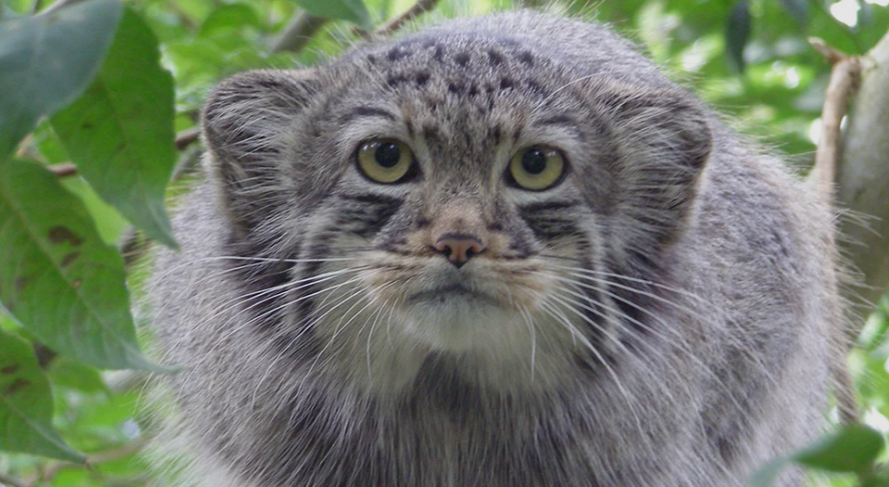
Pallas’s cat, also known as the manul, is a stocky cat with extremely dense fur, a flat face and small, low-set ears. It weighs 5 to 10 pounds and has a famously grumpy, expressive look. Its thick coat protects it from the bitter cold of the steppe. It hunts pikas, voles and gerbils and often ambushes them near burrows.
It lives in the cold, dry grasslands and rocky hills of Central Asia, including Mongolia, Kazakhstan, Russia, the Tibetan Plateau and Iran. It has been recorded at elevations above 16,000 feet. Pallas’s cat is poorly adapted to deep snow, which limits where it can live. Poisoning of pikas and hunting for fur are among its threats.
35. Jungle Cat
The jungle cat is a lanky, long-legged cat that weighs between 10 and 35 pounds, often larger than a house cat. Its plain, sandy-gray coat has few markings, and its tail is ringed near the tip. It is also known as the reed cat or swamp cat because it often lives in dense vegetation near water. Rodents, birds, frogs and fish make up much of its diet.
The jungle cat ranges from Egypt and the Middle East through Central and South Asia to Southeast Asia and southern China. It thrives in wetlands, reed beds, farmland and scrub. Ancient Egyptians mummified jungle cats, along with African wildcats, in their tombs. It is listed as least concern, though it sometimes hybridizes with domestic cats.
36. Black-Footed Cat
The black-footed cat is the smallest cat in Africa, weighing only 2.4 to 5.5 pounds. It has a spotted, tawny coat and black pads on its feet. It is a fierce and successful hunter, with a kill rate of more than 60 percent in some studies. A single cat may eat 10 to 14 small animals in a night.
It lives in the dry grasslands, scrub and semi-desert of southern Africa, including South Africa, Namibia and Botswana. During the day, it shelters in abandoned burrows and termite mounds. The species is listed as vulnerable. Rodents, small birds and insects are its main prey.
37. Sand Cat
The sand cat is a small, sandy-colored cat with a broad head, huge ears and thick fur on the soles of its feet. The fur insulates its paws from scorching sand and helps it walk without sinking. It weighs 3 to 7.5 pounds and can survive extreme temperatures. It can go long periods without drinking by getting moisture from its prey.
Sand cats live in the deserts of North Africa, the Arabian Peninsula and Central Asia, including the Sahara, Iran, Pakistan and Turkmenistan. Its large ears detect prey moving underground, and it digs out gerbils, lizards and snakes. It is one of the few cats that truly lives in sandy desert. It is listed as least concern but is difficult to study.
38. Chinese Mountain Cat
The Chinese mountain cat, also called the Chinese desert cat, is a sandy-gray cat with faint stripes and black-tipped ears. It weighs about 5 to 18 pounds. It hunts pikas, voles and other small mammals, as well as birds. Very little is known about its behavior in the wild.
This cat is found only in China, on the Qinghai-Tibet Plateau and in neighboring provinces such as Sichuan and Gansu. It lives in grasslands, shrublands and mountain meadows at high elevations. Fewer than 10,000 mature individuals are thought to remain. Poisoning campaigns against pikas and rodent control programs threaten its food supply.
39. European Wildcat
The European wildcat is a stocky, striped cat that looks like a larger, more robust tabby. It weighs about 5 to 15 pounds and has a bushy tail with a blunt black tip and several dark rings. It hunts rodents, rabbits and birds in forests and open land. In Scotland, it is nicknamed the Highland tiger.
It lives in scattered populations across Europe, including Spain, France, Germany, the Carpathians, the Balkans and the Scottish Highlands, as well as the Caucasus. Hybridization with domestic cats is a serious problem, and few genetically pure animals remain in some areas. Release efforts have begun in the Cairngorms of Scotland. The species is listed as least concern overall but is highly threatened locally.
40. African Wildcat
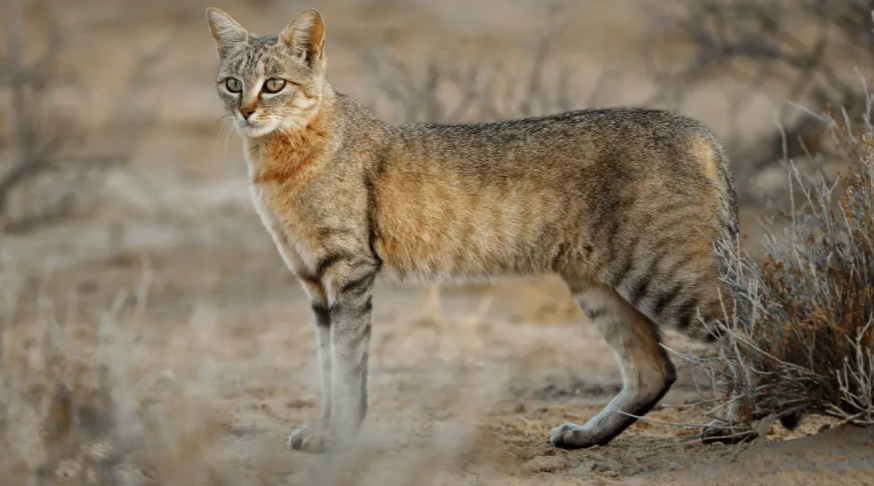
The African wildcat looks much like a domestic tabby, but it is leaner, longer-legged and sandy-gray, with reddish backs to its ears. It weighs about 5 to 15 pounds. It hunts mostly at night, taking rodents, birds, reptiles and insects. Domestic cats descend from a population of this species in the Near East, domesticated around 10,000 years ago.
The African wildcat lives across Africa, the Arabian Peninsula, the Middle East and parts of Central Asia. It inhabits savanna, steppe, scrub and semi-desert, avoiding dense rainforest. Interbreeding with domestic and feral cats is a serious threat, since it can erase the genetic identity of wild populations. It is listed as least concern.
41. Domestic Cat
The domestic cat is the most numerous cat on Earth, with hundreds of millions of animals living alongside people. Those that live without human care are called feral cats, and they have formed wild populations on nearly every continent. They hunt rodents, birds, reptiles and insects, and they can survive in surprisingly harsh conditions. Studies estimate that free-roaming cats in the United States kill between 1.3 and 4 billion birds each year.
Feral cats have been introduced to islands and mainlands almost everywhere except Antarctica. They live in cities, farmland, forests, deserts and remote islands, including Australia and New Zealand, where they are especially damaging. They have contributed to at least 63 extinctions of birds, mammals and reptiles, mostly on islands. Trap-neuter-return programs and cat containment rules are common responses to the problem.
Key Takeaways:
– Wild cats live across the world: They inhabit forests, grasslands, deserts, mountains, and wetlands across Africa, Asia, Europe, and the Americas.
– Wild cats vary greatly in size: Species range from small cats, such as the rusty-spotted cat, to large predators, including tigers and lions.
– Different species have unique features: Coat patterns, ear shapes, tail lengths, body sizes, and facial markings help distinguish wild cat species.
– Wild cats have diverse hunting strategies: Some hunt alone using stealth and ambush, while lions live in social groups and often cooperate when hunting.
– Habitat loss threatens many wild cats: Deforestation, human-wildlife conflict, poaching, and declining prey populations put several species at risk.
– Conservation helps protect wild cat populations: Habitat restoration, anti-poaching efforts, protected areas, and wildlife research are important for the long-term survival of wild cats.