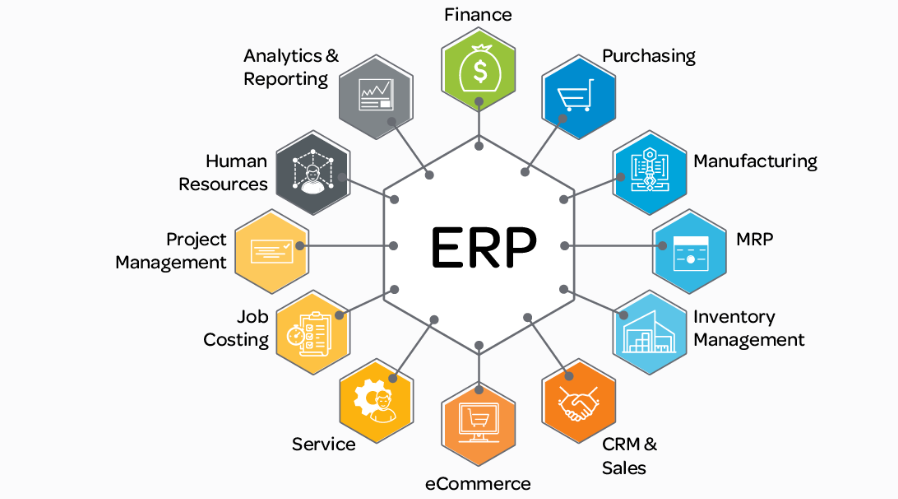
An enterprise resource planning (ERP) system is an integrated software platform that centralizes and automates the core business processes of an organization — including finance, accounting, procurement, inventory, manufacturing, human resources, and customer relationship management — into a single unified system built on a common database. By replacing disconnected departmental software silos with one integrated platform, ERP systems give organizations real-time visibility across all business functions, eliminate redundant data entry, reduce errors from manual reconciliation, and enable faster, more informed decision-making at every level of management. First emerging as Material Requirements Planning (MRP) systems in manufacturing during the 1960s and 1970s, ERP evolved into its modern form through the 1990s and today represents one of the largest and most strategically significant categories of enterprise software investment worldwide.
The global ERP software market was valued at approximately $50 billion in 2023 and is projected to exceed $130 billion by 2032, growing at a compound annual growth rate of around 11% driven by cloud adoption, digital transformation initiatives, and expanding ERP penetration among small and medium-sized enterprises. SAP and Oracle together account for over 40% of global ERP market share, with Microsoft, Infor, Sage, and a growing ecosystem of industry-specific and cloud-native vendors competing for the remainder. Implementation costs for large enterprise ERP deployments can range from $1 million to over $100 million when software licensing, customization, data migration, training, and change management are included, making ERP selection and implementation one of the highest-stakes technology decisions an organization can make.
Modern ERP systems have evolved dramatically from the monolithic on-premise software installations of the 1990s into flexible, modular, cloud-delivered platforms that can be deployed rapidly, scaled incrementally, and accessed from anywhere on any device. Cloud ERP adoption has accelerated sharply since 2020, with Gartner reporting that over 50% of new ERP deployments are now cloud-based, driven by lower upfront costs, faster implementation timelines, automatic software updates, and the ability to integrate with the broader ecosystem of cloud-based business applications through open APIs. Artificial intelligence, machine learning, and advanced analytics are increasingly embedded directly into ERP platforms, enabling capabilities such as predictive demand forecasting, automated anomaly detection in financial data, intelligent procurement recommendations, and natural language querying of business data that were impossible in earlier generations of ERP software.
SAP S/4HANA
SAP S/4HANA is the world’s leading enterprise ERP platform by revenue and market share, built on SAP’s proprietary in-memory HANA database that enables real-time processing of massive transaction volumes with analytical capabilities previously requiring separate business intelligence systems. Used by over 40,000 organizations across more than 180 countries — including the majority of Fortune 500 companies — it covers finance, supply chain, manufacturing, procurement, sales, and human resources in an integrated suite of extraordinary depth and breadth. Its complexity and implementation cost are substantial, making it most appropriate for large enterprises with the resources and technical capacity to leverage its full capabilities.
Oracle ERP Cloud (Fusion)
Oracle ERP Cloud, part of the Oracle Fusion Applications suite, is a comprehensive cloud-native ERP platform covering financials, procurement, project management, risk management, and supply chain in a unified system built for large enterprises and government organizations. It leverages Oracle’s powerful database infrastructure, embedded AI and machine learning capabilities, and deep integration with Oracle’s broader suite of business applications including HCM, CX, and supply chain planning. Oracle ERP Cloud has become a leading choice for organizations migrating from legacy Oracle E-Business Suite and PeopleSoft installations to modern cloud architecture.
Microsoft Dynamics 365
Microsoft Dynamics 365 is a modular cloud ERP and CRM platform that integrates business applications for finance, supply chain, commerce, human resources, and customer engagement within Microsoft’s broader ecosystem of Azure cloud services, Teams collaboration, Power BI analytics, and Office 365 productivity tools. Its deep integration with tools that most organizations already use daily gives it a significant adoption advantage, particularly among mid-market and enterprise organizations already invested in the Microsoft technology stack. The platform’s modular structure allows organizations to implement only the applications they need and expand incrementally as requirements grow.
SAP Business One
SAP Business One is SAP’s dedicated ERP solution for small and medium-sized enterprises, offering a significantly more accessible and affordable entry point into SAP’s ecosystem than the full S/4HANA platform while covering the core business functions — financials, sales, purchasing, inventory, production, and reporting — that growing businesses require. It is deployed in over 70,000 companies across more than 170 countries, supported by an extensive global network of value-added resellers who provide industry-specific customizations and local implementation support. Its relative simplicity compared to S/4HANA makes it implementable within weeks rather than the months or years that large enterprise ERP deployments typically require.
Oracle NetSuite
Oracle NetSuite is the world’s most widely used cloud ERP system by number of customers, designed specifically for small to mid-sized businesses and fast-growing companies that need a fully integrated, cloud-native business management platform without the cost and complexity of enterprise-tier systems. It covers financial management, inventory and order management, CRM, e-commerce, and professional services automation in a single platform accessible via web browser from anywhere, and its multi-subsidiary, multi-currency, and multi-language capabilities make it particularly popular among companies with international operations. NetSuite is especially prevalent among software companies, e-commerce businesses, and professional services firms.
Infor CloudSuite
Infor CloudSuite is a family of industry-specific cloud ERP solutions built on the AWS platform, offering purpose-built configurations for manufacturing, distribution, healthcare, hospitality, fashion, and public sector organizations that reduce the customization burden typically associated with implementing a generic ERP in an industry with specialized process requirements. Infor’s industry micro-vertical approach — with separate CloudSuite products for automotive suppliers, aerospace and defense manufacturers, food and beverage producers, and others — has earned it strong loyalty among mid-market manufacturers who find that its out-of-the-box industry functionality fits their operations more closely than horizontal ERP platforms require significant modification to match.
Epicor ERP
Epicor ERP is a manufacturing-focused enterprise resource planning platform with particular strength in discrete manufacturing, distribution, retail, and building supply industries, serving mid-market companies that need robust production management, supply chain, and financial capabilities without the scale and cost of SAP or Oracle enterprise platforms. It has deep roots in manufacturing ERP dating back to the 1970s and has evolved through multiple generations into a modern cloud-capable platform with strong shop floor control, advanced planning and scheduling, and quality management functionality. Epicor is particularly widely used among automotive parts manufacturers, industrial equipment producers, and building materials distributors.
Sage X3
Sage X3 is a mid-market ERP platform from UK-based Sage Group targeting manufacturing, distribution, and chemical companies in the 50 to 1,000 employee range, offering strong financial management, production control, and supply chain capabilities with faster implementation timelines and lower total cost of ownership than enterprise-tier competitors. It is particularly well-established in Europe, Africa, and Asia-Pacific markets where Sage has historically had strong channel partner networks, and its multi-country, multi-currency, and multi-language capabilities make it well-suited to mid-sized businesses operating across multiple geographies.
Odoo
Odoo is an open-source, modular ERP platform that has grown from a simple business application into a comprehensive suite covering CRM, sales, inventory, manufacturing, accounting, HR, e-commerce, and project management, with over 16 million users worldwide making it one of the most widely deployed business software platforms on earth. Its open-source foundation allows unlimited customization without licensing fees for the community edition, while the enterprise edition adds more advanced features, hosting, and support for a subscription fee that remains significantly below proprietary ERP alternatives. Odoo’s modular structure — allowing businesses to start with one or two applications and add more as needed — has made it particularly popular among small and growing businesses seeking affordable, flexible ERP functionality.
IFS Applications
IFS Applications is an enterprise ERP platform with particular strength in asset-intensive industries — aerospace and defense, energy and utilities, construction and engineering, and field service management — where the ability to manage complex assets, projects, and service operations alongside conventional ERP functions is a critical requirement. Developed by the Swedish company Industrial and Financial Systems, IFS has built a strong reputation for deep functionality in project-based and asset lifecycle management scenarios, and its relatively streamlined implementation approach compared to SAP and Oracle has earned it loyal customers in the mid-to-large enterprise segment across more than 60 countries.
Syspro
Syspro is a manufacturing and distribution-focused ERP platform designed specifically for mid-market companies, offering strong functionality in discrete and process manufacturing, inventory management, and supply chain operations with a relatively straightforward implementation process and accessible total cost of ownership. Founded in South Africa in 1978, Syspro has a particularly strong installed base in South Africa, the United States, Canada, Australia, and the UK, and its industry focus on food and beverage, electronics, automotive components, and industrial machinery manufacturing has given it deep domain-specific functionality in these sectors.
Acumatica
Acumatica is a cloud-native ERP platform designed for small and mid-market businesses, distinguished by its consumption-based pricing model — which charges based on system resources used rather than per user — making it economically attractive for organizations with large numbers of occasional or light users who would face prohibitive per-seat licensing costs on traditional ERP platforms. It covers financials, project accounting, distribution, manufacturing, construction, and retail in industry-specific editions, and its modern REST API architecture enables straightforward integration with the broader ecosystem of cloud business applications. Acumatica has been one of the fastest-growing ERP vendors in the mid-market segment over the past decade.
Workday Financial Management
Workday Financial Management is a cloud-native ERP platform for financial management and human capital management, built from the ground up on a modern, object-oriented data model that enables real-time reporting and analytics without the batch processing delays characteristic of older ERP architectures. Initially focused on HR and HCM, Workday has expanded its financial management capabilities significantly and is now a primary ERP choice for large enterprises in professional services, higher education, healthcare, and technology industries where workforce costs are the dominant financial management challenge. Its unified finance and HR data model provides uniquely integrated visibility into labor costs and workforce productivity.
Unit4 ERP
Unit4 ERP is a people-centric enterprise resource planning platform specifically designed for service-oriented organizations — professional services firms, public sector agencies, universities, and nonprofit organizations — where project management, resource planning, and grant or fund accounting are more central to operations than the manufacturing and inventory management functionality that dominates most ERP platforms. Its self-driving ERP vision, incorporating AI-powered automation of routine administrative tasks, aims to reduce the manual data entry burden on professional staff and free them to focus on higher-value work, and it is particularly well-established in Northern Europe where Unit4 has its roots.
Deltek
Deltek is a project-based ERP platform purpose-built for project-driven businesses — government contractors, architecture and engineering firms, consulting companies, and marketing agencies — where project cost tracking, government compliance, earned value management, and resource planning are the core operational requirements rather than the manufacturing and inventory management functions central to most horizontal ERP platforms. It is the dominant ERP vendor among US government contractors, where compliance with Federal Acquisition Regulation (FAR) cost accounting standards is a non-negotiable operational requirement that generic ERP platforms struggle to meet without extensive customization.
IQMS (Dassault Systèmes DELMIAworks)
Now branded as DELMIAworks following its acquisition by Dassault Systèmes, IQMS is a manufacturing ERP platform with particularly deep real-time shop floor integration, connecting ERP business processes directly to machine monitoring, production scheduling, and quality management on the factory floor in ways that most ERP platforms achieve only through third-party manufacturing execution system integrations. It is primarily used by plastics, rubber, and discrete manufacturers in the automotive and medical device supply chains who require tight integration between business planning and real-time production visibility.
Plex Manufacturing Cloud
Plex Manufacturing Cloud is a cloud-native ERP and manufacturing execution system (MES) platform designed specifically for discrete manufacturers — particularly in the automotive, aerospace, food and beverage, and industrial equipment sectors — that combines traditional ERP business functions with deep shop floor control, quality management, and supplier management in a single cloud platform. Its cloud-native architecture, built as a true multi-tenant SaaS platform from inception rather than a legacy system retrofitted to the cloud, gives it modern integration and deployment characteristics that attract manufacturers looking to replace aging on-premise ERP systems with a more agile cloud alternative.
QAD Adaptive ERP
QAD Adaptive ERP is a manufacturing-focused cloud ERP platform with particular strength in global discrete manufacturing companies across automotive, life sciences, consumer products, food and beverage, and high-tech industries that require strong multi-site, multi-currency, and regulatory compliance capabilities across complex international manufacturing operations. QAD’s adaptive manufacturing enterprise model emphasizes operational agility — the ability to rapidly reconfigure business processes in response to changing customer requirements, supply chain disruptions, or regulatory changes — as the central value proposition of its ERP platform.
Sage Intacct
Sage Intacct is a cloud-native financial management platform that has emerged as a leading accounting and financial ERP solution for small to mid-sized businesses in professional services, nonprofits, healthcare, hospitality, and software companies, recognized by the American Institute of CPAs (AICPA) as its preferred financial management solution. While more narrowly focused on financial management than full-suite ERP platforms, its best-in-class general ledger, multi-entity consolidation, revenue recognition, and reporting capabilities — combined with open API integration with best-of-breed applications for CRM, payroll, and operations — make it a compelling alternative to broader but less financially sophisticated ERP suites for finance-driven organizations.
Priority ERP
Priority ERP is a comprehensive, highly flexible ERP platform developed by Israeli software company Priority Software, serving small to large enterprises across manufacturing, distribution, retail, professional services, and construction with a full suite of business management applications at a price point and implementation complexity significantly below SAP and Oracle. It is particularly strong in Israel, the UK, and parts of Europe and Asia, and its open, fully programmable architecture allows deep customization without the need for specialized development environments, making it popular among organizations with unique process requirements that standard ERP configurations cannot accommodate without modification.
Aptean ERP
Aptean is a portfolio of industry-specific ERP solutions — including Ross ERP for process manufacturing, Centric for fashion and apparel, Catalyst for food and beverage, and several others — each purpose-built for a specific industry vertical with out-of-the-box functionality that addresses the unique regulatory, production, and supply chain requirements of that sector. Aptean’s strategy of acquiring and developing deep industry-specific ERP products rather than competing as a horizontal platform has built a loyal customer base among mid-market manufacturers and distributors who find that industry-specific functionality reduces implementation time and customization costs compared to generic ERP alternatives.
Rootstock ERP
Rootstock ERP is a cloud manufacturing ERP platform built natively on the Salesforce platform, making it uniquely suited to manufacturing companies that are already using Salesforce CRM and want to extend Salesforce’s data model and user experience into their back-office manufacturing, supply chain, and financial operations without managing a separate ERP system and integration layer. Its native Salesforce architecture means that customer, order, and product data flows seamlessly between CRM and ERP without custom integration, and users work in a single Salesforce environment across sales, manufacturing, and operations — a significant user experience advantage over conventional ERP platforms.
Global Shop Solutions
Global Shop Solutions is a manufacturing-focused ERP platform designed specifically for job shops, make-to-order manufacturers, and custom fabricators — small to mid-sized discrete manufacturers that produce highly variable, customer-specific products in low volumes where shop floor scheduling, job costing, and quoting accuracy are the most critical operational capabilities. Its single-database, fully integrated architecture covers estimating and quoting, job scheduling, shop floor data collection, inventory, purchasing, and accounting in a platform specifically engineered for the operational realities of custom manufacturing rather than adapted from a distribution or process manufacturing ERP.
MYOB Acumatica (formerly MYOB Advanced)
MYOB Acumatica is the Australian and New Zealand localization of the Acumatica cloud ERP platform, distributed by MYOB — one of Australia’s largest business software companies — with deep local compliance features for Australian and New Zealand tax, payroll, and regulatory requirements built into the standard product. It serves mid-market businesses across distribution, manufacturing, professional services, and retail in Australia and New Zealand seeking a cloud ERP platform with strong local support, established local partner networks, and out-of-the-box compliance with Australian GST, BAS reporting, and single touch payroll requirements.
Kinetic (Epicor Kinetic)
Epicor Kinetic is the cloud-native evolution of Epicor’s long-established manufacturing ERP platform, redesigned with a modern browser-based user interface, microservices architecture, and low-code customization tools that allow manufacturers to adapt the platform to their specific processes without traditional ERP programming. It retains the deep manufacturing functionality — advanced planning and scheduling, MES integration, multi-site management, quality management — that made Epicor a leading mid-market manufacturing ERP, while adding the deployment flexibility, integration capabilities, and modern user experience that cloud-native competitors offer.
JD Edwards EnterpriseOne
JD Edwards EnterpriseOne is Oracle’s hybrid ERP platform designed for asset-intensive industries — manufacturing, distribution, construction, real estate, and energy — that require robust on-premise or private cloud deployment options alongside the deep industry functionality that made JD Edwards one of the most widely implemented manufacturing ERP systems of the 1990s and 2000s. It remains actively developed and widely used, particularly in the agricultural, construction, and discrete manufacturing sectors, and Oracle has invested substantially in modernizing its user interface, cloud integration capabilities, and orchestration framework to extend its relevance for current and future deployments.
Visibility ERP
Visibility ERP is a manufacturing ERP platform specifically designed for engineer-to-order (ETO) and make-to-order (MTO) manufacturers — companies that design and build highly custom products to individual customer specifications, such as specialized industrial equipment, defense systems, and custom machinery — where standard ERP platforms designed for repetitive or configure-to-order manufacturing struggle to manage the complexity of highly variable, project-based production processes. Its core strength lies in integrating engineering change management, project-based costing, complex bill of materials management, and long-cycle production scheduling in a single platform tailored to the ETO manufacturing model.
Infor M3
Infor M3 is a cloud ERP platform with particular strength in process manufacturing industries — food and beverage, fashion, chemicals, and equipment rental — offering deep industry-specific functionality including recipe and formula management, catch weight processing, lot traceability, and seasonal buying cycle management that generic ERP platforms require extensive customization to replicate. It is widely used by mid-to-large manufacturers in Europe and North America, and its multi-site, multi-company, and multi-currency capabilities make it well-suited to internationally operating manufacturers with complex organizational structures and diverse regulatory compliance requirements across multiple jurisdictions.
Sage 300
Sage 300 is a mid-market ERP platform from Sage Group targeting distribution, manufacturing, and services companies in the 10 to 200 employee range with strong multicurrency financial management, inventory control, purchasing, and order entry capabilities across a modular architecture that allows businesses to license only the functional modules they require. Particularly well-established in Canada, Southeast Asia, the Middle East, and Africa, Sage 300 has a long history and extensive local partner network in these markets that provides strong implementation support and local regulatory compliance expertise for businesses operating in these regions.
Cetec ERP
Cetec ERP is a cloud-native manufacturing ERP platform designed specifically for small to mid-sized contract manufacturers, printed circuit board assemblers, and electronics manufacturers, offering shop floor control, inventory management, quality management, and financial integration in a browser-based platform at a subscription price point accessible to smaller manufacturing operations that cannot justify the implementation costs of mid-market ERP platforms. Its industry-specific focus on electronics and contract manufacturing — including native support for IPC quality standards, RoHS compliance tracking, and component traceability — has built a loyal niche customer base in the electronics manufacturing services sector.