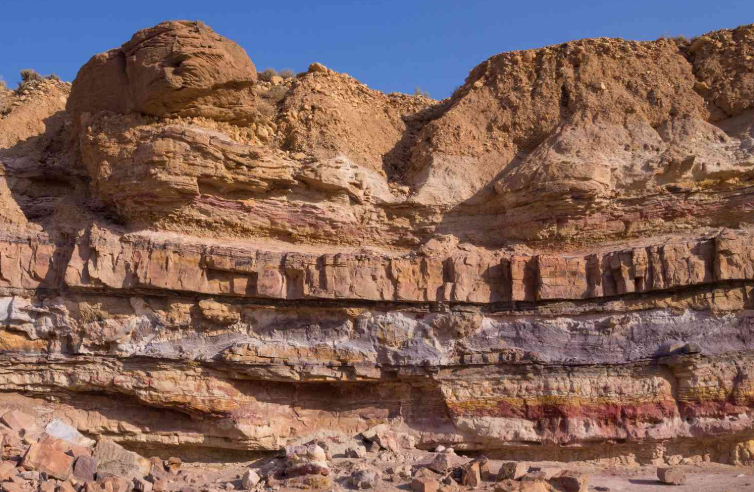
Sedimentary rocks form at or near the Earth’s surface through the accumulation, compaction, and cementation of mineral and organic particles, making them fundamentally different from igneous and metamorphic rocks, which form through processes deep within the crust or mantle. These rocks cover roughly three-quarters of the Earth’s land surface, despite making up only a small fraction of the crust’s total volume, because they form a relatively thin but extensive blanket over the older igneous and metamorphic rocks that constitute most of the crust’s mass. Sedimentary rocks are unique among the major rock categories in their capacity to preserve direct evidence of past environments and the organisms that lived within them.
The formation of sedimentary rocks begins with the weathering and erosion of pre-existing rocks, which breaks down solid rock into smaller fragments and dissolved components that can be transported by water, wind, ice, or gravity to a site of deposition. Over time, layers of sediment accumulate, and the weight of overlying material combined with the precipitation of mineral cement from groundwater gradually transforms loose sediment into solid rock through the process of lithification. This entire sequence — weathering, erosion, transport, deposition, and lithification — can take place over timescales ranging from years to millions of years depending on the specific environment involved.
Sedimentary rocks are broadly classified into three major categories based on the nature of the material from which they form. Clastic sedimentary rocks form from fragments of pre-existing rocks and minerals, ranging in size from microscopic clay particles to large boulders. Chemical sedimentary rocks form when minerals precipitate directly from solution, often as water evaporates or as dissolved chemicals become saturated beyond their solubility limits. Organic or biochemical sedimentary rocks form from the accumulated remains of plants and animals, with the carbon-rich material in these rocks often retaining traces of the biological processes that created it.
The layered structure characteristic of most sedimentary rocks, known as stratification or bedding, records the sequential deposition of sediment over time, with each layer potentially representing a distinct depositional event or environmental condition. This layering, combined with the fossils, sedimentary structures, and chemical signatures that sedimentary rocks often contain, makes them invaluable to geologists seeking to reconstruct ancient environments, climates, and the history of life on Earth. Exploring the different types of sedimentary rocks reveals the remarkable variety of processes by which loose sediment can be transformed into the solid rock that forms so much of the planet’s surface.
Sandstone
Sandstone is a clastic sedimentary rock composed primarily of sand-sized mineral grains, most commonly quartz, that have been cemented together by minerals such as silica, calcite, or iron oxide precipitated from groundwater. It forms in an enormous variety of environments, including deserts, beaches, river channels, and shallow marine settings.
The internal structures preserved within sandstone, including ripple marks, cross-bedding, and graded layers, provide geologists with detailed information about the currents and conditions present at the time the sand was deposited. Sandstone’s moderate hardness and attractive appearance, combined with its tendency to form in distinct, easily quarried layers, have made it a widely used building material throughout history.
Shale
Shale is a fine-grained clastic sedimentary rock formed from the compaction of clay and silt particles that were deposited in low-energy environments where fine sediment could settle out of suspension slowly, such as deep lakes, lagoons, and offshore marine basins. Its defining characteristic is a tendency to split into thin, parallel layers.
This fissile, layered structure, known as lamination, reflects the way fine sediment accumulated in thin horizontal sheets over long periods of time, often preserving delicate fossils and organic material within its layers. Shale has become economically significant as a source rock for oil and natural gas, with advances in hydraulic fracturing technology enabling extraction from shale formations that were previously considered uneconomical.
Conglomerate
Conglomerate is a clastic sedimentary rock composed of rounded fragments, called clasts, that are larger than sand grains and have been cemented together within a finer-grained matrix. The rounded shape of these fragments indicates that they were transported and abraded by water or other agents before being deposited.
The size, roundness, and composition of the clasts within a conglomerate provide clues about the distance and energy of transport involved, with well-rounded clasts typically indicating transport over considerable distances by fast-flowing water. Conglomerates often form in high-energy environments such as river channels, alluvial fans, and beaches where strong currents can move larger particles.
Breccia
Breccia is a clastic sedimentary rock similar to conglomerate but composed of angular rather than rounded fragments, indicating that the constituent clasts were not transported far enough to become rounded before deposition. This angularity is the key feature that distinguishes breccia from conglomerate.
Sedimentary breccias commonly form through processes such as the collapse of cave systems, rockfalls at the base of cliffs, or the rapid deposition of material during landslides and debris flows, where angular rock fragments are deposited close to their source. The angular shapes preserved within breccia can provide valuable information about the type of event that produced the deposit.
Siltstone
Siltstone is a clastic sedimentary rock composed of particles intermediate in size between sand and clay, representing a grain size category known as silt. Siltstone typically lacks the fine lamination of shale while also lacking the visible grains characteristic of sandstone, giving it a somewhat featureless appearance.
Siltstone often forms in environments with moderate energy levels, such as floodplains, deltas, and offshore marine settings beyond the reach of strong wave action, where silt-sized particles can settle out of suspension. Distinguishing siltstone from very fine sandstone or shale can sometimes require close examination, as the grain size differences involved are at the boundary of what is easily visible to the naked eye.
Limestone
Limestone is a chemical or biochemical sedimentary rock composed primarily of calcium carbonate, most commonly forming through the accumulation of the skeletal remains of marine organisms such as corals, mollusks, and microscopic plankton on the floor of shallow seas. Limestone is one of the most abundant sedimentary rocks and forms the parent material for karst landscapes worldwide.
The biological origin of most limestone means it frequently contains abundant and well-preserved fossils, making limestone formations valuable for reconstructing ancient marine ecosystems and for correlating rock layers across different regions. Limestone’s susceptibility to dissolution by slightly acidic water has shaped some of the world’s most extensive cave systems and distinctive surface landscapes over geological time.
Chalk
Chalk is a soft, fine-grained variety of limestone composed almost entirely of the microscopic skeletal remains of single-celled marine algae called coccolithophores, which accumulated in enormous quantities on the floors of warm, shallow seas during certain periods of Earth’s history. Its extremely fine, uniform texture distinguishes chalk from coarser forms of limestone.
The famous white cliffs found along sections of the English Channel coastline are composed of chalk deposited during the Cretaceous period, a time when much of Europe was covered by warm, shallow seas teeming with these microscopic organisms. Chalk’s softness and porosity have given it practical applications ranging from writing materials to agricultural soil amendments used to neutralize acidic soils.
Dolostone
Dolostone is a chemical sedimentary rock composed primarily of the mineral dolomite, a calcium magnesium carbonate that typically forms either through the direct precipitation of dolomite or through the alteration of existing limestone by magnesium-rich fluids in a process called dolomitization. This process can occur during or after the original deposition of the rock.
Dolostone is generally more resistant to weathering and chemical dissolution than ordinary limestone, often forming prominent ridges and cliffs in landscapes where the two rock types occur together in the same sequence. The Dolomite mountains of northern Italy, from which both the mineral and the rock take their name, showcase the dramatic pale cliffs and peaks that dolostone can form when exposed at the surface.
Rock Salt (Halite)
Rock salt, also known as halite, is a chemical sedimentary rock composed of the mineral sodium chloride, forming when bodies of saltwater evaporate completely, leaving behind the dissolved salts that were present in the water as a solid deposit. This process is known as evaporation and the resulting deposits are called evaporites.
Thick deposits of rock salt can accumulate in basins where seawater has been repeatedly trapped and evaporated over long periods, sometimes creating salt layers hundreds or even thousands of meters thick that can later deform into distinctive structures called salt domes due to the relatively low density of salt compared to surrounding rocks. Rock salt deposits are economically important both as a source of salt for human consumption and industrial use and as potential storage sites for hydrocarbons and other materials.
Gypsum
Gypsum is a chemical sedimentary rock composed of hydrated calcium sulfate, forming through the evaporation of water containing dissolved calcium and sulfate ions, typically in restricted marine basins or arid lake environments where evaporation rates exceed water input. Like rock salt, gypsum is classified as an evaporite deposit.
Gypsum deposits often form in association with rock salt and other evaporite minerals, with the specific sequence of minerals that precipitate reflecting the order in which different dissolved salts reach their saturation points as water evaporates. Gypsum has significant economic importance as the primary raw material for plaster and drywall, two of the most widely used materials in modern construction.
Coal
Coal is an organic sedimentary rock formed from the compressed and chemically altered remains of plant material that accumulated in ancient swamp environments, where waterlogged, oxygen-poor conditions prevented the complete decomposition of organic matter. Over millions of years, burial and increasing pressure transform this plant material into coal.
The progressive transformation from plant debris to coal occurs through several recognized stages, beginning with peat and progressing through lignite and bituminous coal to anthracite, with each stage representing increasing carbon concentration and energy content. Coal deposits have played a foundational role in industrialization worldwide, though concerns about their environmental impact when burned have driven a global shift toward alternative energy sources.
Coquina
Coquina is a coarse-grained sedimentary rock composed almost entirely of loosely cemented shell fragments and other marine debris, typically forming along beaches and shorelines where wave action concentrates and breaks apart the shells of mollusks and other shelled organisms. Its composition gives coquina a distinctive coarse, fossiliferous appearance.
The relatively weak cementation typical of coquina makes it one of the softer and more porous sedimentary rocks, a characteristic that has nonetheless made it useful as a building material in certain coastal regions where it occurs in sufficient quantity. Coquina deposits provide clear evidence of high-energy shoreline environments where shell material has been concentrated by wave and current action.
Banded Iron Formation
A banded iron formation is a distinctive sedimentary rock characterized by alternating layers of iron-rich minerals and silica-rich chert, forming almost exclusively during a specific period of Earth’s early history when the chemistry of the oceans and atmosphere was dramatically different from today. These formations represent some of the oldest sedimentary rocks on the planet.
The formation of banded iron deposits is closely linked to the gradual oxygenation of Earth’s atmosphere by early photosynthetic organisms, which caused dissolved iron that had been abundant in the ancient oceans to precipitate out as iron oxide minerals in rhythmic layers. Banded iron formations represent the primary source of the world’s iron ore, making them economically vital as well as scientifically significant for understanding the early evolution of Earth’s atmosphere and oceans.
Arkose
Arkose is a clastic sedimentary rock similar to sandstone but distinguished by its high content of feldspar minerals, typically exceeding 25 percent of the rock’s composition, in addition to quartz. This high feldspar content gives arkose a distinctive pink, tan, or reddish coloration.
The abundance of feldspar in arkose indicates that the rock was derived from the rapid erosion of granite or similar feldspar-rich rocks under conditions where chemical weathering had insufficient time to break down the feldspar before burial, since feldspar is more chemically unstable than quartz. Arkose deposits often form near mountain fronts where rapid uplift and erosion bring large volumes of granite-derived sediment into nearby basins.