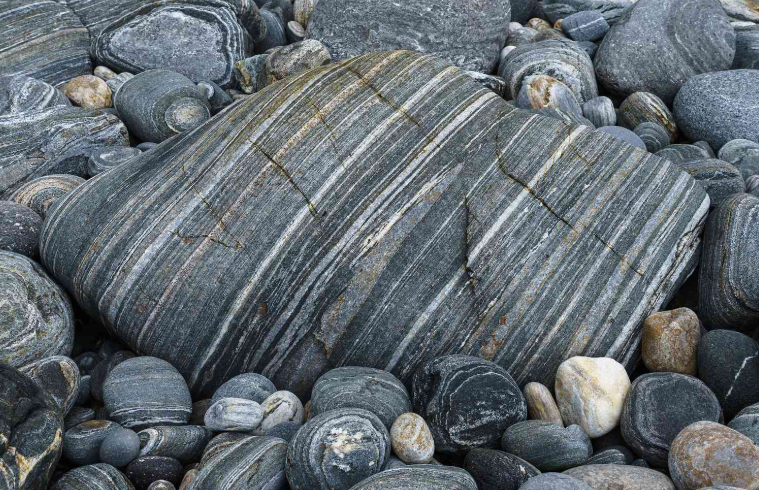
Metamorphic rocks form when pre-existing rocks — whether igneous, sedimentary, or even other metamorphic rocks — are transformed through the application of heat, pressure, or chemically active fluids, without melting completely into magma. This transformation, known as metamorphism, alters the mineral composition, texture, and structure of the original rock, often producing entirely new minerals that are stable only under the specific temperature and pressure conditions to which the rock has been subjected. The word metamorphic derives from Greek roots meaning to change form, an apt description of the often dramatic transformations these rocks undergo.
Metamorphism occurs primarily in two broad settings, each producing characteristically different rock types. Regional metamorphism affects large volumes of rock over extensive areas, typically occurring deep within mountain belts where the collision of tectonic plates generates both intense heat and directional pressure simultaneously. Contact metamorphism, by contrast, occurs in a much more localized zone surrounding an intrusion of magma, where heat from the molten rock alters the surrounding country rock without the strong directional pressure characteristic of regional settings.
The texture of a metamorphic rock provides crucial information about the conditions under which it formed, with the presence or absence of foliation — a layered or banded arrangement of minerals — representing one of the most fundamental distinctions in metamorphic classification. Foliated metamorphic rocks form when platy or elongated minerals such as mica become aligned perpendicular to the direction of applied pressure, creating the layered appearance characteristic of rocks like slate, schist, and gneiss. Non-foliated metamorphic rocks lack this directional alignment, often because they formed under conditions without strong directional pressure or because their constituent minerals do not naturally form platy or elongated crystals.
Metamorphic rocks occupy a crucial position in the rock cycle, representing the transformation pathway between the other major rock categories and recording within their structure a history of geological events that may have occurred deep within mountain ranges over millions of years. Studying the different types of metamorphic rocks allows geologists to reconstruct the temperature and pressure conditions a region has experienced, providing a window into the tectonic history of mountain belts and the deep processes that have shaped the continents over geological time.
Slate
Slate is a fine-grained, foliated metamorphic rock that forms through the low-grade regional metamorphism of shale or mudstone, in which the original clay minerals recrystallize and become aligned under directional pressure to produce a rock with pronounced slaty cleavage. This cleavage allows slate to be split into thin, smooth, flat sheets.
The orientation of slate’s cleavage planes reflects the direction of the pressure applied during metamorphism rather than the original bedding of the parent sedimentary rock, meaning these two surfaces can occur at different angles within the same piece of slate. Slate’s durability and natural tendency to split into flat sheets have made it valuable for roofing, flooring, and writing surfaces throughout history.
Phyllite
Phyllite is a fine-grained, foliated metamorphic rock representing an intermediate grade of metamorphism between slate and schist, characterized by a distinctive silky or satiny sheen on its foliation surfaces. This sheen results from the growth of fine mica crystals that have become aligned but remain too small to be individually visible.
Phyllite often displays a crinkled or wrinkled surface texture, known as crenulation, that records the folding deformation the rock experienced during its formation. As metamorphic grade increases beyond phyllite, the mica crystals continue to grow larger, eventually producing the coarser foliation characteristic of schist.
Schist
Schist is a medium to coarse-grained, strongly foliated metamorphic rock characterized by abundant platy minerals, particularly mica, that have grown large enough to be clearly visible and that give the rock a pronounced tendency to split along these mineral-rich layers. This texture is known as schistosity.
The specific minerals present within a schist — which can include garnet, staurolite, kyanite, and other index minerals — form only within particular temperature and pressure ranges, allowing geologists to use the mineral assemblage of a schist to determine the precise metamorphic conditions under which it formed. Schist commonly forms through the progressive metamorphism of shale at intermediate to high grades.
Gneiss
Gneiss is a coarse-grained, high-grade metamorphic rock characterized by a distinctive banded texture in which light-colored bands rich in quartz and feldspar alternate with dark-colored bands rich in minerals such as biotite and hornblende. This banding, called gneissic texture, represents one of the most visually striking forms of metamorphic foliation.
Gneiss can form from the high-grade metamorphism of a wide range of parent rocks, including granite, sandstone, and shale, with the resulting mineral composition reflecting both the original rock’s chemistry and the intense conditions of metamorphism it experienced. Gneiss often occurs in the deeply eroded cores of ancient mountain belts, representing some of the oldest exposed rocks on the continents.
Marble
Marble is a coarse-grained, non-foliated metamorphic rock that forms when limestone or dolostone is subjected to heat and pressure, causing the original calcium carbonate minerals to recrystallize into a denser network of interlocking calcite or dolomite crystals. This recrystallization typically destroys any fossils present in the original rock.
The pure white marble prized by sculptors throughout history forms from limestone with very few impurities, while the colorful veining seen in many ornamental marbles results from mineral impurities such as iron oxides or clay that were present in the original rock and became concentrated along bands during metamorphism. Marble’s relative softness makes it workable with hand tools, a property exploited by artists for millennia.
Quartzite
Quartzite is a hard, non-foliated metamorphic rock that forms when sandstone composed primarily of quartz grains is subjected to sufficient heat and pressure to cause the individual grains to recrystallize and fuse into a dense, interlocking mosaic. This process eliminates the pore spaces and grain boundaries present in the original sandstone.
The resulting rock is significantly more resistant to weathering than ordinary sandstone, often forming prominent ridges, hills, and resistant outcrops in landscapes where softer rocks have eroded away around it. Quartzite’s hardness, while making it an excellent and durable building material, also makes it considerably more difficult to cut and shape than many other stone types.
Hornfels
Hornfels is a fine-grained, non-foliated metamorphic rock that forms through contact metamorphism, in which heat from a nearby igneous intrusion bakes the surrounding country rock without the directional pressure that produces foliated textures. The result is a hard, dense rock with a uniform, splintery texture.
Hornfels typically forms in a zone called an aureole that surrounds an igneous intrusion, with the intensity of metamorphism — and the resulting mineral assemblage — decreasing with increasing distance from the heat source. The specific minerals found in hornfels can provide a record of the temperatures reached at different distances from the intrusion that caused the metamorphism.
Amphibolite
Amphibolite is a medium to coarse-grained metamorphic rock composed primarily of amphibole minerals, particularly hornblende, along with plagioclase feldspar, typically forming from the metamorphism of basalt or gabbro under intermediate to high-grade conditions. Its composition reflects the iron and magnesium-rich chemistry of its mafic parent rocks.
Amphibolite often displays a weak to moderate foliation caused by the alignment of elongated amphibole crystals, though this foliation is typically less pronounced than that seen in schist or gneiss. The presence of amphibolite within a sequence of otherwise different rock types can indicate that a body of basaltic or gabbroic rock — perhaps representing an ancient lava flow or intrusion — has been incorporated into a metamorphic terrain.
Migmatite
Migmatite is a composite metamorphic rock that represents the boundary between metamorphism and igneous processes, displaying a mixture of metamorphic and igneous-looking components that formed when rock was heated to the point of partial melting without becoming fully molten. The resulting rock contains both unmelted metamorphic material and once-molten material that has since crystallized.
The striking, often swirled or banded appearance of migmatite reflects the complex interplay between the solid and partially molten portions of the rock during its formation, with the melted portions typically appearing as lighter-colored bands or pods within a darker, more typically metamorphic matrix. Migmatites form under the highest-grade metamorphic conditions, typically in the deep roots of mountain belts where temperatures approach those required for rock to begin melting.
Eclogite
Eclogite is a dense, coarse-grained, non-foliated metamorphic rock that forms under exceptionally high pressures, typically associated with the subduction of oceanic crust to depths of many tens of kilometers within the Earth’s mantle. Its formation requires conditions far more extreme than those involved in producing most other metamorphic rocks.
The characteristic mineralogy of eclogite — bright red garnet crystals set within a matrix of green sodium-rich pyroxene called omphacite — creates a visually distinctive rock that provides direct evidence of the extreme depths to which the original rock was subducted before being returned to the surface. Eclogites are of great scientific interest for what they reveal about deep subduction processes and the fate of oceanic crust within the mantle.
Serpentinite
Serpentinite is a metamorphic rock composed primarily of serpentine group minerals, forming through the hydrothermal alteration of ultramafic rocks such as peridotite, typically in settings where oceanic mantle rocks have interacted with water at relatively low temperatures. This alteration process is known as serpentinization.
Serpentinite often has a mottled green to black appearance with a smooth or waxy texture, and its formation can be associated with the release of hydrogen gas through chemical reactions between water and the original ultramafic minerals, a process of interest to scientists studying the potential for life in deep subsurface environments. Serpentinite is commonly found in regions where slices of oceanic crust and mantle, known as ophiolites, have been thrust onto continental margins.
Mylonite
Mylonite is a fine-grained metamorphic rock that forms through intense mechanical deformation along fault zones, in which the original minerals of the parent rock are crushed, stretched, and recrystallized through ductile flow rather than brittle fracturing. This process occurs at depths where rocks deform plastically rather than breaking.
The resulting rock typically displays a fine, streaky banding that records the direction and intensity of the shearing motion that occurred along the fault, providing geologists with valuable information about the kinematics of fault zones at depth. Mylonites are often found along major fault zones where significant horizontal displacement has occurred between adjacent blocks of crust.
Greenschist
Greenschist is a fine to medium-grained, foliated metamorphic rock that takes its name and characteristic color from the green minerals — chlorite, epidote, and actinolite — that form through the low to intermediate-grade metamorphism of basaltic rocks. This green coloration distinguishes greenschist from most other common metamorphic rock types.
Greenschist represents a specific metamorphic grade within a broader sequence of progressive metamorphism that mafic rocks can undergo, occurring at temperatures and pressures intermediate between those that produce minimal alteration of basalt and those that produce amphibolite at higher grades. The greenschist facies, a term geologists use to describe the broader range of conditions under which this rock type forms, is widely used as a reference point for characterizing metamorphic conditions in many geological settings.
Blueschist
Blueschist is a fine-grained metamorphic rock characterized by its distinctive blue color, derived from the blue amphibole mineral glaucophane, forming under relatively high-pressure but comparatively low-temperature conditions typically associated with subduction zones. This combination of high pressure and low temperature is relatively unusual in metamorphic settings.
The specific pressure and temperature conditions required to form blueschist mean that this rock type is relatively rare and is typically found in regions where subduction has occurred relatively recently in geological terms, as the distinctive blueschist mineral assemblage tends to be unstable and transform into other mineral assemblages if the rock is subsequently subjected to higher temperatures. The presence of blueschist in a geological terrain provides important evidence of past subduction zone processes.