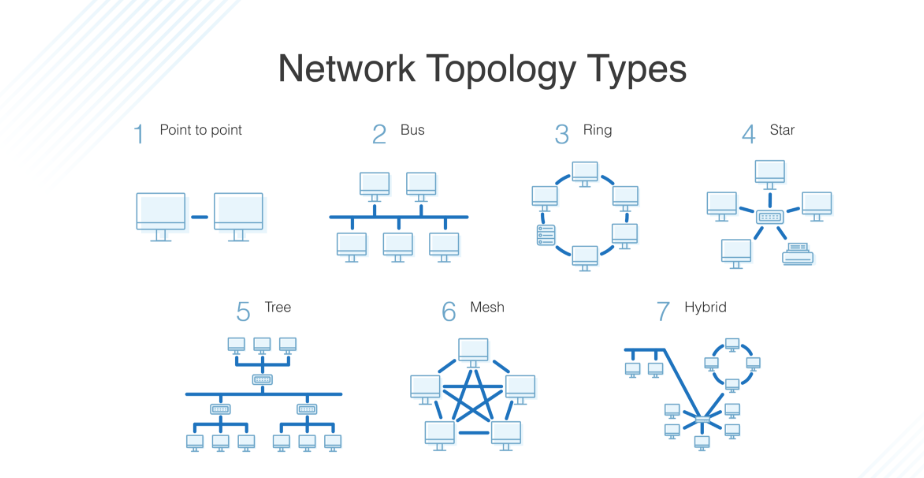
Network topology refers to the arrangement and interconnection of nodes, links, and devices within a computer network — the physical or logical structure that defines how data flows between devices and how the network behaves under normal operation and failure conditions. Understanding network topology is fundamental to network design, performance optimization, fault tolerance planning, and security architecture, as the chosen topology profoundly influences every aspect of how a network functions, scales, and responds to problems.
The concept of network topology encompasses two distinct but related perspectives. Physical topology describes the actual physical layout of cables, devices, and connections — the tangible hardware arrangement that an engineer would encounter when physically inspecting a network installation. Logical topology describes the path that data actually follows through the network, which may differ significantly from the physical arrangement. A network can be physically arranged as a star but operate logically as a bus, for example — a distinction that is important for understanding network behavior and troubleshooting problems.
The global network infrastructure market reflects the enormous scale and importance of network design decisions. The enterprise networking market was valued at approximately $67 billion in 2023, with data center networking, campus networking, and wide-area networking each representing significant segments. The rapid growth of cloud computing, software-defined networking, and the Internet of Things is driving fundamental changes in how networks are designed and what topologies are most appropriate for modern workloads. The following 12 topology types represent the full spectrum of network architectural approaches used in contemporary computing environments.
1. Bus Topology
In a bus topology, all devices are connected to a single central cable — called the bus or backbone — and communicate by transmitting data that travels the length of the cable in both directions, with all devices receiving every transmission and accepting only those addressed to them. Bus topology was the foundation of early Ethernet networks using coaxial cable, and its simplicity made it the dominant network architecture of the 1980s and early 1990s. The critical weakness of bus topology is that a single break anywhere in the backbone cable brings down the entire network, and performance degrades significantly as more devices are added because all devices share the same transmission medium and must take turns transmitting to avoid collisions.
2. Star Topology
In a star topology, all devices connect individually to a central hub or switch, with no direct connections between end devices — all communication passes through the central device, which forwards data to the appropriate destination. Star topology is by far the most widely deployed network topology in modern local area networks, largely replacing bus topology from the mid-1990s onward as the cost of Ethernet switches fell dramatically. The central switch provides significant advantages over the bus: a failure of any individual device or cable affects only that device rather than the entire network, and modern switches allow simultaneous full-duplex communication between multiple device pairs without the collision problems of shared-medium bus networks.
3. Ring Topology
In a ring topology, devices are connected in a closed circular chain — each device connects to exactly two neighbors, one on either side — and data travels around the ring in one direction (or both directions in a dual-ring configuration) until it reaches its destination. IBM’s Token Ring network technology, which dominated many enterprise networks in the 1980s, used a logical ring topology in which a special control packet called a token circulated continuously around the ring and a device could only transmit when it possessed the token — a collision-free access method with predictable, deterministic performance characteristics well-suited to time-sensitive industrial and manufacturing applications. Ring topologies are vulnerable to single-point failure — a break anywhere in the ring interrupts the entire network unless a dual-ring or automatic bypass mechanism is implemented.
4. Mesh Topology
In a full mesh topology, every device in the network has a direct, dedicated connection to every other device, providing the maximum possible redundancy and fault tolerance — any single link can fail without affecting communication between any other pair of devices, as alternative paths always exist. Full mesh is the most resilient of all topology types but also the most expensive and complex to implement, as the number of connections required grows with the square of the number of nodes — a network of ten devices requires 45 individual connections. Full mesh topology is used in the most critical network segments where maximum redundancy justifies the cost, particularly between core routers in service provider backbone networks and between data center interconnect points.
5. Partial Mesh Topology
Partial mesh topology provides redundant connections between the most critical nodes in a network while accepting single connections for less critical devices, balancing the resilience of full mesh with the cost and complexity constraints of real-world deployments. In a partial mesh, some nodes have multiple connections to different parts of the network while others have only a single connection, with the redundant connections concentrated where network continuity is most important. Most real-world enterprise and service provider networks use partial mesh topologies for their core and distribution layers, providing redundant paths between the most traffic-intensive nodes while using simpler, less costly topologies for edge connections to end devices.
6. Tree Topology (Hierarchical Topology)
Tree topology — also called hierarchical topology — arranges devices in a branching, parent-child hierarchy with a root node at the top, intermediate nodes forming branches, and leaf nodes at the ends of the branches. The classic three-tier enterprise network architecture — core layer, distribution layer, access layer — is a tree topology, with the root at the core, distribution switches forming the intermediate nodes, and access switches connecting to end devices at the leaves. Tree topology scales well to large networks and provides a logical, organized structure that is easy to understand and manage, but single points of failure exist at higher levels of the hierarchy — failure of a distribution switch affects all access switches and devices below it.
7. Hybrid Topology
A hybrid topology combines two or more different topology types within a single network, leveraging the strengths of each for different parts of the overall design. Most large real-world networks are hybrid topologies — a typical enterprise campus network might use a star topology in each building for end device connectivity, connected through a partial mesh of core switches for inter-building redundancy, with ring topologies used for certain high-availability server clusters. Hybrid topologies provide the flexibility to apply the most appropriate architectural approach to each segment of the network based on its specific requirements for redundancy, performance, cost, and scalability.
8. Point-to-Point Topology
A point-to-point topology is the simplest possible network topology — a direct, dedicated connection between exactly two devices, with no other devices sharing the link. Every WAN connection between two sites, every serial link between two routers, every fiber optic link between two switches, and every leased line circuit is a point-to-point topology at its most fundamental level. Point-to-point connections offer guaranteed bandwidth, low latency, and complete isolation from other traffic, as the link is dedicated exclusively to the two connected devices. The internet’s backbone infrastructure is built from thousands of high-capacity point-to-point fiber optic links connecting routers at major exchange points worldwide.
9. Point-to-Multipoint Topology
In a point-to-multipoint topology, a single central node maintains individual connections to multiple remote nodes, but the remote nodes have no direct connections to each other — all communication between remote nodes must pass through the central hub node. Point-to-multipoint topology is fundamental to cellular mobile networks, where a single base station communicates with multiple mobile devices, to satellite broadband networks where a single satellite transponder serves multiple ground stations, and to wireless internet service provider (WISP) networks where a single tower-mounted radio serves multiple customer premises. It efficiently concentrates the intelligence and routing function at the central node while keeping remote nodes simple and inexpensive.
10. Daisy Chain Topology
In a daisy chain topology, devices are connected sequentially in a line — each device connects to the next in the chain, with the first and last devices having only one neighbor each. Unlike a ring, the daisy chain does not close back on itself. Daisy chain connections are common in certain industrial automation protocols, in USB and FireWire device chains where multiple peripherals are connected through each other, and in some audio-visual equipment installations. The topology is simple and inexpensive for small numbers of devices but has significant limitations — every connection failure downstream of the break point isolates all devices beyond it, and the sequential routing of data through each device adds latency proportional to the chain length.
11. Spine-Leaf Topology
Spine-leaf topology is a modern, two-tier data center network architecture specifically designed to address the limitations of traditional three-tier tree topologies for east-west traffic — the server-to-server communication patterns that dominate modern virtualized and cloud data center workloads. In a spine-leaf design, every leaf switch (connecting to servers) connects to every spine switch (the backbone layer) but never to another leaf switch, and spine switches never connect to each other. This architecture ensures that any two servers in the data center are always exactly two hops apart regardless of their location, providing consistent, predictable, low-latency communication and easy horizontal scaling by simply adding leaf switches connected to all spines. Spine-leaf has become the dominant data center network topology in cloud and hyperscale computing environments.
12. Fat Tree Topology
Fat tree topology is a specific variant of hierarchical tree topology used in high-performance computing and data center networks, designed to eliminate the bandwidth bottleneck that occurs at the root of a conventional tree topology — where all traffic from the lower levels must pass through a single, potentially congested root node. In a fat tree, the links become progressively wider — carrying more bandwidth — as they approach the top of the hierarchy, so that the aggregate bandwidth available at each level matches the aggregate demand from all nodes below it. The fat tree concept, introduced by Charles Leiserson in 1985, has been highly influential in supercomputer and data center network design, and variants of the fat tree topology are used in some of the world’s most powerful computing clusters.