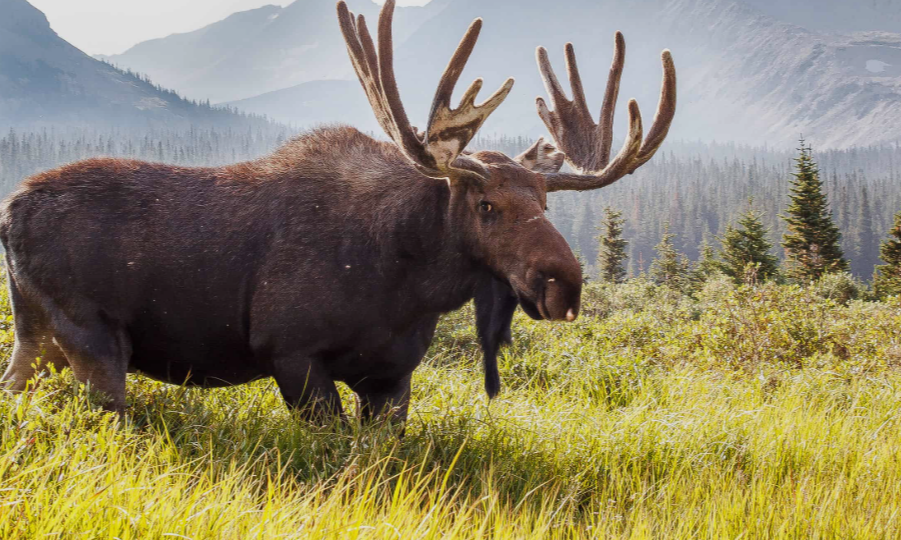
The types of moose make up one of the most impressive groups in the deer family, and they live in cold northern forests on three continents. Moose are the largest living deer on Earth, and big bulls can stand about 7 feet tall at the shoulder and weigh 1,300 pounds or more. In North America they are called moose, while in Europe and Asia the same animal is usually called elk. The name moose comes from an Algonquian word that means twig eater.
A moose is easy to recognize. It has long, spindly legs, a humped shoulder, a drooping muzzle and a flap of skin under the throat called a bell. Males, called bulls, grow the biggest antlers of any mammal, and a single rack can weigh almost 80 pounds. The flat, palm-shaped antlers also work like a dish that helps the animal collect sound. Bulls shed the antlers each winter and grow a new set every spring.
Moose live in boreal forest, wetlands and river valleys, where they eat willow and birch twigs, aquatic plants and young shoots. They are strong swimmers and will wade or dive to reach pond vegetation. Most adults live alone, except for cows with calves and the gatherings of the autumn mating season. Their dark coats and long legs help them handle deep snow, though they can be hard to spot as they cross roads at night.
Scientists disagree on how to count moose. Many treat them as a single species with about 8 or 9 subspecies, while some authorities split the American moose from the Eurasian elk. This article reaches 12 by listing both of those groups, the subspecies of each and the extinct moose-like deer that came before them. Here are the 12 types of moose, along with where each one is found.
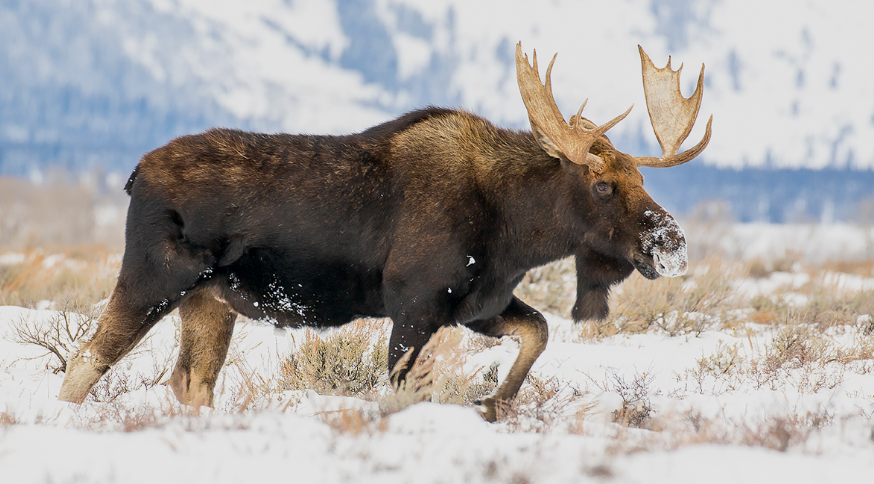
1. American Moose
The American moose is the form that most people picture when they hear the word moose. It is the largest deer in North America, with a dark brown coat, pale lower legs and a massive set of palmate antlers on males. Some scientists treat it as its own species, while others count it as part of a single worldwide species. Estimates suggest more than 1 million live across the continent.
Its range covers nearly all of Canada, most of central and western Alaska, the upper Rocky Mountains and Michigan’s Upper Peninsula. Several hundred thousand moose live in Canada, and Alaska holds an estimated 175,000 to 200,000. Moose were also brought to Colorado in 1978, and the state now has a herd of more than 1,000. The American moose is divided into four subspecies, which are described below.
2. Eurasian Elk
The Eurasian elk, also called the European elk, is the original form of the species that Europeans named. In Europe and Asia, the word elk refers to this animal, and it should not be confused with the North American elk, or wapiti. It is a large, dark-brown deer with a shaggy bell and palmate antlers. Bulls are generally a bit smaller than the biggest Alaskan moose.
It lives in Finland, Sweden, Norway, Estonia, Latvia, Lithuania, Poland, Belarus, Ukraine and Russia. Sweden has the densest moose population in the world, with a summer population of about 300,000 to 400,000. Before the Middle Ages, the animal lived across most of Europe, but hunting and habitat loss reduced it. Today it is growing in many places, and hunters take a large share of the Swedish herd each autumn.
3. Eastern Moose
The eastern moose is the third largest moose in North America, smaller than the western and Alaska forms but larger than the Shiras moose. Its antlers average about 5 feet across. It has a dark coat and lives in thick forest with lakes, bogs and streams. It eats twigs, bark, shoots and aquatic plants.
It lives in eastern Canada, New England and northern New York State. The population is estimated at about 350,000, and numbers grew for decades into the early 2000s. It is hunted for food and sport in autumn and winter. Moose in the southern part of this range can be hurt by ticks and warming winters.
4. Western Moose
The western moose, also called the northwestern moose, is a big, heavily built form of central and western Canada. It is the second largest moose in North America after the Alaska moose. A Canadian bull with an antler spread of 50 inches is usually considered a trophy. Its coat is dark brown to nearly black.
It lives from British Columbia to western Ontario, in the eastern Yukon, the Northwest Territories and southwestern Nunavut. Its range also reaches into the northern United States, including Michigan’s Upper Peninsula, northern Wisconsin, northern Minnesota and northeastern North Dakota. It uses boreal forest, wetlands and river valleys. Parts of its southern range, such as Minnesota, have seen declines in recent decades.
5. Shiras Moose
The Shiras moose, also known as the Yellowstone or Wyoming moose, is the smallest moose in North America. Big bulls weigh up to about 1,000 pounds and stand roughly 5.5 to 5.75 feet at the shoulder, and their antlers can span 40 to 50 inches. The coat is deep brown, with light gray lower legs. It was named after George Shiras III, who explored the Yellowstone region.
It is the southernmost moose, found in Wyoming, Idaho, Utah, Colorado, Montana and Washington, as well as southern Alberta and southeastern British Columbia. Colorado’s herd began in 1978 with 24 moose moved from Utah and Wyoming. The Yellowstone population fell from roughly 1,000 in the 1970s to about 200 in 1996, and it depends on mature spruce and fir forest for winter survival. Wyoming managers estimated 4,050 moose statewide in 2014.
6. Alaska Moose
The Alaska moose is the largest moose in the world. Bulls typically weigh 1,200 to 1,800 pounds, and the largest on record weighed 1,808 pounds and stood 7.6 feet tall at the shoulder. That animal was shot in the western Yukon in 1897. Mature bulls can carry an antler spread of more than 6.5 feet, and the widest ever recorded was 83 inches.
It lives throughout most of Alaska and most of the western Yukon, in boreal forest and mixed woodland. It is also called the giant moose or Yukon moose in Canada. It feeds on willow and birch shoots and other vegetation, and it is mostly solitary, with only small groups forming at times. The antlers alone can weigh up to 79 pounds, a record for the species.
7. Yakutia Moose
The Yakutia moose is also known as the Siberian, Mid-Siberian or Lena elk. It is the most common moose in Asia. It is a large, dark deer built for the cold, with a long face and heavy antlers. It lives in the vast forests of the Russian interior.
Its range extends from the Yenisei River in the west across most of Siberia, and it also reaches Mongolia and Manchuria. It does not occur in the far east, where the Chukotka and Ussuri forms live. The forests of eastern Russia are its stronghold. It feeds on shoots, bark and aquatic plants.
8. Manchurian Moose
The Manchurian moose, also called the Ussuri or Amur moose, lives in the far east of the continent. It is a smaller, lighter-colored form than the northern Siberian moose. It lives in a milder climate, with a mix of forests and wetlands. Little detail is known compared with North American moose.
It lives in far eastern Russia and northeastern China, in the region around the Amur and Ussuri rivers. It uses mixed forest, river valleys and wetlands. It is one of the lesser-known subspecies, and its numbers are poorly documented. Habitat loss and hunting are the main concerns.
9. Chukotka Moose
The Chukotka moose, also called the East Siberian moose, is the largest moose in Eurasia. Bulls can stand over 7 feet tall and weigh upwards of 1,500 pounds, which puts them close to Alaska moose in size. They live in some of the coldest forests on Earth. Their coats are dark and thick.
It lives in the Russian Far East, from the Alazeya River basin east to the Kolyma and Anadyr basins. Its range extends south through the Koryak Mountains to the Kamchatka Peninsula. It uses river valleys, willow thickets and boreal forest. Its home is remote and sparsely populated.
10. Caucasian Moose
The Caucasian moose was a regional form that lived in the Caucasus Mountains and nearby lands. It is now extinct, and some experts doubt it was ever a valid subspecies. It was a forest animal that lived alongside tigers, lynx and golden eagles. It was sometimes confused with the European elk.
It lived across the Caucasus region, including parts of Russia, Armenia, Georgia, Azerbaijan, Turkey and northern and western Iran. It was common until the middle of the 19th century, when overhunting and habitat loss caused its numbers to fall. It disappeared around the beginning of the 20th century. It is one of the few moose forms lost in recent history.
11. Stag-Moose
The stag-moose was a large, moose-like deer that lived in North America during the Late Pleistocene. It had long legs, a more deer-like muzzle and antlers that were more complex and branched than those of a modern moose. It weighed around 1,500 pounds, similar to a big modern moose. It became extinct about 11,500 years ago, at the end of the last ice age.
Its fossils turn up across the northern United States, with more than 20 sites in Iowa and Wisconsin and others in northern Illinois. It lived in spruce woodland alongside mammoths, giant beavers and woodland musk-oxen. Early human hunters may have targeted it. Scientists think it evolved from the broad-fronted moose, which migrated to North America.
12. Broad-Fronted Moose
The broad-fronted moose, also called the giant moose, is possibly the largest deer that ever lived. It weighed around 2,200 pounds and stood about 7 feet tall at the shoulder, roughly 30 percent heavier than the stag-moose. It had broad, palmate antlers and probably lived in marshy habitats with scattered scrub. It is thought to be the ancestor of both the modern moose and the stag-moose.
It lived across Europe and Asia during the Pleistocene, with fossils found in Italy and across Siberia. It first appeared in the late Early Pleistocene. In Europe, it died out around the end of the Middle Pleistocene, replaced by its descendant, the modern moose. Its size makes it a favorite of paleontologists.
Sources:
- Moose, Encyclopaedia Britannica
- Moose, Alaska Department of Fish and Game
- Moose, Yellowstone National Park, National Park Service
- Moose Species Account, Wyoming Game and Fish Department
- Northern Nomads to Refuge Royalty, U.S. Fish and Wildlife Service
- Genome-wide SNP Analysis of Three Moose Subspecies, Conservation Genetics
- Moose (Elk): Characteristics, Size, Habitat, Subspecies, Facts and Details
- How Big Is a Moose?, Outdoor Life
- Facts About Moose in Sweden, Wild Sweden
- Moose: The Animal Files
- Eastern Moose, Wikipedia
- Alaska Moose, Wikipedia
- Shiras Moose, Wikipedia
- Caucasian Moose, Wikipedia
- Stag-Moose, Wikipedia
- Broad-Fronted Moose, Wikipedia