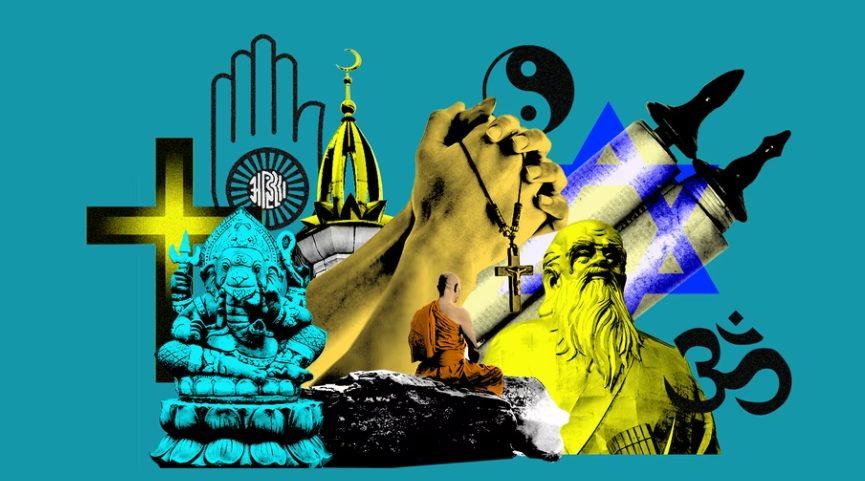
Religion generally involves a system of beliefs, practices, and moral guidelines organized around a relationship to something regarded as sacred, transcendent, or ultimate, whether that is understood as a deity, a collection of deities, an impersonal cosmic order, or a state of spiritual realization. Religions typically address fundamental questions that fall outside the reach of ordinary empirical investigation, such as the origin and purpose of existence, what happens after death, the nature of good and evil, and how human beings ought to relate to forces or realities greater than themselves. Because these questions admit of no single settled answer, the world’s religious traditions have developed remarkably different frameworks for approaching them, ranging from elaborate theological systems built around a single all-powerful creator, to traditions with vast pantheons of gods and spirits, to paths that emphasize inner spiritual discipline over any particular claim about divine beings at all.
Religion also functions as far more than a private set of metaphysical beliefs; it typically shapes communal identity, social structure, ethical norms, ritual practice, and cultural expression across generations. Sacred texts, oral traditions, rites of passage, seasonal festivals, dietary rules, and codes of moral conduct all commonly emerge from a religious tradition’s core beliefs, embedding those beliefs into the daily rhythms and shared identity of a community rather than confining them to abstract doctrine alone. This social dimension helps explain why religious traditions have historically been such powerful forces in shaping law, art, architecture, political authority, and interpersonal relationships across nearly every documented human civilization, and why religious identity so often intertwines closely with ethnic, national, or familial identity in ways that can be difficult to fully separate from belief alone.
Scholars of religion generally distinguish between a handful of broad structural categories that recur across otherwise very different traditions. Monotheistic religions center on belief in a single, supreme deity, as seen in Judaism, Christianity, and Islam; polytheistic traditions recognize multiple distinct deities, each often associated with particular natural forces, domains of life, or localities; and various non-theistic or transtheistic traditions, including several major schools within Buddhism, focus on ethical conduct, meditative discipline, or metaphysical insight without necessarily centering worship of a personal creator god at all. Other traditions blur these categories further still, incorporating ancestor veneration, animistic beliefs in spirits inhabiting the natural world, or a fluid combination of philosophical and devotional elements that resist easy classification into any single one of these broad categories.
Religious traditions also differ enormously in scale, organization, and historical continuity, ranging from globally dispersed institutional religions with billions of adherents and centuries of accumulated theological scholarship, to small-scale Indigenous traditions transmitted orally within a single community, to relatively new religious movements founded within the past two centuries that have already attracted millions of followers worldwide. Understanding this diversity requires approaching each tradition on its own terms, recognizing that believers within any given tradition often hold a wide internal range of interpretations, practices, and levels of observance, and that outside descriptions, however carefully researched, can never fully substitute for the lived experience and self-understanding of practitioners themselves. What follows is a survey of forty religious traditions, encompassing major world religions, significant denominational branches within them, and a range of Indigenous, ancient, and newer traditions that together illustrate the breadth of humanity’s religious life.
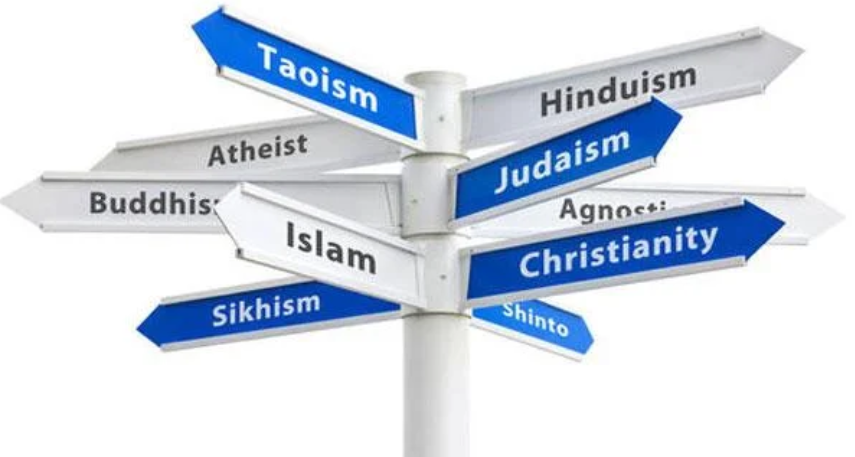
Types of Religions
Christianity
Christianity is the world’s largest religion by number of adherents, centered on the life, teachings, death, and resurrection of Jesus of Nazareth, whom followers regard as the Son of God and the awaited messiah prophesied in Hebrew scripture. Its central sacred text, the Bible, comprises the Hebrew Bible, referred to by Christians as the Old Testament, and the New Testament, which recounts the life of Jesus and the early development of the Christian church. Core Christian beliefs generally include the concept of the Trinity, understanding God as three persons in one divine being, the belief that Jesus’s death and resurrection offer salvation and reconciliation with God, and an emphasis on love, forgiveness, and moral conduct as central to religious life. Christianity has since divided into numerous major branches and thousands of denominations, spreading from its origins in the eastern Mediterranean to become a global religion practiced on every inhabited continent.
Catholicism
Catholicism, formally the Roman Catholic Church, is the largest single Christian denomination, tracing its institutional authority through an unbroken line of leadership to the apostle Peter and recognizing the Pope in Rome as its supreme earthly authority on matters of doctrine and church governance. Catholic theology places strong emphasis on the seven sacraments, including baptism, the Eucharist, and confession, as channels of divine grace, alongside a rich tradition of veneration for the Virgin Mary and the saints, whose intercession believers may seek through prayer. The Church maintains an extensive hierarchical structure of bishops, priests, and religious orders, and it has produced a vast body of theological scholarship, canon law, and artistic and architectural achievement across nearly two thousand years of continuous institutional development, remaining a major global religious and cultural institution today.
Protestantism
Protestantism refers to the broad family of Christian traditions that emerged from the sixteenth-century Reformation, a movement initiated by figures such as Martin Luther and John Calvin who challenged specific doctrines and practices of the medieval Catholic Church, particularly regarding the sale of indulgences and the authority of church tradition relative to scripture. Protestant traditions generally emphasize the authority of the Bible as the primary source of religious truth, salvation through faith rather than through ritual works alone, and the priesthood of all believers, reducing reliance on clerical intermediaries between individual worshippers and God. This foundational movement subsequently splintered into a wide array of distinct denominations, including Lutheran, Calvinist, Baptist, Methodist, and Pentecostal traditions among many others, each developing its own particular theological emphases, worship styles, and organizational structures while sharing this common Reformation heritage.
Eastern Orthodoxy
Eastern Orthodoxy is a major branch of Christianity that developed primarily in the eastern Mediterranean and Slavic world, formally separating from the Roman Catholic Church in the Great Schism of 1054, largely over disputes concerning papal authority and certain points of theology and liturgical practice. Organized as a communion of self-governing national and regional churches, such as the Greek, Russian, and Serbian Orthodox Churches, rather than under a single central authority comparable to the Pope, Orthodoxy places strong emphasis on continuity with the early Christian councils, elaborate liturgical worship rich in chant and incense, and a deeply contemplative theological tradition centered on the concept of theosis, or the gradual union of the believer with the divine nature through grace. Distinctive Orthodox practices include the veneration of icons, richly decorated sacred images believed to serve as windows to the divine, and an emphasis on mystery and liturgical continuity that has remained remarkably stable across many centuries of practice.
Islam
Islam is the second-largest religion in the world, founded on the teachings received by the Prophet Muhammad in seventh-century Arabia, which Muslims believe were revealed to him by God, known in Arabic as Allah, and subsequently compiled into Islam’s central sacred text, the Quran. Central Islamic practice is organized around the Five Pillars: declaring faith in the oneness of God and Muhammad’s prophethood, performing five daily prayers, giving alms to those in need, fasting during the month of Ramadan, and undertaking a pilgrimage to Mecca at least once if physically and financially able. Islamic theology emphasizes strict monotheism, submission to God’s will, which is the literal meaning of the word “Islam” itself, and adherence to a comprehensive legal and ethical framework known as sharia, derived from the Quran and the recorded sayings and practices of Muhammad, known as the hadith.
Sunni Islam
Sunni Islam is the largest branch of Islam, comprising the majority of Muslims worldwide, distinguished from Shia Islam primarily by its view of the proper succession of leadership following the death of the Prophet Muhammad, holding that the early caliphs chosen by the broader Muslim community were legitimate successors rather than requiring direct familial descent from Muhammad. Sunni Islam recognizes several established schools of Islamic jurisprudence, each offering somewhat different interpretive approaches to deriving religious law from the Quran and hadith, while sharing core theological commitments regarding the oneness of God, the finality of Muhammad’s prophethood, and the authority of the Quran as the literal word of God. Sunni religious authority is generally more decentralized than in Shia Islam, relying on a broad community of religious scholars, known as the ulama, rather than on a single formal clerical hierarchy with centralized doctrinal authority.
Shia Islam
Shia Islam is the second-largest branch of Islam, distinguished from the Sunni majority by its belief that leadership of the Muslim community rightfully belonged to Muhammad’s cousin and son-in-law, Ali, and his direct descendants, known as Imams, who are regarded as divinely appointed spiritual and political successors to the Prophet. This distinct view of legitimate succession, which developed following a historical dispute in the early decades after Muhammad’s death, has shaped a Shia theological and legal tradition with its own body of scholarship, distinctive commemorative practices such as the mourning observance of Ashura marking the martyrdom of Imam Husayn, and a more centralized religious hierarchy in many Shia communities, particularly within the dominant Twelver branch found predominantly in Iran, Iraq, and parts of the broader Middle East and South Asia.
Sufism
Sufism refers to the mystical dimension of Islamic practice, focused on cultivating direct, personal, experiential closeness to God through spiritual discipline, meditation, poetry, and often ecstatic ritual practices such as rhythmic chanting or the whirling dance associated with certain Sufi orders. Rather than constituting a separate sect distinct from Sunni or Shia Islam, Sufism has historically existed as a spiritual current running through both major branches, organized into various orders, called tariqas, each following the teachings and spiritual lineage of a particular founding master. Sufi literature, especially the poetry of figures such as Rumi and Hafez, has achieved enormous influence and popularity both within the Islamic world and internationally, prized for its rich use of metaphor to express themes of divine love, spiritual longing, and the soul’s journey toward union with the divine.
Judaism
Judaism is one of the world’s oldest continuously practiced monotheistic religions, tracing its origins to the ancient Israelites and centered on a covenantal relationship between God and the Jewish people as described in the Torah, the foundational text comprising the first five books of the Hebrew Bible. Jewish religious life is deeply shaped by the concept of mitzvot, or commandments, covering ethical conduct, ritual observance, dietary law, and communal life, alongside an extensive tradition of rabbinic scholarship and legal interpretation recorded in texts such as the Talmud. Judaism has historically developed multiple streams of practice and interpretation, and beyond its religious dimension, it carries a strong ethnic, cultural, and historical identity shaped profoundly by a long history of diaspora, communal resilience, and periodic persecution across many different regions and centuries.
Orthodox Judaism
Orthodox Judaism is the branch of contemporary Judaism that maintains the strictest adherence to traditional Jewish law, or halakha, as historically interpreted through classical rabbinic scholarship, viewing the Torah as divinely revealed and its accompanying oral tradition as authoritative and binding on daily religious practice. Orthodox communities generally maintain traditional practices such as strict Sabbath observance, kosher dietary laws, and, in many communities, distinctive dress and separate religious education for men and women, alongside continued study of classical religious texts as a central and lifelong religious pursuit. Orthodox Judaism itself encompasses considerable internal diversity, ranging from Modern Orthodox communities that combine traditional observance with active engagement in broader secular society, to more insular Haredi, or ultra-Orthodox, communities that maintain a more separated and tradition-focused way of life.
Reform Judaism
Reform Judaism is a modern movement within Judaism that emerged in nineteenth-century Germany, emphasizing the evolving, historically conditioned nature of Jewish law and practice and generally granting individual practitioners greater latitude in determining which traditional observances remain personally meaningful, rather than treating halakha as uniformly binding in its traditional form. Reform congregations typically emphasize ethical teaching, social justice engagement, and an updated approach to worship, including greater gender egalitarianism in religious leadership and ritual participation, reflecting the movement’s broader emphasis on adapting Jewish practice to contemporary social and intellectual contexts. Reform Judaism today represents one of the largest Jewish religious movements in North America, alongside Orthodox and Conservative Judaism, each offering a distinct approach to balancing continuity with Jewish tradition against engagement with modern life.
Hinduism
Hinduism is among the world’s oldest living religious traditions, originating in the Indian subcontinent and encompassing an extraordinarily diverse array of beliefs, deities, and practices rather than a single unified doctrine or founding figure. Central concepts widely shared across Hindu traditions include dharma, referring to one’s righteous duty and cosmic order; karma, the principle that actions carry moral consequences shaping future circumstances; and samsara, the cycle of death and rebirth from which spiritual liberation, known as moksha, is ultimately sought. Hindu religious life encompasses devotion to numerous deities, including major figures such as Vishnu, Shiva, and the goddess Devi in her many forms, alongside a vast body of sacred literature including the Vedas, Upanishads, and epic texts such as the Bhagavad Gita, supporting a wide range of philosophical schools, devotional practices, and regional traditions across the subcontinent and its global diaspora.
Buddhism
Buddhism originated in the fifth century BCE in the northern Indian subcontinent, founded on the teachings of Siddhartha Gautama, known as the Buddha, or “the awakened one,” who taught a path toward liberation from suffering through ethical conduct, meditative discipline, and the cultivation of wisdom regarding the true nature of existence. Central Buddhist teachings include the Four Noble Truths, which diagnose the universal presence of suffering and its causes, and the Eightfold Path, a practical guide to ethical and mental discipline aimed at overcoming that suffering and ultimately achieving liberation, known as nirvana. Unlike many major world religions, classical Buddhism does not center on worship of a creator deity, instead emphasizing direct insight into the impermanent, interconnected nature of reality, and it has since developed into several major branches that differ considerably in their doctrine, practice, and geographic distribution across Asia and, more recently, the wider world.
Theravada Buddhism
Theravada Buddhism, meaning “the teaching of the elders,” is the oldest surviving branch of Buddhism, predominant today in Sri Lanka, Thailand, Myanmar, Cambodia, and Laos, and generally regarded as maintaining the closest continuity with the earliest recorded teachings of the historical Buddha as preserved in the Pali Canon. Theravada practice places strong emphasis on individual liberation through personal discipline, ethical conduct, and meditation, with the monastic community, or sangha, playing a central role in preserving and transmitting the Buddha’s teachings across generations. The tradition’s ideal spiritual figure is the arhat, a practitioner who has achieved enlightenment and liberation from the cycle of rebirth through their own sustained effort, and Theravada communities typically maintain a close, mutually supportive relationship between lay practitioners, who provide material support to monastics, and the monastic community, which in turn provides religious teaching and spiritual guidance to the laity.
Mahayana Buddhism
Mahayana Buddhism, meaning “the great vehicle,” is a major branch of Buddhism that developed somewhat later than Theravada and became predominant across East Asia, including China, Japan, Korea, and Vietnam, introducing an expanded body of scripture and a distinctive emphasis on the bodhisattva ideal, a being who postpones their own final liberation in order to compassionately assist all other sentient beings toward enlightenment as well. Mahayana traditions generally place greater emphasis on universal compassion and the potential for enlightenment available to all beings, alongside a rich cosmology of numerous celestial Buddhas and bodhisattvas, such as Amitabha and Avalokiteshvara, who are venerated and appealed to for spiritual assistance within various devotional practices. This branch encompasses considerable internal diversity, giving rise to numerous distinct schools and traditions, including Zen, Pure Land, and Nichiren Buddhism, each developing its own particular emphasis, practice, and interpretive approach to the broader Mahayana framework.
Vajrayana Buddhism
Vajrayana Buddhism, sometimes called Tantric or Tibetan Buddhism, is a distinct branch that developed primarily in Tibet, Bhutan, Mongolia, and parts of the Himalayan region, building upon Mahayana teachings while incorporating additional esoteric practices, including elaborate ritual, visualization techniques, mantra recitation, and specialized meditative disciplines intended to accelerate the practitioner’s progress toward enlightenment within a single lifetime. The tradition places significant emphasis on the guidance of a qualified spiritual teacher, or lama, who transmits specialized teachings and initiations directly to students, and it is closely associated with a rich tradition of elaborate ritual art, including intricate mandala imagery and richly symbolic iconography representing various deities and enlightened states of mind. Vajrayana Buddhism gained significant international visibility in the latter half of the twentieth century, particularly following the Tibetan diaspora and the global prominence of figures such as the Dalai Lama.
Sikhism
Sikhism is a monotheistic religion founded in fifteenth-century Punjab by Guru Nanak, who taught devotion to a single formless, universal God alongside a strong ethical emphasis on equality, honest labor, and selfless service to others, rejecting the caste distinctions and ritualism that Guru Nanak observed in the surrounding religious traditions of his time. Sikh teaching was subsequently developed and transmitted through a succession of ten human Gurus, culminating in the compilation of the Guru Granth Sahib, a sacred scripture that Sikhs regard as the eternal living Guru and ultimate spiritual authority for the community following the death of the tenth human Guru. Distinctive Sikh practices include maintaining the Five Ks, physical articles of faith such as uncut hair and a ceremonial dagger, worship at gurdwaras featuring communal recitation of scripture, and the operation of langar, a free communal kitchen open to all people regardless of religion or social background, reflecting the tradition’s strong commitment to equality and service.
Jainism
Jainism is an ancient Indian religious tradition centered on the principle of ahimsa, or strict non-violence toward all living beings, considered by Jains to be the highest ethical duty and the guiding principle shaping nearly every aspect of religious practice and daily life. Jain cosmology holds that the universe is eternal and uncreated, operating according to natural law rather than the will of a creator deity, with liberation from the cycle of rebirth achieved through rigorous ethical discipline, asceticism, and the shedding of karmic matter accumulated through the soul’s actions across countless lifetimes. Jain practitioners, particularly monastics, often observe extraordinarily careful dietary and behavioral restrictions to avoid harming even the smallest living creatures, and the tradition has produced a notable historical legacy of scholarship, temple architecture, and influence on broader Indian philosophical and ethical thought, including its documented influence on figures such as Mahatma Gandhi.
Confucianism
Confucianism is a Chinese philosophical and ethical tradition founded on the teachings of Confucius in the sixth century BCE, centered on cultivating personal moral virtue, maintaining proper social relationships, and fostering social harmony through adherence to ritual propriety, filial piety, and respect for established hierarchical roles within family and society. While scholars debate whether Confucianism should be classified as a religion in the strict sense, given its limited emphasis on metaphysical claims about deities or an afterlife, it has functioned throughout Chinese and broader East Asian history as a comprehensive ethical and social framework deeply interwoven with religious ritual, particularly ancestor veneration and reverence for tradition and established moral authority. Confucian thought profoundly shaped Chinese governance, education, and family structure for over two thousand years and continues to exert significant cultural influence across China, Korea, Japan, and Vietnam today.
Taoism
Taoism, also spelled Daoism, is a Chinese philosophical and religious tradition centered on the concept of the Tao, often translated as “the Way,” an ineffable, underlying natural order that pervades and unifies the entire universe, with human flourishing understood as arising from living in harmony with this natural order rather than through excessive striving or artificial imposition of will. Foundational Taoist texts, particularly the Tao Te Ching attributed to the sage Laozi, emphasize simplicity, spontaneity, humility, and the principle of wu wei, or effortless, non-forced action aligned with the natural flow of circumstances. Beyond its philosophical dimension, religious Taoism developed an elaborate tradition of ritual practice, meditation, alchemy, and a rich pantheon of deities and immortals, with organized Taoist religious institutions, temples, and ordained priesthood continuing to operate actively across China, Taiwan, and the broader Chinese diaspora today.
Shinto
Shinto is the Indigenous religious tradition of Japan, centered on reverence for kami, a broad category of sacred spirits or divine forces associated with natural phenomena, ancestral figures, and specific sacred sites, worshipped at shrines maintained by dedicated priests throughout the country. Rather than emphasizing a fixed body of doctrine or a single authoritative scripture, Shinto practice focuses heavily on ritual purity, seasonal festivals, and maintaining a harmonious relationship between human communities and the natural and spiritual world surrounding them. Shinto has coexisted with Buddhism in Japan for well over a thousand years, often blending in practice such that many Japanese people participate in both Shinto and Buddhist rituals at different life stages without regarding this dual participation as contradictory, reflecting Shinto’s characteristically flexible, practice-centered approach to religious life rather than one built around exclusive doctrinal commitment.
Zoroastrianism
Zoroastrianism is one of the world’s oldest monotheistic religions, founded in ancient Persia by the prophet Zoroaster, centered on worship of Ahura Mazda as the supreme, wise creator deity, engaged in an ongoing cosmic struggle against the destructive force of Angra Mainyu, with human beings called upon to align themselves with truth, good thoughts, good words, and good deeds in support of the forces of cosmic good. Zoroastrian theology introduced influential concepts, including a final cosmic judgment, an eventual restoration of the world to a state of perfection, and a strong emphasis on individual moral responsibility and free will, ideas that scholars have noted bear notable similarities to later concepts found in Judaism, Christianity, and Islam. Once the dominant religion of the vast Persian Empire, Zoroastrianism today survives as a comparatively small but historically significant religious community, particularly among the Parsi community of India and smaller communities in Iran and the broader global diaspora.
Bahá’í Faith
The Bahá’í Faith is a religion founded in nineteenth-century Persia by Bahá’u’lláh, who taught that he was the most recent in a line of divine messengers that includes figures such as Abraham, Moses, Jesus, and Muhammad, each sent by God to guide humanity according to the needs and capacity of their particular historical era. Central Bahá’í teachings emphasize the fundamental unity of all religions as expressions of a single evolving divine truth, the unity of all humanity regardless of race, nationality, or social background, and the harmony that Bahá’ís believe properly exists between religious faith and rational scientific inquiry. The Bahá’í community maintains an elected, non-clerical administrative structure without professional clergy, and it has grown into a globally dispersed religious community with adherents across virtually every country in the world, despite continuing to face significant persecution in some regions, including its birthplace of Iran.
Rastafarianism
Rastafarianism, or Rastafari, is a religious and social movement that emerged in Jamaica during the 1930s, centered on the belief that the former Ethiopian Emperor Haile Selassie I represented a divine figure and the fulfillment of biblical prophecy, drawing heavily on a distinctive reinterpretation of Christian scripture alongside a strong emphasis on African identity, dignity, and liberation from the historical legacies of colonialism and slavery. Rastafari practice often includes distinctive dietary guidelines emphasizing natural, unprocessed foods, the wearing of dreadlocks as a symbol of natural living and spiritual identity, and, among many practitioners, the ceremonial and sacramental use of cannabis as an aid to meditation and spiritual reflection. The movement gained substantial international visibility through its close association with reggae music, particularly through the global popularity of musician Bob Marley, whose work helped introduce Rastafari themes and imagery to a worldwide audience well beyond Jamaica.
Mormonism
Mormonism refers to the religious tradition founded by Joseph Smith in early nineteenth-century United States, whose largest institutional expression is The Church of Jesus Christ of Latter-day Saints, centered on belief in the Book of Mormon as additional scripture alongside the Bible, understood by adherents as an ancient religious record translated by Smith through divine revelation. Latter-day Saint theology includes distinctive doctrines regarding the nature of God, the eternal potential of human spiritual progression, and the restoration of Christian authority and priesthood believed to have been lost following the death of the original apostles, with modern-day prophets and apostles continuing to receive ongoing divine revelation for the guidance of the church. The tradition places strong emphasis on family life, missionary service, temple worship, and a comprehensive lay ministry structure, and it has grown from its nineteenth-century American origins into a global religious movement with millions of adherents worldwide.
Jehovah’s Witnesses
Jehovah’s Witnesses are a Christian-derived religious movement that emerged in the late nineteenth-century United States, distinguished by distinctive beliefs including a rejection of the traditional doctrine of the Trinity, a strong emphasis on the imminent establishment of God’s kingdom on earth, and characteristic practices such as door-to-door evangelism and the refusal of blood transfusions and participation in military service or nationalistic observances based on their interpretation of biblical teaching. The movement places central authority in its governing body, which provides doctrinal guidance and biblical interpretation for the worldwide community, and members study extensively using literature published by the Watch Tower Bible and Tract Society, gathering regularly at local Kingdom Halls for worship, instruction, and organized evangelistic activity. Jehovah’s Witnesses maintain a notably distinct communal and doctrinal identity relative to mainstream Christian denominations, reflected in their characteristically separate approach to broader civic and religious life.
Unitarian Universalism
Unitarian Universalism is a liberal religious tradition formed through the twentieth-century merger of the historically separate Unitarian and Universalist movements, both of which had roots in more traditional Christian denominations before evolving toward a broader, non-creedal approach that does not require adherence to any single fixed theological doctrine. Unitarian Universalist congregations typically emphasize a shared set of ethical principles, including respect for the inherent worth of every person, support for a free and responsible search for truth and meaning, and commitment to justice and compassion, while allowing individual members considerable latitude in their personal theological beliefs, which may range from theistic to humanist to beliefs drawn from various world religious traditions. This pluralistic approach makes Unitarian Universalism somewhat distinct among organized religious movements, functioning more as a shared ethical and communal framework accommodating diverse personal beliefs than as a tradition built around a single unified doctrinal system.
Modern Paganism
Modern Paganism, sometimes called Neopaganism, refers to a diverse family of contemporary religious movements that draw inspiration from pre-Christian European religious traditions, nature worship, and polytheistic or animistic spiritual frameworks, generally emphasizing reverence for nature, the changing of the seasons, and, in many though not all traditions, worship of multiple deities drawn from various historical pantheons. These movements developed substantially over the course of the twentieth century, often reconstructing or reimagining historical practices with limited surviving documentation, resulting in considerable internal diversity across different specific Pagan traditions, each emphasizing somewhat different historical inspirations, ritual practices, and theological frameworks. Modern Pagan practice commonly includes seasonal festivals tied to the solar calendar, ritual magic, and a strong ecological and nature-centered spiritual orientation, appealing to practitioners seeking an alternative to mainstream monotheistic religious traditions.
Wicca
Wicca is a specific Neopagan religious tradition developed in mid-twentieth-century England, largely through the work of Gerald Gardner, centered on the worship of a Goddess and a God, often understood as complementary polarities representing the divine feminine and masculine, alongside a structured system of ritual magic, seasonal celebration, and initiatory practice organized within small worship groups known as covens. Central Wiccan ethical guidance is often summarized in the Wiccan Rede, a principle generally interpreted as encouraging practitioners to act according to their own will provided that doing so causes no harm to others, alongside a broader emphasis on personal spiritual responsibility and the ethical use of ritual magical practice. Wicca has grown substantially since its mid-twentieth-century origins, diversifying into numerous distinct traditions and lineages while generally maintaining its core emphasis on nature reverence, ritual seasonal observance, and a polarity-based approach to understanding the divine.
Druidry
Modern Druidry is a Neopagan spiritual tradition inspired by the historical Druids, the learned religious and intellectual class of ancient Celtic societies in pre-Roman Britain, Ireland, and Gaul, though modern Druidry is substantially a contemporary reconstruction, since very little reliable historical documentation survives regarding the actual beliefs and practices of the ancient Druids themselves. Contemporary Druid practice generally emphasizes deep reverence for nature, creative and artistic expression, particularly poetry and music, and ritual observance of seasonal festivals aligned with the solar calendar, often conducted at significant natural or historically resonant sites such as ancient stone circles. Organized Druid orders and groves operate today across Britain, Ireland, and internationally, with practitioners drawing on a blend of historical Celtic inspiration, environmental spirituality, and creatively reconstructed ritual practice to form a distinctly modern approach to nature-centered religious life.
Animism
Animism refers to a broad category of religious and spiritual worldview, found across numerous Indigenous cultures throughout history and around the world, holding that spiritual essence or personhood is not confined to human beings alone but extends to animals, plants, natural landforms, and even certain objects, each of which may be understood as possessing its own spirit, consciousness, or agency deserving of respect and careful relationship. Rather than constituting a single unified religious tradition, animism describes a shared underlying worldview found within many distinct Indigenous religious traditions across Africa, the Americas, Asia, and Oceania, each of which develops its own specific practices, spirits, and ritual relationships according to local culture and environment. Animistic worldviews commonly emphasize maintaining respectful, reciprocal relationships with the surrounding natural and spiritual world, often through ritual offerings, careful ecological practice, and specialized spiritual practitioners who mediate between human communities and the broader spirit world.
Shamanism
Shamanism refers to a widespread religious practice found across numerous Indigenous cultures, particularly in Siberia, Central Asia, and the Americas, centered on the role of a shaman, a specialized spiritual practitioner believed capable of entering altered states of consciousness in order to communicate with spirits, retrieve lost souls, diagnose and heal illness, and mediate between the human community and the broader spiritual world on behalf of their community. Shamanic practice often involves the use of ritual drumming, chanting, fasting, or in some traditions the ceremonial use of specific plant substances, to achieve the altered states of consciousness through which the shaman is believed to journey into spiritual realms inaccessible to ordinary waking consciousness. While shamanic traditions vary considerably in their specific practices and cosmology across different cultures and regions, the shared underlying role of a specialized spiritual intermediary capable of direct communication with the spirit world represents a recurring pattern found across many otherwise distinct Indigenous religious traditions worldwide.
Vodou
Vodou, sometimes spelled Voodoo, is a syncretic religious tradition that developed primarily in Haiti, blending West African religious traditions, particularly from the Fon and Yoruba peoples, with elements of Roman Catholicism introduced during the era of colonial slavery, resulting in a distinctive tradition centered on a supreme creator deity alongside a large pantheon of spirits, known as lwa, each associated with particular natural forces, domains of life, and ritual practices. Vodou ceremonies typically involve music, dance, and ritual offerings intended to invite the lwa to communicate with and, in some ceremonial contexts, to spiritually possess practitioners, providing guidance, healing, or blessing to the community gathered for the ceremony. Vodou has historically faced considerable misrepresentation and stigmatization in popular Western media, obscuring its actual character as a structured religious tradition with its own coherent theology, ethical framework, and deep historical significance to Haitian cultural identity and the broader history of resistance to colonial slavery.
Santería
Santería, also known as Lucumí or Regla de Ocha, is a syncretic religious tradition that developed primarily in Cuba, blending the religious traditions of the Yoruba people of West Africa with elements of Roman Catholicism introduced during the colonial era, centered on veneration of orishas, powerful spiritual beings each associated with particular natural forces, human concerns, and, through syncretic association developed under conditions of colonial religious suppression, specific Catholic saints. Santería practice includes initiation rituals, ceremonies involving music, dance, and ritual offerings intended to honor and communicate with the orishas, and the guidance of experienced priests and priestesses who oversee ceremonies and provide spiritual counsel and divination for community members. Like Haitian Vodou, Santería developed as a means of preserving West African religious tradition and cultural identity under the severe constraints of colonial slavery, and it remains practiced today by significant communities in Cuba, the broader Caribbean, and various parts of Latin America and the United States.
Native American Religions
Native American religious traditions encompass an extraordinarily diverse range of distinct spiritual practices and belief systems developed independently among the many hundreds of Indigenous nations across North America, each shaped by its own particular history, language, and relationship to a specific regional landscape, making any single unified description necessarily an oversimplification of this vast underlying diversity. Common themes recurring across many, though certainly not all, Native American traditions include a deep spiritual relationship with the natural world and specific ancestral lands, ceremonial practices tied to seasonal cycles and significant life events, and reverence for ancestors and, in many traditions, for a category of spiritual beings or forces closely connected to the natural environment. Following centuries of colonization, forced relocation, and often deliberate suppression of Indigenous religious practice, many Native American nations have worked actively in recent generations to preserve, revitalize, and pass on their specific traditional religious and ceremonial practices to younger generations within their communities.
African Traditional Religion
African Traditional Religion is a broad umbrella term referring to the numerous distinct Indigenous religious traditions historically practiced across the African continent prior to and alongside the spread of Christianity and Islam, encompassing an enormous diversity of specific beliefs, deities, and ritual practices that vary considerably among the continent’s many different ethnic groups and regions. Common threads found across many though not all African traditional religions include belief in a supreme creator deity often understood as somewhat distant from everyday human affairs, veneration of ancestral spirits believed to remain actively involved in the lives of their living descendants, and reverence for a range of lesser spirits or deities associated with particular natural forces and domains of human life. These traditions have profoundly influenced numerous syncretic religious movements that developed in the Americas among African diaspora communities, including Vodou, Santería, and Candomblé, and many African traditional religious practices continue to be actively maintained today, sometimes alongside Christian or Islamic practice within the same communities or even individual families.
Ancient Greek Religion
Ancient Greek religion was the polytheistic religious system practiced throughout ancient Greece prior to the widespread adoption of Christianity, centered on a pantheon of anthropomorphic deities headed by Zeus and including major figures such as Athena, Apollo, Poseidon, and Aphrodite, each associated with particular domains of nature, human activity, and civic life. Religious practice centered on temple worship, ritual sacrifice, and major civic and pan-Hellenic festivals such as the Olympic Games, which were themselves originally a religious observance held in honor of Zeus, alongside oracular sites such as Delphi, where individuals sought divine guidance through a specially designated priestess believed to channel prophetic insight from Apollo. Ancient Greek religion lacked a single centralized sacred scripture or unified priesthood, instead developing through a rich body of interconnected mythology, local cult practice, and civic religious observance that varied considerably between different Greek city-states while sharing a broadly common pantheon and mythological framework.
Ancient Egyptian Religion
Ancient Egyptian religion was a complex polytheistic tradition practiced for over three thousand years along the Nile River valley, centered on a large pantheon of deities, including major figures such as Ra, the sun god; Osiris, god of the afterlife and resurrection; and Isis, a powerful goddess associated with magic and motherhood, alongside a strong religious emphasis on maintaining cosmic order, known as ma’at, against the ever-present threat of chaos. Egyptian religious practice placed particularly strong emphasis on the afterlife, reflected in elaborate funerary rituals, mummification practices intended to preserve the body for the journey into the next world, and the construction of monumental tombs and pyramids intended to secure a successful transition into eternal life for the deceased, particularly for Egypt’s pharaohs, who were themselves regarded as divine or semi-divine figures serving as intermediaries between the gods and human society. This religious tradition profoundly shaped ancient Egyptian art, architecture, and social organization across an extraordinarily long period of historical continuity before gradually giving way to Christianity and later Islam.
Norse Paganism
Norse Paganism, also known in its modern revived form as Heathenry or Ásatrú, refers both to the historical polytheistic religion practiced by pre-Christian Scandinavian and broader Germanic peoples, centered on a pantheon of deities including Odin, Thor, and Freyja, and to its modern reconstruction and revival among contemporary practitioners drawing on surviving mythological sources such as the Poetic and Prose Eddas. Historical Norse religious practice included ritual sacrifice, seasonal seasonal festivals, and a rich mythological cosmology involving multiple interconnected worlds and a coming apocalyptic event known as Ragnarök, in which many of the principal gods were foretold to perish in a final great cosmic battle. Modern Heathenry and Ásatrú practitioners generally emphasize values drawn from surviving historical sources, including honor, hospitality, and courage, alongside ritual practices such as blót, a ceremonial offering, and sumbel, a ceremonial toasting ritual, adapted for contemporary practice from historical and mythological source material.
Secular Humanism
Secular Humanism is a non-theistic worldview and ethical life stance that, while not a religion in the traditional theistic sense, is often studied and discussed alongside religious traditions because it addresses many of the same fundamental questions concerning meaning, ethics, and human purpose, doing so through reliance on reason, scientific evidence, and shared human values rather than through appeal to divine revelation or supernatural belief. Secular Humanists generally emphasize human dignity, ethical responsibility grounded in empathy and rational reflection rather than religious doctrine, and a commitment to improving human welfare and the natural world through science, education, and democratic cooperation, often organizing into humanist associations that provide many of the same communal, ethical, and life-cycle functions, such as weddings and memorial services, traditionally associated with organized religion. Because it explicitly rejects supernatural belief while still engaging seriously with life’s deepest ethical and existential questions, Secular Humanism occupies a distinctive position at the boundary between religious and purely philosophical worldviews, illustrating the difficulty of drawing a single sharp line around what should and should not be classified as a religion.