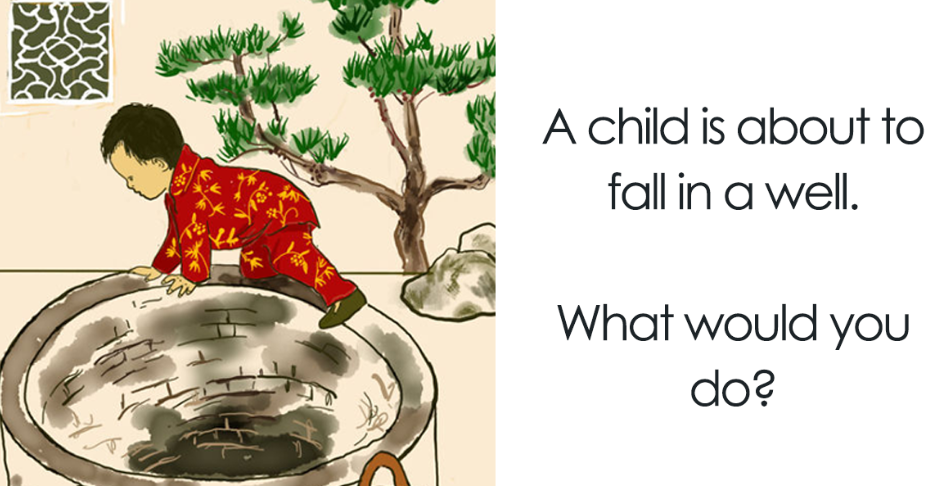
A thought experiment is a deliberate exercise of the imagination in which a person constructs a hypothetical scenario, often deliberately simplified or exaggerated, in order to test an idea, expose a hidden assumption, or clarify the logical consequences of a theory. Unlike a laboratory experiment, no physical apparatus is required; the “laboratory” is the mind itself, and the “data” are the intuitions and judgments the scenario provokes. Thought experiments strip away the noise of real-world complexity so that a single variable or principle can be examined in isolation. A well-built one asks a question that could not easily be asked, let alone answered, through ordinary observation or direct evidence gathering.
Philosophers have relied on thought experiments since antiquity because many of the questions philosophy asks are not empirical in the ordinary sense. Whether personal identity survives radical change, whether morality permits killing one person to save five, or whether a machine could genuinely think are not questions that can be settled by measurement alone. Instead, thinkers imagine a case, run it through their intuitions, and see what falls out. The method is not unique to philosophy; physicists such as Einstein and Galileo used it too, imagining riding alongside a beam of light or dropping objects from a tower, to reason about physical laws before any instrument could confirm the results. But philosophy has made the thought experiment into something close to a signature tool, since so much of its territory concerns concepts, meaning, and value rather than measurable phenomena.
The power of a thought experiment lies in its capacity to generate a conflict between a theory and an intuition. A person might hold a general principle, such as “always maximize overall happiness,” and feel confident in it until a scenario is described in which following that principle would require doing something that feels obviously wrong, such as harvesting one person’s organs to save five others. The tension this creates forces a choice: revise the theory, bite the bullet and accept the uncomfortable implication, or find a relevant difference between the imagined case and the real-world situations the theory was meant to cover. This back-and-forth between principle and case, sometimes called “reflective equilibrium,” is one of the primary engines of philosophical progress.
Critics of the method point out real limitations. Thought experiments can smuggle in unstated assumptions, rely on intuitions that differ across people and cultures, or describe situations so far removed from ordinary life that the conclusions drawn from them may not transfer back to real ethical or metaphysical questions. A scenario involving runaway trolleys or teleportation machines is, after all, nothing anyone will actually encounter, and skeptics ask whether intuitions about such exotic cases should carry much weight. Even so, thought experiments remain indispensable because they let philosophers test the boundaries and consequences of a position with a precision that vague, abstract argument alone cannot achieve. What follows is a tour of fifty of the most influential and thought-provoking examples the tradition has produced.
The Trolley Problem
A runaway trolley is speeding toward five people tied to the track, unable to move. A bystander stands next to a lever that would divert the trolley onto a side track, where it would kill one person instead of five. Philippa Foot introduced this scenario, and Judith Jarvis Thomson later developed it further, to probe the moral difference between killing and letting die, and between actively causing harm and merely redirecting an existing threat. Most people say pulling the lever is permissible, even required, since it trades one life for five. The puzzle becomes sharper once the scenario is varied, revealing that our intuitions about harm are sensitive to factors beyond simple arithmetic, such as whether the harm is a means to the good outcome or merely a side effect of it.
The Footbridge Dilemma
This variant of the trolley scenario asks the person to imagine standing on a footbridge above the track, next to a large stranger whose body would be heavy enough to stop the trolley if pushed onto the tracks below, saving the five people at the cost of his life. Structurally, the arithmetic is identical to the original trolley case: one life traded for five. Yet most people who would pull the lever in the classic version refuse to push the stranger, revealing that outcome alone does not determine moral judgment. The dilemma is central to the doctrine of double effect, which distinguishes between harm used as a means to an end and harm that occurs as a foreseen but unintended side effect, and it remains a key data point for theories that try to explain the psychology and ethics of harm.
Ship of Theseus
As recounted by Plutarch, the ship in which the mythical hero Theseus sailed was preserved by the Athenians, who replaced its rotting planks one by one over the years until, eventually, not a single original plank remained. The question is whether the fully replaced vessel is still the same ship. A further twist, added by later philosophers, imagines that all the discarded original planks are collected and reassembled into a second ship, forcing a choice between two candidates for the “real” Ship of Theseus. The puzzle is not really about boats; it is about the criteria that make an object, a person, or an institution the same thing over time despite constant material change, a question with direct implications for debates about personal identity, organizations, and even the persistence of the self.
Brain in a Vat
This modern descendant of Descartes’ skeptical arguments imagines a brain removed from a body and kept alive in a vat of nutrients, wired to a supercomputer that feeds it electrical signals perfectly simulating an ordinary life. From the inside, the brain’s experience would be indistinguishable from an embodied person walking through the world, eating meals, and having conversations. The thought experiment asks how anyone could be certain they are not that brain, and if such certainty is unattainable, what that means for the reliability of all sensory knowledge. It has become a touchstone for debates in epistemology about skepticism and the nature of justification, and it also anticipates later cultural depictions of simulated realities.
The Chinese Room
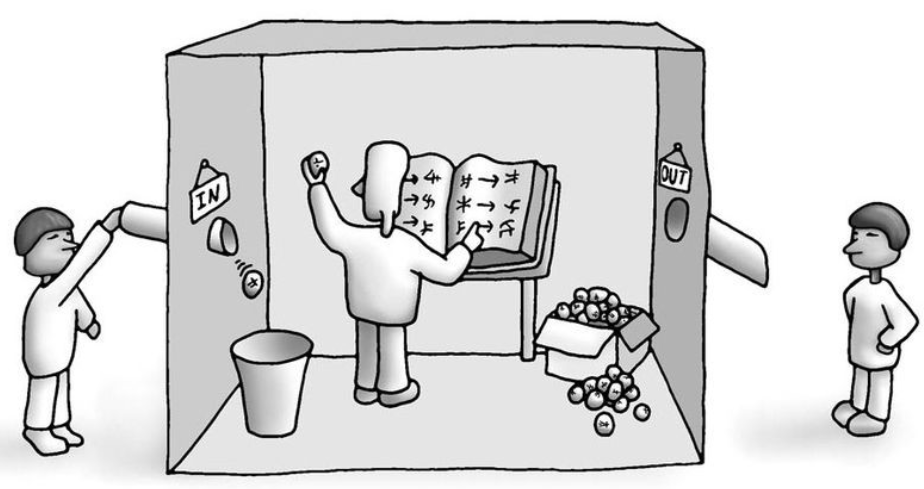
John Searle imagined a person who does not understand Chinese sitting inside a sealed room, equipped with an extensive rulebook written in English that tells them exactly how to manipulate Chinese symbols passed in from outside, producing responses that, from the outside, look like fluent conversation. The person inside is merely following syntactic rules without any grasp of meaning, yet the room as a whole behaves as though it understands Chinese. Searle used this scenario to argue that pure symbol manipulation, however sophisticated, does not amount to genuine understanding, challenging the claim that a sufficiently complex computer program could be said to truly think. The thought experiment remains central to debates over artificial intelligence, consciousness, and what, if anything, separates simulation from the real thing.
The Veil of Ignorance
John Rawls asked readers to imagine designing the basic rules of a society from behind a “veil of ignorance,” a hypothetical state in which no one knows what position they will occupy once the veil is lifted: not their wealth, talents, race, gender, or social class. Because self-interest could not be used to tilt the rules in one’s own favor, Rawls argued that rational people in this position would choose principles of justice that protect the worst-off members of society, since anyone could end up there. The device is used to derive fairness from impartiality rather than from any particular moral intuition about specific policies, and it has become one of the most influential tools in modern political philosophy for reasoning about distributive justice.
The Experience Machine
Robert Nozick asked whether people would choose to plug into a machine capable of generating any experience they desired, indistinguishable from reality, for the rest of their lives, with no memory that it was a simulation. Most people, when asked, decline the offer, even though the machine promises a life of guaranteed pleasure and satisfaction. Nozick used this reluctance to argue against pure hedonism, the view that pleasurable experience is the only thing that matters, since something in people evidently cares about actually doing things, actually being a certain kind of person, and being in genuine contact with reality, not merely having the corresponding experiences. The thought experiment remains a key challenge to any theory of well-being built solely on subjective states.
Twin Earth
Hilary Putnam imagined a planet identical to Earth in every respect except that the substance its inhabitants call “water” is not H2O but a different chemical compound, XYZ, which looks, tastes, and behaves exactly like water. When an Earthling and their molecular duplicate on Twin Earth both use the word “water,” Putnam argued they are actually referring to two different substances, even though the word feels subjectively identical to both speakers and neither could tell the difference by introspection alone. The scenario supports the claim that the meaning of a word is not fixed solely by what is happening inside a speaker’s head but depends on the actual environment and history that word is embedded in, a position summarized in Putnam’s slogan that “meanings just ain’t in the head.”
Mary’s Room
Frank Jackson described Mary, a brilliant scientist who has spent her entire life in a black-and-white room, learning every physical fact there is to know about color and human color vision through books and monochrome screens. The question is what happens when Mary is finally released and sees a red tomato for the first time. Jackson argued that she learns something new, namely what red actually looks like, despite already possessing complete physical knowledge of color perception beforehand. If this is right, it suggests that physical facts alone cannot capture everything there is to know about conscious experience, posing a serious challenge to purely physicalist accounts of the mind and fueling ongoing debate about the nature of qualia.
The Philosophical Zombie
Philosophers ask readers to imagine a creature physically and behaviorally identical to a normal human being in every observable respect, one that walks, talks, winces when hurt, and reports feelings, yet has no inner subjective experience whatsoever; there is simply nothing it is like to be this creature. If such a “zombie” is even conceivable without contradiction, the argument goes, then consciousness cannot be reduced to physical or functional processes alone, since two physically identical beings could differ in whether they have any inner experience at all. Critics respond that mere conceivability does not establish genuine possibility, but the thought experiment continues to structure much of the contemporary debate over physicalism and the so-called hard problem of consciousness.
Schrödinger’s Cat
Erwin Schrödinger devised this scenario to highlight what he saw as an absurd consequence of a certain interpretation of quantum mechanics. A cat is sealed in a box with a radioactive atom that has a fifty percent chance of decaying within an hour, a decay that would trigger a mechanism releasing poison and killing the cat. According to the standard interpretation of quantum superposition, until the box is opened and observed, the atom exists in a combined state of having decayed and not decayed, which would seem to imply the cat is simultaneously alive and dead. Though devised as a critique rather than an endorsement, the thought experiment has become the most famous illustration of the strangeness of quantum superposition and the philosophical puzzles surrounding observation and measurement.
Buridan’s Ass
Named for the medieval philosopher Jean Buridan, though he likely never wrote it quite this way, this scenario imagines a hungry donkey placed at an exactly equal distance between two identical, equally appealing piles of hay. With no rational basis for preferring one pile over the other, the donkey, if reasoning were purely a matter of weighing competing reasons, would be paralyzed by indecision and starve to death between two equally good options. The paradox is used to probe questions about free will and rational choice, asking whether decisions require some further faculty beyond pure reason to break ties, and whether determinism can account for how agents act at all when reasons are perfectly balanced.
The Prisoner’s Dilemma
Two suspects are arrested and interrogated separately, each offered the same deal: betray the other and go free while the other serves a long sentence, stay silent and receive a moderate sentence if both stay silent, or both receive a harsher sentence if both betray each other. Developed within game theory by Merrill Flood and Melvin Dresher and later formalized by Albert Tucker, the dilemma shows that two purely rational, self-interested agents will often both choose to betray each other, landing in a worse outcome for both than if they had cooperated, even though cooperation was available and mutually beneficial. The scenario has become foundational not only in economics and political science but in philosophical discussions of trust, cooperation, and the rationality of altruism.
Plato’s Allegory of the Cave
In Book VII of the Republic, Plato describes prisoners chained since childhood inside a cave, facing a wall on which shadows are cast by objects paraded behind them in front of a fire, shadows the prisoners have always mistaken for the whole of reality. One prisoner is freed and dragged out into the sunlight, painfully adjusting to the sight of real objects and eventually the sun itself, before being asked to return and explain the truth to those still chained, who refuse to believe him and mock his account. The allegory illustrates Plato’s theory of Forms, in which sensory experience offers only shadows of a deeper, unchanging reality accessible through reason and philosophical education, and it doubles as commentary on the difficulty of enlightening a public comfortable with illusion.
Pascal’s Wager
Blaise Pascal argued that belief in God is the only rational wager available under uncertainty, framing the choice as a bet with asymmetric stakes. If God exists and a person believes, the reward is infinite; if God exists and a person disbelieves, the loss is infinite; if God does not exist, the cost of having believed or disbelieved is comparatively small either way. Pascal concluded that expected value reasoning favors belief regardless of the actual evidence for God’s existence, since even a small probability multiplied by an infinite payoff outweighs any finite consideration. Critics have raised the “many gods” objection, pointing out that the wager does not specify which of many possible deities or belief systems should be the object of belief, along with concerns about whether belief can be chosen as a matter of strategic decision at all.
The Ring of Gyges
Recounted by Plato’s brother Glaucon in the Republic, this thought experiment imagines a shepherd who discovers a ring that grants its wearer complete invisibility at will. Glaucon uses the story to ask whether anyone, however outwardly virtuous, would continue to act justly if they could commit any act without fear of detection or punishment, suggesting that morality might be nothing more than a social constraint people obey only because they are watched and judged by others. The thought experiment challenges Socrates, and the reader, to defend the claim that justice is valuable in itself, independent of reputation or consequence, and it remains a foundational test case for theories of moral motivation and the relationship between virtue and self-interest.
Newcomb’s Problem
A being with near-perfect predictive powers presents a person with two boxes: one transparent box always containing a visible thousand dollars, and one opaque box that the predictor has already filled with either a million dollars or nothing, based on a prediction made in advance of whether the person will take only the opaque box or take both boxes. The puzzle, devised by physicist William Newcomb and popularized by philosopher Robert Nozick, is that two seemingly sound principles of rational choice give opposite recommendations: dominance reasoning says take both boxes since the opaque box’s contents are already fixed, while expected-value reasoning says take only the opaque box since the predictor’s near-perfect accuracy means that choice correlates strongly with the million-dollar outcome. Decades of debate have not produced full agreement on which strategy is correct, making it a central puzzle in decision theory.
The Teletransportation Paradox
Imagine a machine that scans every atom of a person’s body, destroys the original, and instantaneously reconstructs an atom-for-atom duplicate on Mars. Derek Parfit used this scenario, along with variants in which the original body is not destroyed or in which multiple duplicates are created, to probe whether the person who steps out on Mars is truly the same individual who stepped into the machine on Earth, or merely a perfect copy with all the same memories and personality. The thought experiment is designed to loosen the intuitive grip of the idea that personal identity is a deep, all-or-nothing fact, suggesting instead that what matters in survival might be psychological continuity and connectedness rather than strict numerical identity.
The Violinist
Judith Jarvis Thomson imagined waking up to find oneself surgically connected to an unconscious, world-famous violinist whose kidneys have failed, having been kidnapped in the night by music lovers who discovered only one’s own blood type could keep him alive. Unplugging the violinist would kill him, but staying connected for nine months guarantees his survival at the cost of the kidnapped person’s freedom and bodily autonomy for that entire period. Thomson used the scenario, first presented in her essay “A Defense of Abortion,” to argue that even granting a fetus full moral status as a person, it does not automatically follow that a pregnant person is morally obligated to sustain that life with their own body, since bodily autonomy can outweigh another being’s right to life in certain circumstances.
The Original Position
Closely related to the veil of ignorance, Rawls’s original position is the fuller hypothetical scenario in which rational, mutually disinterested parties gather to select the basic principles that will govern their society, deliberating without any knowledge of their eventual place within it. Unlike a simple thought experiment about a single decision, the original position models an entire bargaining and deliberative process, asking what principles free and equal rational agents would unanimously agree to under conditions of fair procedural impartiality. Rawls argued this setup would generate his two principles of justice: equal basic liberties for all, and social and economic inequalities arranged so that they benefit the least advantaged members of society, forming the philosophical backbone of his theory of justice as fairness.
The Sorites Paradox
Also called the Paradox of the Heap, this ancient puzzle, attributed to Eubulides of Miletus, begins with an obviously true premise: a heap of sand with one grain removed is still a heap. Applying this premise repeatedly, one grain at a time, eventually leads to the absurd conclusion that a single grain, or even zero grains, still counts as a heap, since no single grain removal was ever conceded to turn a heap into a non-heap. The paradox exposes the strange logical behavior of vague predicates, words like “heap,” “bald,” or “tall” that lack sharp boundaries, and it has generated an entire subfield of philosophical logic devoted to theories of vagueness, fuzzy logic, and how classical binary true-or-false reasoning should handle borderline cases.
The Grandfather Paradox
A staple of time-travel philosophy, this thought experiment imagines a person traveling back in time and killing their own biological grandfather before he ever meets their grandmother, thereby preventing their own eventual birth. But if the time traveler was never born, they could never have traveled back in time to commit the murder in the first place, generating a direct logical contradiction. Philosophers have used the paradox to explore whether backward time travel is logically coherent at all, and various proposed resolutions invoke fixed, self-consistent timelines in which such contradictory actions simply cannot occur, or branching parallel timelines in which the traveler’s actions create a divergent reality rather than erasing their own origin.
The Simulation Hypothesis
Philosopher Nick Bostrom formalized an old speculative idea into a rigorous trilemma: given enough time and computing power, advanced civilizations would likely be capable of running vast numbers of detailed ancestor simulations containing conscious beings; therefore, either civilizations reliably go extinct before reaching that capability, or they reliably choose not to run such simulations, or nearly all minds like ours are in fact simulated rather than “base reality” beings, since simulated minds would vastly outnumber original ones. The argument does not claim we are definitely in a simulation, only that one of the three options must be true, and it revives classical skeptical worries about the reliability of our picture of reality in a strikingly contemporary, technologically grounded form.
The Utility Monster
Robert Nozick devised this creature to challenge classical utilitarianism’s demand to maximize total aggregate happiness. The utility monster is a hypothetical being capable of deriving vastly more pleasure or utility from any given resource than an ordinary person could, so much so that pure utilitarian calculation would require funneling all of society’s resources toward satisfying this one being at everyone else’s expense, since doing so produces a greater total sum of happiness. Because this conclusion strikes most people as grotesquely unjust, the thought experiment is used to argue that utilitarianism, in its simplest aggregative form, lacks the resources to properly respect the separateness of persons and needs supplementary principles of fairness or distribution to avoid such monstrous conclusions.
Achilles and the Tortoise
One of Zeno of Elea’s famous paradoxes of motion imagines the swift Achilles racing a slow tortoise that is given a modest head start. Zeno argued that Achilles can never actually overtake the tortoise, because by the time Achilles reaches the tortoise’s starting point, the tortoise has moved a little further ahead, and by the time Achilles reaches that new point, the tortoise has advanced again, ad infinitum, generating an endless sequence of ever-smaller gaps that logically seem never to close. The paradox was originally intended to defend the Eleatic view that motion and plurality are ultimately illusory, and though modern calculus explains how an infinite series of intervals can sum to a finite distance, the puzzle remains a foundational case study in the philosophy of mathematics, infinity, and the nature of continuous space and time.
The Repugnant Conclusion
Derek Parfit demonstrated that certain plausible-seeming principles of population ethics, when combined, lead to a deeply counterintuitive outcome: for any population of extremely happy people, there exists some much larger population living lives barely worth living whose sheer numbers give it greater total welfare, and which total-utilitarian reasoning would therefore judge as better. Parfit did not endorse this conclusion; he named it “repugnant” precisely because it clashes so strongly with ordinary moral intuition, and he presented it as a challenge for any theory of population ethics to solve. Decades later, no fully satisfying way of avoiding the repugnant conclusion while keeping all the other plausible axioms that generate it has achieved a philosophical consensus, making it one of the most stubborn open problems in ethics.
Roko’s Basilisk
Originating in an internet philosophy forum, this modern thought experiment imagines a hypothetical future artificial superintelligence that, upon coming into existence, would have an incentive to retroactively punish anyone who knew of its potential creation but failed to help bring it about, since the threat of such punishment, if anticipated in advance, would motivate people to accelerate its creation. The scenario borrows structurally from decision theory and acausal reasoning about how agents can be influenced by predictions of future entities, and it generated significant online controversy, with some commentators treating it seriously as a genuine hazard and others dismissing it as a confused thought experiment that misapplies decision-theoretic concepts to an ill-defined scenario.
Lifeboat Ethics
Philosopher Garrett Hardin used the metaphor of a lifeboat with limited capacity, surrounded by swimmers desperately trying to climb aboard, to argue about the ethics of resource scarcity on a global scale, particularly regarding wealthy nations and immigration or foreign aid. If the boat is already full, Hardin argued, admitting more swimmers risks capsizing it and drowning everyone, including those already safely aboard, suggesting that a policy of selective exclusion, however harsh it may seem, can be the only way to preserve any lives at all. The thought experiment has been sharply criticized for oversimplifying complex questions of global justice and resource distribution into an artificially closed system, but it remains a widely cited, if controversial, touchstone in debates over environmental ethics and international obligation.
Swampman
Donald Davidson imagined a scenario in which a hiker is struck dead by lightning in a swamp, and at the exact same moment, an entirely unrelated bolt of lightning strikes a nearby dead tree, and by sheer coincidence rearranges its molecules into an atom-for-atom duplicate of the hiker, one that walks, talks, and behaves exactly as the original hiker would have, complete with apparent memories. Davidson used the case to argue that despite being physically identical to the original person, Swampman would have no genuine mental content, memories, or intentional states, because meaning and reference depend on a creature’s causal history in the world, not merely on its current physical configuration. The scenario has become central to debates over externalism about mental content and whether meaning can be reduced to a being’s internal states alone.
Frankfurt’s Counterexample
Harry Frankfurt devised a scenario to challenge the widely held principle that moral responsibility requires the ability to have done otherwise. He imagined a person deciding to perform some action entirely on their own, while unbeknownst to them, a neuroscientist stands ready with a device that would have forced them to perform that exact same action if they had shown any sign of choosing differently, though the device never actually needs to activate because the person freely chooses the action anyway. Because the person could not, in fact, have done otherwise, yet still acted entirely from their own reasons and desires without any external interference, Frankfurt argued that moral responsibility does not require genuine alternative possibilities after all, reshaping subsequent debates over free will and determinism.
The Ticking Time Bomb
This scenario imagines a captured terrorist who knows the location of a bomb set to detonate in a densely populated area within hours, and who refuses to disclose its location under standard interrogation. The thought experiment asks whether torture becomes morally permissible, or even obligatory, in such an extreme, time-pressured circumstance where countless innocent lives hang in the balance and no other means of extracting the information seems available. Critics argue the scenario is a misleading and unrealistic idealization, since real interrogations rarely offer such certainty about a bomb’s existence, a suspect’s guilt, or torture’s reliability in producing accurate information, while defenders use it to test whether absolute prohibitions on torture can survive genuinely extreme hypothetical stakes, making it a recurring flashpoint in applied ethics and just war theory.
The Drowning Child
Peter Singer asked readers to imagine walking past a shallow pond and noticing a small child drowning in it, with no one else around to help. Most people agree that wading in to save the child is obviously required, even at the cost of ruining an expensive pair of shoes, since a minor material sacrifice is clearly outweighed by a child’s life. Singer then argued that this same reasoning applies to the everyday choice between spending money on luxuries and donating that money to effective charities that could save distant strangers’ lives, since physical distance seems morally irrelevant to whether a person is obligated to help when the cost to themselves is comparatively small. The thought experiment has become a foundational argument for the effective altruism movement and a persistent challenge to conventional views about the limits of moral obligation.
The Paradox of the Stone
This classical puzzle asks whether an omnipotent being could create a stone so heavy that even it could not lift it. If the being can create such a stone, then there is something it cannot do, namely lift that stone, and so it is not omnipotent; but if the being cannot create such a stone in the first place, then there is already something it cannot do, and again it is not omnipotent. The paradox is used to probe the coherence of the very concept of omnipotence, with some philosophers arguing that the puzzle reveals a genuine logical limit on unlimited power, while others contend that the demand to create a logically self-defeating object is not a meaningful task at all, and that omnipotence should only be understood as the power to do whatever is logically possible.
The Problem of Evil
Often traced back to Epicurus and later sharpened by numerous philosophers of religion, this argument presents a dilemma for anyone who holds that a wholly good, all-knowing, and all-powerful God exists alongside the undeniable presence of suffering and evil in the world. If God is willing but unable to prevent evil, he is not omnipotent; if he is able but unwilling, he is not benevolent; if he is neither willing nor able, he does not deserve to be called God at all; and if he is both willing and able, then the persistent existence of evil becomes deeply puzzling. The thought experiment has generated centuries of theological and philosophical responses, including theodicies that appeal to free will, the necessity of soul-building through hardship, or the limits of human understanding of divine purposes, making it one of the longest-running debates in the philosophy of religion.
Wittgenstein’s Beetle in a Box
Ludwig Wittgenstein imagined a community in which everyone has a box, and each person claims to have something called a “beetle” inside their own box, though no one is ever permitted to look inside anyone else’s box. Because each person can only ever verify the contents of their own box, the word “beetle” cannot actually be functioning, within the shared language of that community, to refer to any specific private object or experience, since it would make no difference to the public use of the word even if what was inside every box were completely different, or empty entirely. Wittgenstein used this scenario as part of his broader argument against the possibility of a purely private language, suggesting that concepts like sensations and inner experience get their meaning from public, shared use rather than from direct inspection of a private inner realm.
The Gettier Problem
Edmund Gettier presented brief scenarios challenging the long-standing philosophical definition of knowledge as “justified true belief.” In one version, a person has strong justified evidence that a colleague, Jones, will get a certain job and has ten coins in his pocket, leading them to justifiably believe that “the person who will get the job has ten coins in their pocket.” By pure coincidence, the person asking the question themselves gets the job instead, and it happens that they also have exactly ten coins in their own pocket, making the original belief true, justified, and yet clearly not an instance of genuine knowledge, since it was true only by lucky accident rather than through a reliable connection between the justification and the truth. Gettier’s brief 1963 paper triggered decades of attempts to patch or replace the traditional definition of knowledge with an account immune to such lucky coincidences.
Plato’s Ship of State
In the Republic, Plato compares the governance of a city to the operation of a ship at sea, in which a true ship’s captain requires genuine expert knowledge of navigation, the stars, and weather, while on Plato’s imagined ship the crew instead follows whoever is most skilled at flattery and manipulation, dismissing the genuinely knowledgeable navigator as a useless stargazer. The allegory is used to criticize the practice of democratic rule by popular opinion, arguing that just as no reasonable person would want a ship piloted by whoever won a popularity contest among the crew rather than by someone with genuine navigational expertise, political power ought to be entrusted to those with genuine wisdom and expert knowledge of justice and the good, a central plank of Plato’s argument for rule by philosopher-kings.
The Chinese Nation
Also called the China Brain thought experiment, this scenario imagines the entire population of China, over a billion people, coordinated so that each individual acts as a single neuron, communicating with others by telephone or radio according to rules that mimic the functional connections of neurons in a human brain, together forming a system that is functionally identical to a working brain, including the capacity to produce intelligent behavior. Philosophers use the scenario to ask whether such a vast, distributed system, made up of billions of individually non-conscious people simply passing along signals, could ever give rise to genuine unified consciousness, the way an ordinary brain does, or whether consciousness requires something more than mere functional organization, posing a serious challenge to purely functionalist theories of mind.
The Money Pump
This scenario in decision theory imagines an agent whose preferences are intransitive, meaning they prefer option A to option B, B to C, and yet C to A, forming a preference cycle rather than a consistent ranking. A clever trader could exploit such an agent by repeatedly offering trades that move them around this preference cycle, each time charging a small fee for the “improvement,” extracting money from the agent indefinitely without ever actually satisfying their underlying preferences, since the agent ends up back where they started but poorer each cycle. The thought experiment is used to argue that rationality requires transitive preferences, since any agent with intransitive preferences can, in principle, be turned into an endlessly exploitable money pump, providing one of the clearest arguments for why consistency is a genuine requirement of practical rationality.
The Paradox of Fiction
This puzzle asks how it is possible for people to have genuine emotional reactions, such as fear, sadness, or excitement, toward characters and events they know full well to be entirely fictional and non-existent. On one hand, emotions like fear typically seem to require a genuine belief that something dangerous is real; on the other hand, no one who watches a horror film actually believes the monster on screen poses a real threat, yet they still experience authentic fear while watching. Philosophers of art and emotion have proposed various resolutions, including the idea that fiction engages a kind of make-believe or simulated belief rather than literal belief, and the paradox remains central to aesthetics and the philosophy of emotion, illuminating how deeply imagination and genuine affective response are intertwined.
The State of Nature
Thomas Hobbes, and later John Locke and Jean-Jacques Rousseau in markedly different versions, imagined a hypothetical condition prior to the formation of any organized society or government, in which individuals exist without any common authority to enforce laws, contracts, or property rights. Hobbes famously described this state of nature as a “war of all against all,” in which life would be “solitary, poor, nasty, brutish, and short,” using the scenario to justify the necessity of a powerful sovereign authority that people would rationally consent to obey in exchange for security and order. Locke and Rousseau offered more optimistic pictures of natural human cooperation and reasoned that legitimate political authority arises only through a social contract that protects pre-existing natural rights, and the differing conclusions these thinkers drew from broadly similar scenarios have shaped the entire tradition of social contract theory in political philosophy.
Kant’s Universalizability Test
Immanuel Kant proposed a thought experiment embedded within his categorical imperative, asking a person to imagine a maxim, the underlying principle behind a proposed action, being adopted as a universal law that every rational being would follow in similar circumstances. If a person considers lying to escape an inconvenient promise, Kant argued they should ask what would happen if everyone adopted the maxim “break promises whenever convenient” as a universal rule, and conclude that such a world would undermine the very practice of promise-making, making the original lie self-defeating and rationally incoherent. This procedure of imaginative universalization was Kant’s central method for deriving moral duties from pure reason alone, without appeal to consequences or personal desires, and it remains foundational to deontological ethics.
The Free Rider Problem
This scenario imagines a public good, such as a lighthouse, a clean environment, or national defense, that once provided benefits everyone in a community regardless of whether they individually contributed to its cost. Because no one can be easily excluded from enjoying the benefit even without paying, each rational self-interested individual has an incentive to let others bear the cost while still enjoying the good themselves, and if everyone reasons this way, the public good may never be adequately funded or provided at all, despite everyone actually wanting it to exist. Philosophers and economists use the thought experiment to explore the tension between individual rationality and collective welfare, and it underlies arguments for taxation, coordinated regulation, and other mechanisms designed to overcome the gap between what benefits an individual and what benefits the group as a whole.
The Doomsday Argument
Drawing on probabilistic reasoning first proposed by Brandon Carter and developed further by philosopher John Leslie, this argument suggests that a randomly selected human being is more likely to find themselves somewhere in the middle of the total number of humans who will ever live, rather than very near the beginning, simply as a matter of statistical likelihood. Since a person alive today can estimate roughly how many humans have already lived before them, this reasoning is used to argue that humanity is probably closer to the end of its total population than most people assume, implying a higher probability of relatively imminent human extinction than intuition would suggest. The argument has proven deeply controversial, with critics challenging both its underlying probabilistic assumptions and the validity of treating one’s own birth rank as a random sample in the way the argument requires.
The Lottery Paradox
Henry Kyburg described a large, fair lottery with, say, one million tickets, exactly one of which will win. For any individual ticket, it seems perfectly rational to believe that that particular ticket will lose, given the overwhelmingly low odds of it winning. Yet if a person applies this same reasoning to every single ticket in the lottery, they end up believing that ticket one will lose, ticket two will lose, and so on for all one million tickets, a set of beliefs that collectively and directly contradicts the certain fact that one of the tickets must win. The paradox exposes a troubling gap between individually rational beliefs and their collective consistency, raising deep questions in epistemology about whether rational belief must always be closed under logical conjunction, and it continues to inform debates over probabilistic reasoning and the nature of justified belief.
Hempel’s Raven Paradox
Carl Hempel highlighted a puzzling feature of inductive confirmation using the general statement “all ravens are black.” Logically, this statement is equivalent to its contrapositive, “all non-black things are non-ravens,” and under standard confirmation theory, observing any instance that confirms a statement should also confirm any logically equivalent statement. This means that observing a green apple, which is a non-black, non-raven object, technically counts as confirming evidence for the claim that all ravens are black, an outcome that strikes most people as deeply counterintuitive, since sitting in a room full of ordinary household objects seems like an absurd way to gather evidence about the color of ravens. The paradox has generated extensive discussion in the philosophy of science about the proper logic of confirmation and what should actually count as genuine evidence for a general hypothesis.
The Surprise Examination Paradox
A teacher announces that a surprise exam will take place exactly once during the following week, but that students will not know in advance which specific day it will occur. Students reason that the exam cannot be on the last day of the week, since if it had not happened by then, they would know with certainty it must be that day, making it no longer a surprise; but if the last day is eliminated, the same reasoning then applies to the second-to-last day, and so on, apparently eliminating every day of the week through this backward chain of reasoning, which would seem to make a genuine surprise exam logically impossible altogether. Yet the teacher can still simply give the exam on some unexpected day and it does, in fact, surprise the students, revealing a puzzling gap between the students’ seemingly valid logical deduction and what actually happens in practice, a paradox that has generated extensive analysis in logic and epistemology regarding self-referential knowledge claims.
Zhuangzi’s Butterfly Dream
The ancient Chinese philosopher Zhuangzi recounted dreaming that he was a butterfly, fluttering about and enjoying itself, entirely unaware during the dream that it was in fact Zhuangzi dreaming. Upon waking, he found himself uncertain whether he was a man who had just dreamed of being a butterfly, or whether he was actually a butterfly now dreaming that he was a man, since from within either state, the experience felt completely real and consistent. The parable raises deep questions about the reliability of the boundary between dreaming and waking experience, anticipating later Western skeptical arguments by many centuries, and within Zhuangzi’s broader Daoist philosophy it also illustrates the fluid, ever-transforming nature of identity and the limitations of rigid distinctions between separate states of being.
Descartes’ Evil Demon
In his Meditations on First Philosophy, René Descartes imagined the possibility that an immensely powerful and deceptive evil demon might exist, one devoted entirely to systematically deceiving him about absolutely everything, including the existence of the external world, other people, his own body, and even seemingly certain truths of mathematics and logic. By pushing skeptical doubt to this extreme hypothetical limit, Descartes sought to discover whether any belief at all could survive such radical doubt and be established with complete certainty, ultimately arriving at his famous conclusion that even if he were being universally deceived, the very act of thinking and doubting proved that he, as a thinking thing, must exist, captured in the phrase “cogito, ergo sum.” The evil demon scenario remains the direct ancestor of later skeptical thought experiments such as the brain in a vat and the simulation hypothesis.
The Last Man Argument
Environmental philosopher Richard Routley, later known as Richard Sylvan, imagined a scenario in which the very last human being on Earth, in the final moments before their own death, sets about deliberately destroying every remaining tree, animal, and ecosystem on the planet, knowing with certainty that no other humans or sentient beings will ever exist afterward to be affected by this destruction. Because there would be no future people or other sentient beings left to suffer any consequence from this final act of wanton destruction, purely human-centered or purely welfare-based ethical theories struggle to explain why such an act would nonetheless still seem morally wrong. Routley used the thought experiment to argue that nature and ecosystems may possess intrinsic value independent of their usefulness or relevance to human or sentient interests, making it a foundational scenario in the development of environmental ethics.