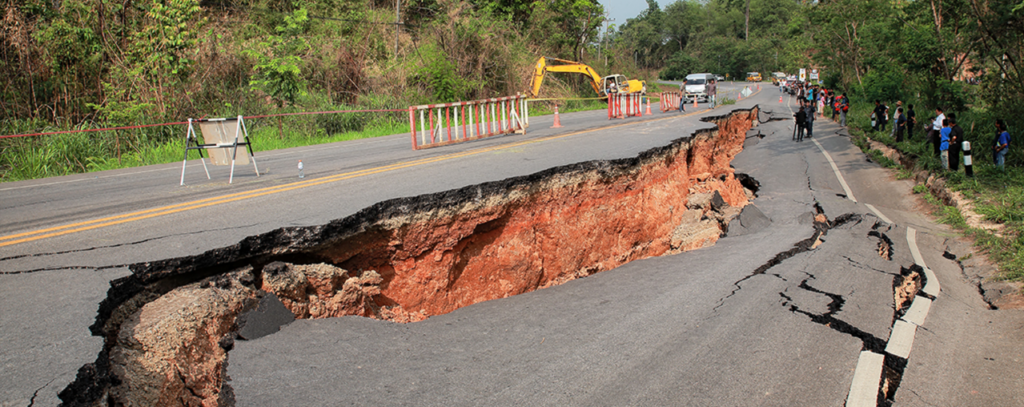
An earthquake is the sudden release of energy stored within the Earth’s crust, resulting in seismic waves that radiate outward and cause the shaking of the ground that can range from imperceptible tremors to catastrophic destruction. This release of energy occurs when stress accumulated over time along faults, fractures, or other geological features exceeds the strength of the rocks involved, causing a sudden rupture and rapid movement along the failure surface. Earthquakes occur constantly across the globe, with hundreds of thousands of detectable events happening every year, though the vast majority are too small to be felt by people.
The scientific study of earthquakes, known as seismology, has revealed that earthquakes are not a single uniform phenomenon but instead arise from a variety of distinct geological processes occurring in different settings and at different depths within the Earth. Most earthquakes are concentrated along the boundaries of tectonic plates, the massive, slowly moving sections of the Earth’s lithosphere whose interactions generate the majority of the stress that leads to seismic activity. However, earthquakes also occur within plate interiors, beneath volcanoes, and in association with human activities, each producing characteristic patterns of seismicity.
The destructive potential of earthquakes varies enormously depending on their magnitude, depth, distance from populated areas, and the specific geological mechanism that produced them. The 2011 earthquake off the coast of Japan, with a magnitude of 9.0, released energy equivalent to hundreds of millions of tons of TNT and triggered a tsunami that caused devastating loss of life and the Fukushima nuclear disaster. Understanding the different mechanisms by which earthquakes occur is essential for assessing seismic hazard, designing earthquake-resistant infrastructure, and developing early warning systems in earthquake-prone regions.
Earthquakes can be classified along multiple dimensions — by the type of fault movement that generates them, by their location relative to tectonic plate boundaries, by their depth within the Earth, and by the specific cause or triggering mechanism involved. Exploring the different types of earthquakes reveals the remarkable diversity of geological processes capable of generating seismic energy and illustrates why earthquake hazard varies so significantly from one region of the world to another.
Tectonic Earthquakes
A tectonic earthquake occurs when stress accumulated along a fault due to the movement of tectonic plates is suddenly released, causing the rocks on either side of the fault to slip relative to one another. This category represents the vast majority of significant earthquakes worldwide and is responsible for the most powerful and destructive seismic events ever recorded.
Tectonic earthquakes are concentrated along the boundaries between tectonic plates, where the relative motion of adjacent plates generates the stress that eventually exceeds the strength of the crustal rocks. The specific characteristics of a tectonic earthquake, including its depth, magnitude, and the type of fault movement involved, depend significantly on the nature of the plate boundary along which it occurs.
Volcanic Earthquakes
A volcanic earthquake is associated with volcanic activity, occurring as a result of the movement of magma, gas, or fluids within and beneath a volcano, or as a direct consequence of volcanic eruptions themselves. These earthquakes are typically smaller and shallower than major tectonic earthquakes but can occur in intense swarms that provide important information about volcanic activity.
The patterns of volcanic earthquakes are closely monitored by volcanologists as an important tool for forecasting eruptions, since increases in the frequency or changes in the character of volcanic seismicity often precede significant volcanic activity. Volcanic earthquakes can result from the fracturing of rock as magma forces its way through the crust, or from the resonance created by fluid movement within volcanic conduits.
Collapse Earthquakes
A collapse earthquake occurs when underground cavities, such as those created by mining activities, the dissolution of soluble rocks like limestone, or volcanic processes, collapse and cause the ground above to subside suddenly. These earthquakes are typically small in magnitude and very localized compared to tectonic earthquakes.
The collapse of underground mine workings has historically been a significant cause of this earthquake type in mining regions, where the removal of large volumes of rock can leave unsupported cavities that eventually fail under the weight of the overlying material. Natural collapse earthquakes can also occur in karst landscapes, where the gradual dissolution of limestone by groundwater creates underground caverns that may eventually collapse.
Explosion Earthquakes
An explosion earthquake is caused by an artificial explosion, whether from mining and quarrying operations, military testing of explosive devices including nuclear weapons, or other industrial activities that release energy suddenly into the surrounding rock. These events produce seismic waves that can be detected and recorded by seismometers in the same way as natural earthquakes.
Distinguishing explosion earthquakes from natural earthquakes is an important task in seismology, particularly in the context of monitoring compliance with nuclear test ban treaties, as the seismic signatures of explosions differ in certain characteristic ways from those of natural tectonic events. The ability to make this distinction has become an important application of seismological science in international security and arms control verification.
Induced Earthquakes
An induced earthquake is caused by human activities that alter the stress conditions within the Earth’s crust, including the injection or extraction of fluids associated with oil and gas operations, the filling of large reservoirs behind dams, geothermal energy extraction, and underground waste disposal. These earthquakes have become an increasingly significant topic of study as human subsurface activities have expanded.
The injection of wastewater from oil and gas operations into deep underground formations has been linked to significant increases in seismic activity in several regions, including parts of the central United States, where areas with historically low natural seismicity have experienced substantial increases in earthquake frequency. Understanding and managing induced seismicity has become an important consideration in the regulation of activities that involve significant subsurface fluid injection or extraction.
Shallow Earthquakes
A shallow earthquake occurs at a depth of less than approximately 70 kilometers below the Earth’s surface, representing the depth range in which the majority of significant earthquakes occur and where seismic energy is most efficiently transmitted to the surface with the least amount of attenuation. Shallow earthquakes tend to cause the most severe surface shaking relative to their magnitude.
Because the seismic energy from a shallow earthquake has a relatively short distance to travel to reach the surface, these events tend to produce more intense ground shaking and greater damage for a given magnitude compared to deeper earthquakes of similar size. Most of the world’s most destructive earthquakes throughout history have been shallow events, occurring at depths where their energy is most directly felt by surface infrastructure and populations.
Intermediate-Depth Earthquakes
An intermediate-depth earthquake occurs at a depth between approximately 70 and 300 kilometers below the surface, typically associated with subduction zones where one tectonic plate is being forced beneath another into the mantle. These earthquakes occur within the descending slab of subducted oceanic crust as it bends, stretches, and undergoes mineral transformations under increasing pressure and temperature.
Although intermediate-depth earthquakes can release substantial amounts of energy, their greater distance from the surface compared to shallow earthquakes generally results in less intense surface shaking for a given magnitude, though large intermediate-depth events can still cause significant damage over wide areas. These earthquakes provide important information about the behavior of subducted lithosphere as it descends into the Earth’s mantle.
Deep-Focus Earthquakes
A deep-focus earthquake occurs at a depth greater than 300 kilometers, with some events recorded at depths approaching 700 kilometers, representing some of the deepest seismic activity detected anywhere on Earth. These earthquakes occur exclusively within subduction zones, where cold, dense oceanic lithosphere descends into the hot mantle.
The mechanism behind deep-focus earthquakes has long puzzled seismologists, as the high pressures and temperatures at these depths would normally be expected to cause rocks to deform plastically rather than fracture suddenly as occurs in shallower brittle failure. Despite their great depth, large deep-focus earthquakes can sometimes still be felt at the surface over very wide areas, though they rarely cause significant damage due to the enormous distance the seismic waves must travel.
Megathrust Earthquakes
A megathrust earthquake occurs along the boundary of a subduction zone where one tectonic plate is being forced beneath another, producing some of the largest and most powerful earthquakes recorded anywhere on Earth. These events occur when a long segment of the subduction interface that has been locked by friction suddenly ruptures.
Megathrust earthquakes are responsible for nearly all of the largest earthquakes in recorded history, including the 1960 Chile earthquake, the largest ever recorded, and the 2004 Indian Ocean earthquake that triggered a devastating tsunami across the region. The vast rupture areas involved in megathrust events, sometimes extending for hundreds of kilometers along a subduction zone, are what allow these earthquakes to release such enormous quantities of energy.
Strike-Slip Earthquakes
A strike-slip earthquake occurs along a fault where the two sides move horizontally past one another, with little or no vertical displacement, generating a shearing motion along the fault plane. The San Andreas Fault in California is one of the most well-known examples of a fault that produces this type of earthquake.
Strike-slip earthquakes can occur at transform plate boundaries, where two plates slide horizontally past each other, as well as along faults within plate interiors that have developed in response to regional stress patterns. The horizontal motion characteristic of strike-slip earthquakes can offset roads, fences, and other linear surface features by significant distances during large events.
Normal Fault Earthquakes
A normal fault earthquake occurs along a fault where the rock above the fault plane, known as the hanging wall, moves downward relative to the rock below, known as the footwall, in response to extensional stress that is pulling the crust apart. These earthquakes are characteristic of regions where tectonic plates are diverging or where the crust is being stretched.
Normal fault earthquakes are common in rift zones, such as the East African Rift, where the crust is actively splitting apart, as well as in regions experiencing crustal extension for other geological reasons. The vertical displacement associated with normal fault earthquakes can create distinctive landscape features, including steep fault scarps that mark the boundary between the dropped and stationary blocks of crust.
Reverse and Thrust Fault Earthquakes
A reverse fault earthquake, or thrust fault earthquake when the fault plane is at a low angle, occurs when the rock above the fault plane moves upward relative to the rock below, in response to compressional stress that is pushing the crust together. These earthquakes are characteristic of regions where tectonic plates are colliding or converging.
Thrust fault earthquakes are responsible for many of the world’s largest and most destructive seismic events, including megathrust earthquakes at subduction zones and major earthquakes associated with continental collision zones such as the Himalayas. The compressional forces that generate these earthquakes are also responsible for building some of the world’s largest mountain ranges over geological time.
Aftershocks
An aftershock is a smaller earthquake that occurs in the same general area as a larger earthquake, known as the mainshock, following the mainshock’s occurrence as the crust adjusts to the stress changes caused by the initial rupture. Aftershock sequences can continue for days, months, or even years following a major earthquake.
The frequency and magnitude of aftershocks generally decrease over time following the mainshock according to a well-documented statistical pattern, though large aftershocks can still cause significant additional damage to structures already weakened by the mainshock. Aftershock sequences provide valuable information to seismologists about the stress changes that occur around a fault following a major rupture.
Foreshocks
A foreshock is a smaller earthquake that occurs in the vicinity of a fault before a larger earthquake, known as the mainshock, occurs on the same or a related fault segment. Unlike aftershocks, which are easily identified after the fact, foreshocks can only be definitively identified retrospectively, once the larger mainshock has occurred.
The relationship between foreshocks and the mainshocks that follow them remains an area of active seismological research, as not all earthquakes are preceded by identifiable foreshocks, and the presence of smaller earthquakes does not reliably predict that a larger event will follow. Understanding foreshock patterns is of significant interest for earthquake forecasting, though reliable short-term prediction based on foreshock activity remains an unsolved scientific challenge.
Swarm Earthquakes
A swarm earthquake refers to a sequence of many earthquakes of similar magnitude occurring in a relatively small area over a period of days, weeks, or months, without a single dominant mainshock that the other events can be classified as foreshocks or aftershocks of. Earthquake swarms are often associated with volcanic activity or with fluid movement within the crust.
Swarms can occur in geothermal areas, along certain types of faults, and in regions experiencing induced seismicity related to human activities such as fluid injection, with the pattern of activity often providing important clues about the underlying processes driving the seismicity. The occurrence of a swarm in a volcanic area is often monitored closely as a potential indicator of changing volcanic activity.
Submarine Earthquakes
A submarine earthquake occurs beneath the ocean floor, generated by the same range of tectonic and geological processes that cause earthquakes on land but located at sites that may be very remote from human populations. Despite their remote locations, submarine earthquakes can have significant effects on coastal regions through the tsunamis they can generate.
When a submarine earthquake involves significant vertical displacement of the seafloor, it can displace the overlying water column and generate a tsunami that travels across the ocean and impacts coastlines that may be thousands of kilometers from the earthquake’s location. The 2004 Indian Ocean earthquake and the 2011 Japan earthquake are both examples of submarine earthquakes that generated catastrophic tsunamis affecting coastal populations across entire ocean basins.