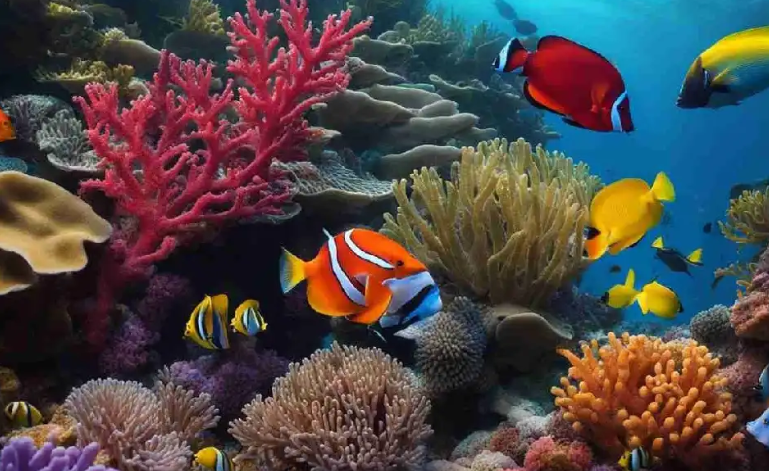
Coral reefs are among the most biologically diverse and ecologically valuable ecosystems on the planet, often described as the rainforests of the sea because of the staggering variety of life they support relative to the relatively small area they occupy. Built over thousands of years by colonies of tiny marine animals called coral polyps that secrete calcium carbonate skeletons, reefs form massive limestone structures that provide habitat for an estimated 25% of all marine species, despite covering less than 1% of the ocean floor. This extraordinary concentration of biodiversity makes coral reefs one of the most important ecosystems for understanding marine life as a whole.
Coral reefs form through a remarkable symbiotic relationship between coral polyps and microscopic algae called zooxanthellae, which live within the coral’s tissues and provide the energy through photosynthesis that allows reef-building corals to grow their stony skeletons at the rates necessary to construct massive reef structures over geological time. This relationship requires specific conditions — warm water temperatures, clear water that allows sunlight to penetrate, and relatively stable salinity — which is why coral reefs are concentrated in tropical and subtropical waters, primarily within the band of ocean stretching roughly between the Tropics of Cancer and Capricorn.
The economic and ecological value of coral reefs is immense, with reefs providing an estimated $9.9 trillion in annual economic value globally through fisheries, tourism, and coastal protection. Reefs act as natural breakwaters, absorbing wave energy and protecting coastlines from erosion and storm damage, while also supporting the fishing industries that hundreds of millions of people worldwide depend on for food and livelihoods. Yet coral reefs are also among the most threatened ecosystems on Earth, with rising ocean temperatures, acidification, pollution, and destructive fishing practices having already destroyed significant portions of reef systems worldwide.
The classification of coral reefs is based primarily on their physical structure, their relationship to nearby landmasses, and the specific geological and oceanographic conditions under which they form. Charles Darwin’s pioneering work on coral reef formation in the 19th century established the foundational framework for understanding how reefs develop and transform over time, a framework that remains largely valid even as modern science has added considerable detail and nuance to our understanding. Exploring the different types of coral reefs reveals both the diversity of forms these remarkable structures can take and the geological processes that shape them over time.
Fringing Reef
A fringing reef is the most common type of coral reef, growing directly along or close to the shoreline of an island or continent with little or no lagoon separating the reef from the land. Fringing reefs typically form in shallow water close to shore, creating a narrow band of reef that closely follows the contours of the coastline.
This reef type often represents the earliest developmental stage in Darwin’s classic model of reef evolution, forming the foundation from which barrier reefs and eventually atolls can develop over long geological timescales. Fringing reefs are widespread throughout the Red Sea, the Caribbean, and across much of Southeast Asia, often forming the first reef structures encountered by anyone wading out from a tropical beach.
Barrier Reef
A barrier reef is separated from the shoreline by a relatively wide and often deep lagoon, forming a substantial offshore barrier that runs parallel to the coast at some distance from it. The Great Barrier Reef off the coast of Australia, the largest reef system in the world, is the most famous example of this reef type, stretching for over 2,300 kilometers.
The lagoon between a barrier reef and the shore can be many kilometers wide and tens of meters deep, creating a sheltered body of water that supports its own distinct ecosystems of seagrass beds, patch reefs, and sandy channels. Barrier reefs represent, in Darwin’s model, a later stage of development than fringing reefs, forming as a landmass subsides while the reef continues growing upward and outward.
Atoll
An atoll is a ring-shaped or horseshoe-shaped reef structure that encircles a central lagoon, typically forming when a volcanic island that originally supported a fringing reef gradually subsides beneath the ocean surface while the coral continues growing upward toward the light. Atolls are particularly common throughout the Pacific and Indian Oceans.
Many of the world’s low-lying island nations, including the Maldives, Kiribati, and the Marshall Islands, are built upon atoll structures that rise only a few meters above sea level, making them especially vulnerable to rising sea levels. The central lagoons of atolls often support unique and isolated ecosystems, with the surrounding reef ring providing protection from open ocean waves.
Patch Reef
A patch reef is a relatively small, isolated reef structure that rises from the seafloor within a lagoon or shallow continental shelf area, distinct from the larger continuous reef structures of fringing and barrier reefs. Patch reefs often occur in clusters scattered across a lagoon floor.
These isolated formations create a complex mosaic of reef habitat interspersed with sand, seagrass, and open water, supporting diverse fish communities that move between the patches and surrounding habitats. Patch reefs are particularly common within the lagoons of larger barrier reef systems, where they provide important stepping-stone habitats for reef organisms.
Bank Reef
A bank reef, sometimes called a platform reef, develops on a submerged elevated portion of the seafloor known as a bank, growing upward and outward in a roughly circular or elongated shape. Bank reefs are typically larger than patch reefs but lack the extensive linear structure of a barrier reef.
These reefs are found in many of the world’s reef regions and often support extensive reef flats that can be exposed at very low tides, creating distinct zones of life adapted to periodic air exposure. Bank reefs can sometimes grow large enough to break the ocean surface entirely, forming small islands or cays at their center.
Apron Reef
An apron reef is a relatively short, sloping reef structure that extends outward and downward from a shoreline, forming an apron-like shape around a point or headland rather than running continuously along an extended coastline. These reefs often form where local coastal topography creates favorable conditions for coral growth.
The sloping profile of an apron reef typically reflects the underlying shape of the headland or point it surrounds, creating a reef structure that hugs the contours of the coastline at that specific location. Apron reefs are often smaller and less extensive than the major fringing and barrier reef systems found nearby.
Ribbon Reef
A ribbon reef is a long, narrow, and often winding reef structure that typically forms along the outer edge of a continental shelf, frequently found in association with larger barrier reef systems such as the Great Barrier Reef. Ribbon reefs often mark the boundary between shallower shelf waters and much deeper waters beyond.
Their narrow, elongated shape creates a distinctive linear formation that can stretch for considerable distances along the shelf edge, often with steep drop-offs on their outer, oceanward side. These reefs are popular among divers for the dramatic contrast between the shallow reef structure and the deep blue water immediately beyond it.
Table Reef
A table reef, also known as a platform reef in some classifications, is an isolated reef that rises from deep water and has a relatively flat top, typically not associated with any island and often too small or deep to break the ocean’s surface. Table reefs can be found scattered across many ocean basins.
Because they may be entirely submerged yet rise abruptly from much deeper surrounding water, table reefs can pose significant navigational hazards to shipping, sometimes lying just beneath the surface in otherwise open ocean. Their isolation often makes them important oases of reef habitat in areas otherwise dominated by open water and soft sediment.
Cay Reef
A cay reef, often associated with small sandy islands called cays, forms when sediment and coral debris accumulate on top of a reef platform to create a small, low-lying island. Cay reefs are common throughout the Caribbean, the Great Barrier Reef region, and other tropical reef areas.
The cays themselves often support vegetation and, in some cases, permanent or temporary human habitation, while also serving as critically important nesting sites for seabirds and sea turtles. The reef platform beneath and surrounding a cay continues to function as a living reef ecosystem even as the island above it remains largely a sandy, terrestrial environment.
Coral Pinnacle
A coral pinnacle, sometimes called a bommie, is a tower-like or column-shaped coral formation that rises steeply from a reef flat or lagoon floor, often reaching close to the surface from considerably deeper water below. Coral pinnacles create dramatic underwater landscapes popular with divers.
Their vertical relief concentrates marine life at different depths along a single structure, creating distinct microhabitats from the pinnacle’s base to its summit within a relatively small horizontal area. Pinnacles are often formed by particularly hardy or fast-growing coral species capable of building structures that extend well above the surrounding seafloor.
Microatoll
A microatoll is a small, disc-shaped or ring-shaped coral colony, typically formed by a single coral species, whose growth is constrained vertically by exposure to air at low tide. This constraint causes the colony to grow outward in a flat, ring-like pattern rather than upward into a mound.
Microatolls are valuable to scientists studying historical sea level changes, as their growth patterns over time provide a natural record of past water levels at a given location. The flat, dead center of an aging microatoll combined with its living outer ring creates a distinctive donut-shaped formation that can be observed across many reef flats.
Deep-Water Coral Reef
A deep-water coral reef, also called a cold-water coral reef, forms in dark, cold ocean waters far below the depths typically associated with tropical coral reefs. These reefs are built by coral species that do not rely on the photosynthetic zooxanthellae that warm-water corals depend on.
Found in locations including the waters off Norway and in parts of the Atlantic and Pacific, deep-water reefs were discovered relatively recently and have revealed that reef-building corals are far more widespread across the world’s oceans than previously understood. These reefs grow extremely slowly and can take thousands of years to develop, making them especially vulnerable to disturbance from bottom trawling and other deep-sea activities.
Mesophotic Coral Reef
A mesophotic coral reef occurs at depths between roughly 30 and 150 meters, in a zone where light levels are too low to support the shallow-water corals most people associate with reefs but still sufficient for certain light-adapted coral species. These reefs occupy a transitional zone between shallow and deep-water reef ecosystems.
Mesophotic reefs are increasingly recognized as potentially important refuges for coral diversity, as their depth may offer some protection from the warming surface waters that threaten shallow reefs during marine heatwaves. Scientists are actively studying whether these deeper reefs could help repopulate damaged shallow reefs through the dispersal of larvae.
Artificial Reef
An artificial reef is a human-made underwater structure, constructed from materials ranging from purpose-built concrete modules to sunken ships, decommissioned oil platforms, and other repurposed structures. These structures are designed to provide substrate for coral growth and habitat for marine life where natural reefs do not exist or have been degraded.
Artificial reefs have become an important tool in marine conservation and restoration efforts, as well as in efforts to create new diving destinations and fish habitat for recreational and commercial fishing. Over time, many artificial reefs become colonized by corals and other marine organisms to the point that they develop ecological communities resembling those found on natural reef structures.
Coral Carpet
A coral carpet refers to a reef formation dominated by low-growing, encrusting, or carpet-like coral species that spread horizontally across the seafloor rather than forming the towering branching or massive structures associated with many other reef types. These formations create a distinctive flat, textured appearance across the seafloor.
These formations often occur in areas with strong currents or wave action where more fragile branching coral forms would be quickly damaged, favoring instead the resilient, low-profile growth patterns of encrusting species. Coral carpets can cover extensive areas of seafloor, forming an important but visually subtle component of many reef ecosystems.
Coral Garden
A coral garden is an area characterized by a particularly dense and diverse concentration of coral colonies of varying species, sizes, and growth forms, creating a visually striking underwater landscape that resembles a cultivated garden in its variety and arrangement. These areas often represent the most photogenic sections of a reef.
Coral gardens often occur in locations with optimal conditions for coral diversity and represent some of the most biodiverse and visually spectacular sections of larger reef systems, frequently becoming focal points for diving tourism. The dense mix of coral forms in a coral garden also creates an exceptionally rich habitat that supports a correspondingly diverse community of fish and invertebrates.