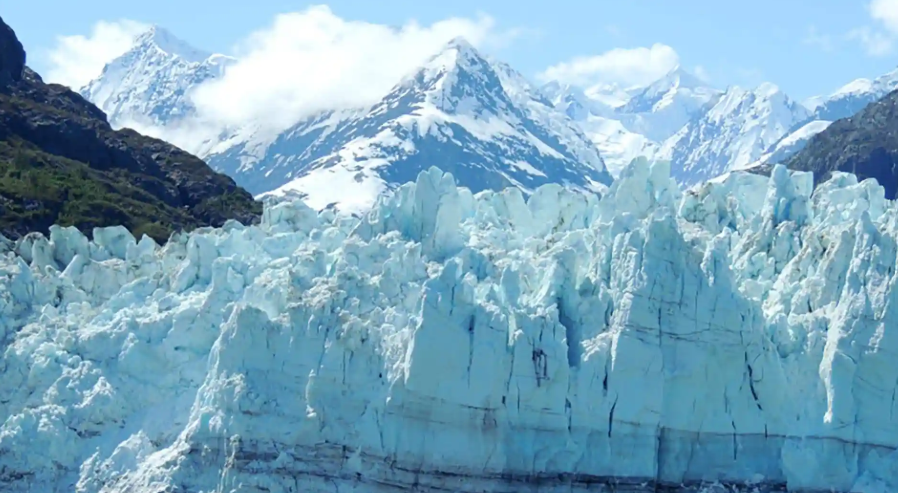
Glaciers are among the most powerful and transformative forces operating on the surface of the Earth — slow-moving masses of compacted snow and ice that carve landscapes, store freshwater, regulate sea levels, and reflect solar energy back into space with a quiet, relentless persistence that has shaped our planet for hundreds of millions of years. A glacier forms when snowfall in a given area consistently exceeds snowmelt over many years, causing successive layers of snow to accumulate, compress, and recrystallize into dense glacial ice. Over time, the sheer weight of the accumulated ice causes it to deform and flow under gravity, moving downslope or outward from a central accumulation zone in the slow, grinding motion that defines glacial behavior.
The global extent of glaciers is both enormous and alarmingly diminished from its recent past. Today, glaciers and ice sheets cover approximately 10 percent of the Earth’s land surface — about 14.9 million square kilometers — but this represents a significant reduction from the peak of the last Ice Age approximately 20,000 years ago, when ice covered roughly 30 percent of all land. The Antarctic Ice Sheet alone contains approximately 26.5 million cubic kilometers of ice, equivalent to about 58 meters of potential global sea level rise if it were to melt entirely. The Greenland Ice Sheet holds enough ice to raise global sea levels by an additional 7.2 meters. Together, the world’s glaciers and ice sheets store approximately 69 percent of all the Earth’s fresh water.
The importance of glaciers extends far beyond their role as frozen water reservoirs. They are among the most sensitive and visible indicators of climate change on the planet, their advance and retreat reflecting shifts in temperature and precipitation with a clarity that makes them invaluable tools for climate scientists. Mountain glaciers provide dry-season water supplies for an estimated 1.9 billion people across Asia, South America, and other regions where glacial meltwater feeds rivers during the warmest and driest months of the year. Glaciers have sculpted some of the world’s most spectacular landscapes — from the fjords of Norway and the cirques of the Alps to the broad outwash plains of Iceland and Alaska. Understanding the different types of glaciers is therefore essential to understanding both the physical geography of our planet and the profound changes currently reshaping it.
Continental Ice Sheets
Continental ice sheets are the largest type of glacier on Earth, vast domes of ice covering millions of square kilometers and burying entire continents and mountain ranges beneath their weight. They form in polar regions where snowfall accumulates over thousands of years, building up ice masses of extraordinary thickness — the Antarctic Ice Sheet reaches a maximum thickness of approximately 4,776 meters, more than four times the height of the tallest building ever constructed. Ice sheets flow outward from their central domes under the pressure of their own weight, spreading toward the margins where ice is lost through melting and calving. Only two true ice sheets exist on Earth today — the Antarctic Ice Sheet, covering 13.9 million square kilometers, and the Greenland Ice Sheet, covering 1.7 million square kilometers — though during past ice ages, ice sheets covered much of North America and northern Europe.
Valley Glaciers
Valley glaciers are the classic, river-like glaciers that flow down mountain valleys under the influence of gravity, confined between valley walls just as a river is confined within its banks. They originate in high-elevation accumulation zones where snowfall is greatest and flow downvalley, often for tens of kilometers, to lower elevations where melting exceeds accumulation. Valley glaciers are the most widely distributed glacier type in the world, found in mountain ranges on every continent including the tropics. The Fedchenko Glacier in Tajikistan is the world’s longest valley glacier outside the polar regions, stretching 77 kilometers through the Pamir Mountains. Valley glaciers are responsible for carving the dramatic U-shaped valleys, cirques, and hanging valleys that characterize glaciated mountain landscapes worldwide.
Piedmont Glaciers
Piedmont glaciers form when valley glaciers descend from mountain valleys and spread out onto flat plains at the foot of the mountains, freed from the confining walls of their valleys and expanding into broad, fan-shaped or lobate masses of ice. The transition from a confined valley glacier to an unconstrained piedmont lobe produces a distinctive spreading pattern quite different from the narrow ribbon of a valley glacier. The Malaspina Glacier in Alaska is the world’s largest piedmont glacier, covering approximately 3,900 square kilometers at the foot of the Saint Elias Mountains — an area larger than the state of Rhode Island. From the air, the Malaspina presents a spectacular display of folded and swirled medial moraines that record the complex flow history of the multiple tributary glaciers that feed it.
Cirque Glaciers
Cirque glaciers are small, bowl-shaped glaciers that occupy cirques — the rounded, armchair-shaped hollows carved into mountainsides by glacial erosion. They represent an early stage in glacial development and are found in high mountain environments around the world where conditions are cold enough to sustain ice but where the topography does not allow the formation of larger valley glaciers. Cirque glaciers are particularly sensitive to climate change because of their small size and limited ice volume — many that were thriving a century ago have now disappeared entirely. The Alps alone have lost approximately 50 percent of their glacier area since 1900, with many cirque glaciers among the first casualties. Despite their modest size, cirque glaciers are powerful erosional agents, carving the characteristic rounded hollows that persist in the landscape long after the ice itself has gone.
Tidewater Glaciers
Tidewater glaciers are valley or outlet glaciers that flow directly into the sea, terminating in a calving front where large blocks of ice break off into the water as icebergs. They are found primarily in Alaska, Greenland, Svalbard, Patagonia, and Antarctica, and they are among the most dynamic and visually dramatic of all glacier types. The calving of icebergs from tidewater glaciers is one of the primary mechanisms by which ice sheets and glaciers lose mass to the ocean. Columbia Glacier in Alaska retreated approximately 20 kilometers between 1980 and 2010 — one of the fastest retreating glaciers ever documented — losing an estimated 100 cubic kilometers of ice in the process. The cracking and thunderous calving events at the fronts of tidewater glaciers can produce icebergs the size of city blocks.
Ice Caps
Ice caps are dome-shaped masses of ice that cover high plateaus or islands, smaller than continental ice sheets but sharing their characteristic of covering the underlying topography rather than being confined to valleys. They flow outward in all directions from a central high point, feeding outlet glaciers that descend to lower elevations around their margins. Iceland sits atop several major ice caps — Vatnajökull, Europe’s largest glacier by volume at approximately 8,100 cubic kilometers, covers roughly 8 percent of Iceland’s total land area. The ice caps of Arctic islands including Svalbard, Franz Josef Land, and Baffin Island are retreating rapidly in response to Arctic warming, which is occurring at approximately four times the global average rate. Ice caps play an important role in regulating regional climate by reflecting solar radiation and influencing local atmospheric circulation.
Outlet Glaciers
Outlet glaciers are streams of fast-moving ice that drain ice sheets and ice caps through gaps in surrounding mountain ranges or along topographic troughs, channeling ice from the interior of a large ice mass to the coast or to lower elevations. They act as the drainage system of continental ice sheets, concentrating the outward flow of ice that would otherwise spread more slowly across a broader front. Outlet glaciers are among the fastest-moving glaciers on Earth — Jakobshavn Glacier in Greenland, one of the world’s fastest outlet glaciers, moves at speeds of up to 46 meters per day and is responsible for draining approximately 6 to 8 percent of the entire Greenland Ice Sheet. The acceleration of Greenland’s outlet glaciers in recent decades is one of the primary drivers of the ice sheet’s increasing contribution to global sea level rise.
Hanging Glaciers
Hanging glaciers are masses of ice perched on steep mountain slopes or cliff faces, clinging to the mountainside at elevations well above the main valley floor. They form where snow and ice accumulate on high ledges, ridges, or concavities in steep terrain, often in locations too steep and exposed for a conventional valley or cirque glacier to develop. Hanging glaciers are inherently unstable and are known for producing dramatic and dangerous ice avalanches when portions of the glacier break away and cascade down the mountainside below. The 2002 Kolka Glacier disaster in North Ossetia, Russia, involved a hanging glacier that collapsed and merged with a rock avalanche, producing a flow that traveled 35 kilometers and killed approximately 125 people. The hanging glaciers of the Swiss and French Alps are monitored continuously for signs of instability.
Rock Glaciers
Rock glaciers are a distinctive and often overlooked glacier type in which a mixture of ice and rock debris moves slowly downslope, with the rocky material either derived from surrounding cliffs falling onto the ice surface or formed by the freezing of water within a mass of coarse debris. They move far more slowly than conventional glaciers — typically a few centimeters to a few meters per year — and their surfaces are completely obscured by rock, making them difficult to identify without careful investigation. Rock glaciers are particularly common in semi-arid mountain environments such as the Andes, the Rockies, and the mountains of Central Asia, where they may contain significant volumes of ice and serve as important water sources. In the Chilean and Argentinian Andes, rock glaciers are estimated to contain more freshwater than all conventional glaciers combined in some regions.
Surging Glaciers
Surging glaciers are glaciers that periodically undergo dramatic episodes of extremely rapid movement, advancing at speeds tens to hundreds of times faster than their normal flow rate before returning to a slow or nearly stagnant state. A surging glacier can advance several kilometers in a matter of months, something that would normally take decades or centuries. The causes of surging are complex and not fully understood, but involve a switch in the conditions at the base of the glacier — from cold, frozen conditions that grip the bedrock to warm, water-lubricated conditions that allow the ice to slide rapidly. Approximately 1 percent of the world’s glaciers are thought to be surge-type glaciers. The Karakoram mountain range in Pakistan and China has an unusually high concentration of surging glaciers, and some Karakoram glaciers have actually been advancing in recent decades — a phenomenon known as the Karakoram Anomaly — even as glaciers worldwide are retreating.
Submarine Glaciers (Ice Shelves)
Ice shelves are floating platforms of ice attached to land-based ice sheets or glaciers, extending out over the ocean surface where the glacier flows into the sea and begins to float. They are found primarily around Antarctica, where they fringe approximately 75 percent of the continent’s coastline and cover a total area of about 1.56 million square kilometers. Ice shelves act as buttresses for the land-based ice behind them, slowing the flow of ice from the interior toward the sea. When ice shelves collapse — as the Larsen B Ice Shelf dramatically did in 2002, disintegrating 3,250 square kilometers of ice in just 35 days — the glaciers behind them accelerate dramatically, increasing their contribution to sea level rise. The Ross Ice Shelf in Antarctica is the world’s largest, roughly the size of France, and reaches thicknesses of up to 750 meters.
Polythermal Glaciers
Polythermal glaciers are glaciers that contain both cold ice — frozen throughout to temperatures well below freezing — and temperate ice — ice that is at the pressure melting point throughout, containing liquid water between ice crystals. The distribution of cold and temperate ice within a polythermal glacier significantly influences its behavior, particularly its sliding speed, erosional capacity, and hydrological characteristics. Most large glaciers in the world are polythermal to some degree, with a temperate core surrounded by colder ice near the surface and margins. Svalbard’s glaciers are among the most extensively studied polythermal glacier systems in the world, and research there has been critical to understanding how changes in the thermal regime of glaciers affect their dynamics and their response to climate warming. The transition between cold and temperate ice zones within polythermal glaciers is a major focus of current glaciological research.