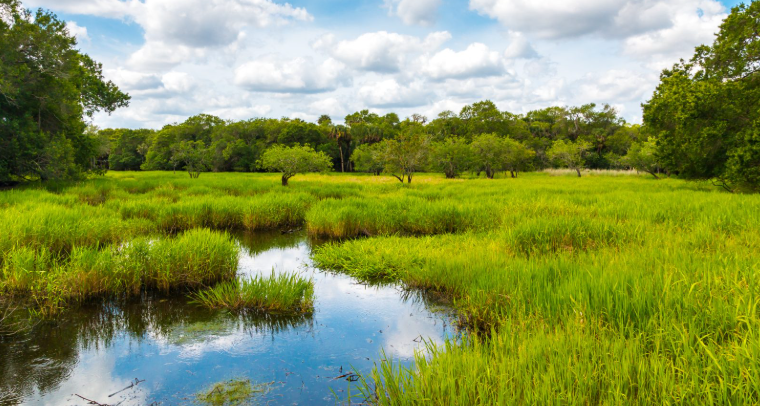
Wetlands are among the most ecologically productive and biologically diverse ecosystems on Earth, occupying the transitional zones between dry land and open water where soil remains saturated or submerged for at least part of the year. Despite covering only around 6% of the planet’s land surface, wetlands support an estimated 40% of all plant and animal species, making them disproportionately important to global biodiversity relative to their physical extent. They occur on every continent except Antarctica, ranging from vast tropical floodplains to small mountain bogs.
The ecological functions wetlands perform extend far beyond habitat provision. They filter pollutants and sediment from water before it reaches rivers, lakes, and oceans, acting as natural water treatment systems. They absorb floodwaters during storms and release water gradually during dry periods, buffering both flood and drought extremes. Coastal wetlands in particular provide critical storm protection for shorelines, absorbing wave energy and reducing the impact of hurricanes and tropical storms on inland communities.
Wetlands have historically been undervalued and heavily destroyed, often drained for agriculture, development, or mosquito control under the assumption that they represented unproductive, even hazardous, land. The United States alone lost more than half of its original wetland area during the 19th and 20th centuries, and similar patterns of loss occurred across Europe, Asia, and other regions during periods of agricultural expansion and urbanization. Only in recent decades has the immense ecological and economic value of wetlands been widely recognized, prompting restoration efforts and legal protections in many countries.
The classification of wetlands is complex, as these ecosystems exist along continuums of salinity, water depth, flow patterns, vegetation type, and soil composition rather than falling into neatly separated categories. Scientists and conservation organizations use various classification systems, with the Ramsar Convention on Wetlands recognizing dozens of distinct wetland types grouped into broad categories of marine and coastal, inland, and human-made wetlands. Understanding the different types of wetlands reveals the remarkable diversity of these ecosystems and the distinct ecological roles each plays.
Marsh
A marsh is a wetland dominated by herbaceous, non-woody vegetation such as grasses, reeds, sedges, and rushes, typically occurring in areas with relatively shallow standing water and nutrient-rich soils. Marshes are among the most productive wetland types, supporting dense plant growth that provides food and shelter for waterfowl, fish, amphibians, and a vast array of invertebrate species.
Swamp
A swamp is a wetland characterized by woody vegetation — trees and shrubs — growing in standing or slow-moving water, distinguishing it from the herbaceous vegetation typical of marshes. Swamps occur in both freshwater and saltwater environments, with cypress and tupelo swamps of the southeastern United States and mangrove swamps in tropical coastal zones representing two of the most ecologically significant swamp types found around the world.
Bog
A bog is an acidic, nutrient-poor wetland fed primarily by rainfall rather than groundwater or surface runoff, characterized by the slow accumulation of partially decomposed plant material known as peat. The acidic, oxygen-poor conditions of bogs slow decomposition dramatically, allowing peat to build up over thousands of years and creating environments where specialized plants like sphagnum moss and carnivorous species such as sundews and pitcher plants thrive.
Fen
A fen is a peat-forming wetland similar to a bog but fed by groundwater or surface water rich in minerals and nutrients, resulting in less acidic conditions that support a greater diversity of plant life than the nutrient-poor environment of a bog. Fens often develop where groundwater rich in calcium emerges at the surface, creating alkaline conditions that favor sedges, grasses, and a wide variety of wildflowers not found in more acidic peatlands.
Floodplain
A floodplain is the relatively flat area of land adjacent to a river or stream that becomes inundated with water during periods of high flow, creating a dynamic wetland environment shaped by the regular cycle of flooding and drying. Floodplain wetlands deposit nutrient-rich sediment across the land during flood events, historically making floodplains some of the most agriculturally fertile regions in the world while also providing critical habitat for fish spawning and migratory bird stopover sites.
Mangrove Forest
A mangrove forest is a coastal wetland dominated by salt-tolerant trees and shrubs adapted to grow in the brackish, oxygen-poor mud of tidal zones in tropical and subtropical regions. Mangrove forests provide nursery habitat for countless fish and invertebrate species, stabilize coastlines against erosion, and sequester carbon at rates significantly higher than most terrestrial forests, making them among the most valuable wetland ecosystems for both biodiversity and climate regulation.
Salt Marsh
A salt marsh is a coastal wetland found in the upper intertidal zone of temperate regions, dominated by salt-tolerant grasses and other halophytic vegetation that can survive regular inundation by saltwater. Salt marshes serve as critical nursery grounds for commercially important fish and shellfish species, filter pollutants from water flowing toward the ocean, and provide essential habitat for migratory shorebirds and waterfowl along major flyways.
Estuary
An estuary is the wetland environment formed where a river meets the sea, creating a zone of brackish water where freshwater and saltwater mix in proportions that vary with tides, seasons, and freshwater flow. Estuaries are among the most productive ecosystems on Earth, supporting complex food webs that sustain commercial fisheries, and they serve as critical transition zones for fish species that migrate between freshwater and marine environments during their life cycles.
Vernal Pool
A vernal pool is a temporary wetland that fills with water during wet seasons — typically spring, giving the pool its name — and dries out completely during summer or other dry periods, creating a unique ecosystem free of fish predators that allows specialized amphibians and invertebrates to complete their breeding cycles. Many species that depend on vernal pools, including certain frogs, salamanders, and fairy shrimp, have evolved life cycles precisely timed to the pools’ predictable cycle of filling and drying.
Riparian Wetland
A riparian wetland occurs in the zone of vegetation directly bordering a river, stream, or other watercourse, where the influence of the adjacent water body creates conditions distinct from the surrounding upland. Riparian wetlands stabilize streambanks against erosion, filter runoff before it enters the watercourse, provide shade that regulates water temperature for aquatic species, and create critical wildlife corridors connecting larger habitat areas.
Peatland
A peatland is any wetland characterized by the accumulation of peat — partially decomposed organic matter that builds up over centuries to millennia under waterlogged, low-oxygen conditions — encompassing both bogs and fens as its major subtypes. Peatlands store an estimated one-third of the world’s soil carbon despite covering only a small fraction of the land surface, making their conservation and restoration a significant priority in efforts to mitigate climate change.
Wet Meadow
A wet meadow is a grassland wetland that experiences seasonal saturation or shallow flooding but typically lacks standing water for most of the year, supporting a diverse community of grasses, sedges, and wildflowers adapted to periodically waterlogged soil. Wet meadows often occur at the transition between marshes and drier grassland habitats, providing important breeding habitat for grassland birds and a rich diversity of pollinator-friendly flowering plants.
Pocosin
A pocosin is a type of shrub-dominated, evergreen wetland found primarily on the Atlantic coastal plain of the southeastern United States, characterized by acidic, sandy, nutrient-poor soils and dense thickets of evergreen shrubs. Often perched on elevated terrain rather than occupying low-lying basins like most wetlands, pocosins are fire-adapted ecosystems that depend on periodic burning to maintain their characteristic vegetation structure and prevent succession toward forest.
Carr
A carr is a type of wetland woodland dominated by willow, alder, or birch trees growing in waterlogged, often peaty soil, representing a transitional stage between open fen vegetation and drier woodland. Carrs are particularly characteristic of temperate regions of Europe, where they form important habitat corridors and represent one of the successional stages that can occur as fens gradually accumulate organic matter and dry out over long timescales.
Tidal Flat
A tidal flat, also known as a mudflat, is a coastal wetland consisting of sediment-rich areas that are exposed during low tide and submerged during high tide, typically lacking the vegetation found in salt marshes or mangroves but supporting enormous populations of burrowing invertebrates. Tidal flats are critically important feeding grounds for migratory shorebirds, which time their long-distance flights to coincide with the tidal exposure of these invertebrate-rich sediments.
Oxbow Lake Wetland
An oxbow lake wetland forms when a meandering river changes course, leaving behind a crescent-shaped body of water that becomes isolated from the main channel and gradually develops into a distinct wetland ecosystem. These cut-off water bodies often become highly productive habitats as they fill with sediment and organic matter over time, supporting dense aquatic vegetation and serving as important refuges for fish during flood events on the adjacent river.
Seep and Spring Wetland
A seep or spring wetland forms where groundwater emerges at the surface, creating a consistently saturated area that may be quite small but often supports highly specialized plant communities adapted to the stable temperature and chemistry of groundwater-fed environments. These wetlands can occur on hillsides, at the base of slopes, or in otherwise dry landscapes, often supporting rare or relict plant species that depend on the unusual constancy of conditions that groundwater seepage provides.
Playa Wetland
A playa wetland is a shallow, temporary wetland that forms in flat-bottomed desert or semi-arid basins when seasonal rainfall accumulates and is unable to drain or infiltrate quickly due to underlying impermeable soils. Common across the southwestern United States and other arid regions worldwide, playa wetlands provide crucial, if temporary, water sources and habitat for migratory waterfowl and other wildlife in landscapes where surface water is otherwise scarce.
Constructed Wetland
A constructed wetland is a human-made wetland system engineered to replicate the water-filtering and habitat functions of natural wetlands, typically designed to treat wastewater, manage stormwater runoff, or compensate for natural wetland losses through restoration projects. These engineered systems use carefully selected vegetation, substrate materials, and water flow designs to remove pollutants, nutrients, and sediment from water passing through them, demonstrating how an understanding of natural wetland processes can be applied to solve practical environmental challenges.
Paddy Wetland
A paddy wetland refers to the flooded agricultural fields used for rice cultivation, which function ecologically as artificial wetlands supporting significant populations of waterfowl, amphibians, and aquatic invertebrates alongside the cultivated rice crop. Rice paddies cover vast areas across Asia and other rice-growing regions, and their seasonal flooding cycles have made them an important, if human-managed, component of wetland habitat networks in many densely populated agricultural landscapes.