Waterfalls are among the most universally captivating features of the natural landscape — points where the steady, patient work of flowing water meets the dramatic vertical expression of geological difference, producing cascades of extraordinary beauty, power, and sound. Whether plunging in a single unbroken ribbon from a cliff hundreds of meters high, tumbling in a series of stepped cascades down a rocky gorge, or spreading in a broad, thundering curtain across a wide river channel, waterfalls represent moments where rivers are suddenly, spectacularly interrupted in their journey to the sea.
The world’s waterfalls vary in scale from tiny seasonal trickles spilling over roadside outcrops to some of the most powerful and voluminous water features on the planet. Angel Falls in Venezuela, the world’s highest uninterrupted waterfall, drops an astonishing 979 meters — nearly a full kilometer — from the summit of Auyán-tepui, with the water atomizing into mist long before it reaches the base. Niagara Falls, while far shorter at just 57 meters, carries an average flow of approximately 2,400 cubic meters of water per second over its crest, making it one of the most powerful waterfalls in the world by volume. Iguazu Falls on the Argentina-Brazil border spreads across a width of 2.7 kilometers and consists of approximately 275 individual falls, making it the world’s widest waterfall system.
Waterfalls are not permanent features of the landscape. They are geologically temporary, constantly being eroded and modified by the very water that creates them. Niagara Falls has retreated approximately 11 kilometers upstream from its original position at the end of the last Ice Age, moving at an average rate of about one meter per year. Some waterfalls disappear entirely as rivers cut through resistant rock bands and eliminate the differential that creates the drop. Others migrate, change character, or split into multiple cascades as erosion reshapes the underlying geology. Understanding the different types of waterfalls — defined by their form, their geological setting, and the manner in which water descends — offers a window into the dynamic relationship between flowing water and the rock over which it travels.
Plunge Waterfalls
Plunge waterfalls are the most dramatic and archetypal waterfall type, in which water descends vertically in free fall from a sharp cliff edge, losing all contact with the underlying rock face for the entire height of the drop.
They form where a band of highly resistant rock overlies softer rock that erodes more rapidly, creating an overhanging lip from which water launches into open air. The undercutting of the softer rock beneath the resistant cap is a self-reinforcing process — the falling water excavates a deep plunge pool at the base, which gradually undermines the overhang above.
Angel Falls in Venezuela is the world’s supreme example of a plunge waterfall, with its 979-meter free-fall drop so high that much of the water evaporates or is blown sideways as mist before reaching the canyon floor below. Yosemite Falls in California, dropping 739 meters in three stages, and Tugela Falls in South Africa, dropping 948 meters, are other iconic plunge waterfalls.
Horsetail Waterfalls
Horsetail waterfalls maintain continuous contact with the underlying rock face as they descend, sliding and rushing down the cliff surface rather than falling freely through the air. The water follows the contours of the rock, spreading outward as it descends and creating the characteristic fan or tail shape that gives this waterfall type its name.
The degree to which the water spreads depends on the texture and angle of the rock face — smooth, gently inclined surfaces produce broad, thin sheets of water, while rougher, steeper faces produce a more turbulent, concentrated flow. Horsetail waterfalls are among the most visually elegant of all waterfall types, the thin film of water catching light beautifully as it slides over polished rock.
Bridalveil Fall in Yosemite Valley, dropping 189 meters down a smooth granite face, is one of the world’s most photographed horsetail waterfalls. A rare optical phenomenon known as the Firefall occurs at Horsetail Fall in Yosemite each February, when the setting sun illuminates the water to glow brilliant orange and red against the darkening valley walls.
Cascades
Cascades are waterfalls in which water tumbles down a series of natural rock steps in a continuous, rushing descent rather than making a single dramatic plunge. The stepped profile of a cascade reflects the underlying geology — alternating bands of hard and soft rock, or a staircase of jointed rock blocks, create the irregular steps over which the water flows.
Cascades are among the most common waterfall types worldwide and are found in virtually every mountainous or hilly landscape. They are often more aesthetically complex than simple plunge falls, with the interplay of multiple tiers, pools, spray, and rock creating a rich visual and acoustic landscape.
The Cascades of the Yellowstone River in Yellowstone National Park descend through one of the most geologically dramatic canyon landscapes in North America. The Rhine Falls in Switzerland — the largest waterfall in Europe by volume, carrying approximately 700 cubic meters per second — is essentially a powerful cascade over a wide ridge of resistant Jurassic limestone.
Tiered Waterfalls (Multi-Step Waterfalls)
Tiered waterfalls consist of two or more distinct, clearly separated drops with intervening pools or ledges between them, giving the waterfall a stacked, layered appearance quite different from either a single plunge fall or a continuous cascade.
Each tier typically reflects a different resistant rock layer or structural feature in the underlying geology — the river drops over one resistant band, gathers briefly in an intermediate pool, then drops again over the next. The number of tiers can range from two to many dozens in complex geological settings.
Yosemite Falls is technically a tiered waterfall, its 739-meter total height divided into an upper fall of 436 meters, a middle cascade section, and a lower fall of 98 meters. Plitvice Lakes in Croatia consists of 16 terraced lakes connected by a system of tiered waterfalls and cascades, a UNESCO World Heritage Site where the falls are built from travertine deposited by the calcium-rich water itself.
Block Waterfalls
Block waterfalls occur where a wide river drops over a broad, relatively straight ledge of resistant rock, producing a wide curtain of water that spans much or all of the river’s channel width. The defining characteristic is the breadth of the fall relative to its height — a block waterfall is dramatically wider than it is tall.
They form where horizontally bedded resistant rock extends across the full width of a river valley, creating a uniform lip over which the entire river plunges simultaneously. The result can be one of the most powerful and volumetrically impressive waterfall types on Earth.
Niagara Falls is the world’s most famous block waterfall, its Horseshoe Falls section spanning approximately 670 meters in width and carrying roughly 90 percent of the Niagara River’s total flow. Victoria Falls on the Zambia-Zimbabwe border is another spectacular block waterfall, spanning 1,708 meters in width and dropping up to 108 meters — during peak flow it is considered the world’s largest sheet of falling water.
Segmented Waterfalls
Segmented waterfalls occur where a river is divided by rock outcrops, islands, or mid-channel obstacles into two or more distinct streams before dropping over the falls, creating parallel channels of falling water separated by dry or semi-dry rock.
The degree of segmentation varies with water level — during high flow, the dividing rocks may be submerged and the falls appear as a single continuous sheet, while during low flow the segments become clearly distinct. This seasonal variability is one of the defining characteristics of segmented waterfalls.
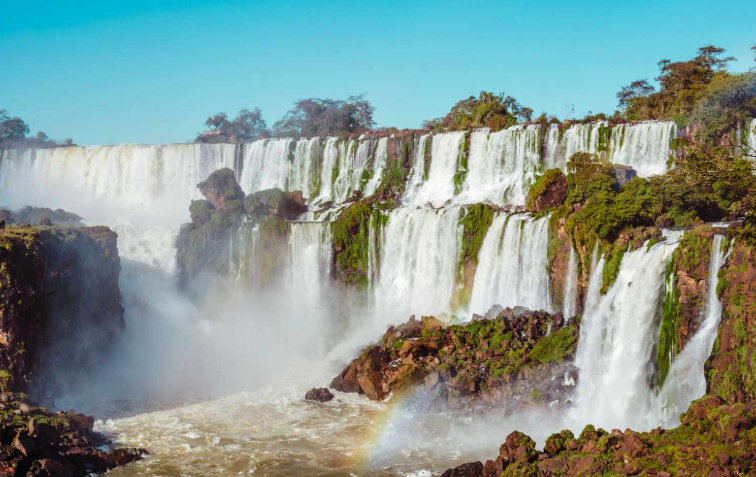
Iguazu Falls is the world’s most spectacular segmented waterfall system, its 2.7-kilometer width divided by numerous forested islands into approximately 275 individual falls. The famous Devil’s Throat section — a U-shaped chasm 82 meters deep and 150 meters wide — represents the most powerful concentration of flow within the segmented system, accounting for approximately half of the total water volume.
Punchbowl Waterfalls
Punchbowl waterfalls are characterized by a narrow, concentrated flow of water that expands dramatically as it enters a wide, circular or bowl-shaped pool at the base — the water constricts as it falls and then spreads outward into the pool like water poured into a bowl.
The punchbowl pool is typically carved into bedrock by the hydraulic action of the falling water and the swirling currents it sets up, gradually excavating a rounded depression that is significantly wider than the waterfall itself. The contrast between the narrow cascade and the wide pool creates a distinctive and visually satisfying form.
Punch Bowl Falls on the Eagle Creek Trail in Oregon is one of the most photographed examples in North America, its narrow curtain of water dropping into a perfectly circular green pool surrounded by basalt walls. Waimoku Falls in Maui, Hawaii, drops 122 meters into a punchbowl pool at the end of the Pipiwai Trail through a bamboo forest.
Fan Waterfalls
Fan waterfalls spread progressively wider as they descend, with the water fanning outward from a narrow point at the top to a broad sheet at the base — the inverse of the punchbowl form. The spreading occurs because the water follows the widening contours of the rock face beneath it, or because the initial concentrated flow breaks apart and spreads as it accelerates down the slope.
Fan waterfalls are closely related to horsetail waterfalls but are distinguished by the more pronounced and systematic widening of the water sheet from top to bottom. The most perfect fan waterfalls form on smooth, slightly outward-curving rock faces that guide the water naturally into the fan shape.
Pericnik Falls in Slovenia is a classic fan waterfall, its water spreading from a narrow lip into a broad apron that reaches the base of the cliff. Snoqualmie Falls in Washington State, dropping 82 meters and drawing over 1.5 million visitors annually, displays fan characteristics during moderate flow conditions.
Frozen Waterfalls
Frozen waterfalls, also known as ice falls, form when the temperatures in a waterfall’s environment drop sufficiently low for the falling water to freeze in place, creating extraordinary sculptural formations of ice columns, curtains, and overhanging masses that preserve the dynamic forms of flowing water in static, crystalline stillness.
The freezing process is rarely complete — typically the outer surface and edges of a waterfall freeze first while water continues to flow beneath the ice, creating hollow ice formations through which the sound of running water can often still be heard. The resulting structures are among the most visually spectacular of any natural ice formation.
Frozen waterfalls are a major attraction for ice climbers, who rate them on a scale from WI1 to WI7 based on angle and difficulty. Helmcken Falls in British Columbia, Canada, one of the world’s premier ice climbing destinations, builds up an enormous cone of ice at its base each winter — the cone can reach 60 meters in height, built from the frozen spray of the 141-meter falls above.
Moulin Waterfalls
Moulin waterfalls are a highly specialized type found exclusively in glacial environments, formed when surface meltwater on a glacier finds a crack or crevasse and plunges vertically downward through the body of the glacier to the bedrock below. The word moulin comes from the French for “mill,” referring to the churning, turbulent character of the water as it spirals downward.
Moulins are not waterfalls in the conventional sense — they descend through ice rather than over rock — but they can carry enormous volumes of water and descend hundreds of meters. They play a critical role in glacial hydrology, draining surface meltwater to the glacier’s base where it lubricates movement and accelerates glacier flow.
On the Greenland Ice Sheet, moulins have been documented carrying meltwater flows of several hundred cubic meters per second during peak summer melting — comparable to a significant surface river. As global warming accelerates surface melting on the Greenland and Antarctic ice sheets, moulins are becoming increasingly important features of polar hydrology.
Ephemeral Waterfalls
Ephemeral waterfalls exist only temporarily, flowing for hours, days, or weeks following significant rainfall or snowmelt events before drying up completely until the next precipitation event supplies sufficient water to reactivate them. They occupy watercourse channels that are dry for most of the year.
Despite their temporary nature, ephemeral waterfalls can be among the most dramatic waterfall experiences precisely because their brief appearance transforms landscapes that are normally dry and static into scenes of sudden, overwhelming water. Desert waterfalls following flash floods and spring snowmelt falls in normally dry canyons fall into this category.
Yosemite Valley hosts several famous ephemeral falls — Ribbon Fall, dropping 491 meters and ranking among the tallest waterfalls in North America, flows only from April through June fed by snowmelt from the Yosemite Creek watershed above. By midsummer, the bare granite face from which it flows is completely dry. Havasu Falls in the Grand Canyon, fed by a spring rather than seasonal flow, is one of the rare desert waterfalls that flows year-round, its vivid turquoise water stained by calcium carbonate deposits.
Submarine Waterfalls
Submarine waterfalls are one of the most surprising and counterintuitive natural phenomena — waterfalls that occur entirely beneath the ocean surface, driven not by gravity acting on freshwater over rock, but by differences in water density causing denser, colder, or saltier water to cascade down underwater slopes and cliffs.
When dense water masses encounter underwater ridges, shelf edges, or topographic drops, they flow over the edge and plunge downward along the slope just as a surface river flows over a cliff. The scale of these submarine cascades can dwarf anything on the land surface.
The Denmark Strait Cataract between Greenland and Iceland is the world’s largest known waterfall of any kind — submarine or surface — with cold Arctic water plunging approximately 3,505 meters down the submarine slope and carrying an estimated flow of 5 million cubic meters per second, roughly 2,000 times the flow of the Amazon River. The Ceará Rise off the coast of Brazil hosts another major submarine waterfall where Antarctic Bottom Water cascades down the continental slope into the deep Atlantic basin.
Tidal Waterfalls
Tidal waterfalls are a unique type of waterfall driven not by river flow but by the rise and fall of ocean tides, occurring at narrow coastal passages where the tidal range is large enough to create a significant difference in water level between two connected bodies of water at different points in the tidal cycle.
As the tide rises on one side of a narrow constriction — a rocky passage, a tidal inlet, or a gap between islands — and the water level on the other side lags behind, a powerful flow develops through the gap that can take on the character of a waterfall or rapid. When the tide reverses, the flow reverses with it, meaning tidal waterfalls change direction twice daily.
The Old Sow whirlpool system near Eastport, Maine and Deer Island, New Brunswick — the largest tidal whirlpool in the Western Hemisphere — is associated with powerful tidal currents that create waterfall-like conditions. The Reversing Falls at Saint John, New Brunswick, where the Saint John River meets the Bay of Fundy — which has the world’s highest tidal range of up to 16 meters — produces tidal waterfall conditions twice daily as the powerful bay tides reverse the river’s flow.
Curtain Waterfalls
Curtain waterfalls occur where water flows over a broad, continuous rock lip in a thin, even sheet that hangs like a fabric curtain between the cliff edge and the pool below. The defining characteristic is the combination of great width and relative thinness of the water sheet, which gives the fall a translucent, veil-like quality quite different from the thundering mass of a block waterfall.
Curtain waterfalls typically form over smooth, horizontal rock ledges where the flow is evenly distributed across the full width of the lip without concentration into channels or segmentation by rock outcrops. The thinness of the water sheet means that light passes through it, creating spectacular optical effects — rainbows, color gradations, and the ability to see the rock face behind the water from certain angles.
One of the most famous curtain waterfalls in the world is the Wallaman Falls in Queensland, Australia, where a thin but wide sheet of water drops 268 meters — the longest single-drop waterfall in Australia. Behind many curtain waterfalls, a dry or semi-dry space exists between the water sheet and the rock face, and some — including parts of Niagara’s Cave of the Winds — allow visitors to walk behind the falling curtain, an experience of extraordinary sensory intensity.
Slide Waterfalls
Slide waterfalls are defined by water that maintains unbroken contact with a smooth, steeply angled rock surface throughout its entire descent, gliding rather than falling or cascading — the water moves at high speed across the polished rock face in a thin, accelerating sheet with minimal turbulence or aeration.
They differ from horsetail waterfalls primarily in the smoothness and regularity of their descent — where horsetail falls follow irregular rock contours and produce turbulent, broken flow, slide waterfalls occur on uniformly inclined, polished surfaces that allow the water to maintain a laminar, glass-like character. Granite and other fine-grained hard rocks most commonly produce slide waterfalls because of their tendency to weather into smooth, uninterrupted surfaces.
Natural water slides in Hawaii and other volcanic island environments frequently take the form of slide waterfalls, where centuries of water flow have polished basalt surfaces to a near-frictionless smoothness. The Sliding Rock in Pisgah National Forest, North Carolina — a 23-meter natural rock slide carrying approximately 11,000 liters of water per minute — is one of the most visited natural slide waterfall features in the United States, attracting over 100,000 visitors annually.
Interflow Waterfalls
Interflow waterfalls are a relatively rare and scientifically fascinating type in which water emerges directly from within a cliff face or rock outcrop — seeping or bursting from springs, fractures, or permeable rock layers partway up a cliff — and falls freely to the base without originating from a surface stream flowing over the cliff edge from above.
Unlike conventional waterfalls fed by rivers or streams arriving at a cliff top, interflow waterfalls are fed entirely by groundwater moving through the rock mass and emerging at the point where a permeable layer meets an impermeable one, or where fractures allow subsurface water to reach the cliff face. The result is a waterfall that appears to materialize from solid rock with no visible source above.
Interflow waterfalls are particularly common in basalt landscapes where lava flows of different permeabilities are interbedded, and in limestone regions where springs emerge from cave systems within cliff faces. Thousand Springs in Idaho, where enormous volumes of groundwater from the Snake River Plain Aquifer — one of the largest aquifers in North America, storing an estimated 37,000 cubic kilometers of water — burst from the basalt cliffs of the Snake River Canyon in dozens of separate falls, is one of the most spectacular interflow waterfall landscapes in the world.