Dams are among the most ambitious and transformative structures ever built by human civilization, reshaping rivers, landscapes, and entire ecosystems to serve the needs of growing populations. For thousands of years, societies have constructed barriers across waterways to store water, control floods, irrigate farmland, and generate power. The earliest known dam, the Jawa Dam in modern-day Jordan, was built around 3,000 BCE, demonstrating just how deeply embedded dam construction is in the history of human engineering.
Today, there are more than 58,000 large dams operating across the world, with China, the United States, India, Japan, and Brazil accounting for the majority. These structures collectively hold back an estimated 10,000 cubic kilometers of water, fundamentally altering the flow of nearly half of the world’s major river systems. The sheer scale of global dam infrastructure reflects how central water control has become to modern agriculture, energy production, and urban development.
Beyond their engineering significance, dams carry profound economic and social weight. Hydropower generated by dams supplies roughly 16% of the world’s total electricity and over 70% of all renewable energy, making dams indispensable to the global push toward cleaner power. At the same time, large dam projects have displaced an estimated 40 to 80 million people worldwide throughout the 20th century, sparking ongoing debates about the human and environmental costs of water infrastructure.
The diversity of dam types reflects the enormous variety of purposes they serve and the different geological, hydrological, and engineering conditions they must contend with. A dam built to retain a small agricultural reservoir in a rural valley looks and functions very differently from a massive hydroelectric structure spanning a major river. Understanding the different types of dams — their materials, designs, strengths, and limitations — offers a window into the ingenuity and complexity of one of humanity’s most powerful tools for managing the natural world.
Gravity Dam
A gravity dam is a solid, massive structure built from concrete or masonry that relies entirely on its own weight to resist the enormous horizontal pressure of the water it holds back. The design is straightforward in principle — the dam must simply be heavy enough that it cannot be pushed, overturned, or slid out of place by the force of the reservoir behind it.
Because they depend on sheer mass for stability, gravity dams require exceptionally strong and stable foundation rock, typically granite or similarly hard bedrock, to bear their tremendous load. They are highly durable and have been used for centuries, with modern examples like the Grand Coulee Dam in the United States standing as testaments to the enduring reliability of this fundamental design.
Arch Dam
An arch dam is a curved concrete structure that redirects the pressure of the water behind it outward toward the walls of the canyon or valley in which it sits, rather than bearing all the load through its own mass. This arching action allows the dam to be far thinner and use significantly less material than a gravity dam of the same height.
Because so much of the structural load is transferred to the surrounding rock walls, arch dams require exceptionally strong and stable canyon sides to function safely — they are therefore only suitable for narrow gorges with solid geological foundations. When conditions are right, however, they produce some of the most elegant and impressive dam structures in the world, with China’s Jinping-I Dam standing as one of the tallest arch dams ever constructed.
Buttress Dam
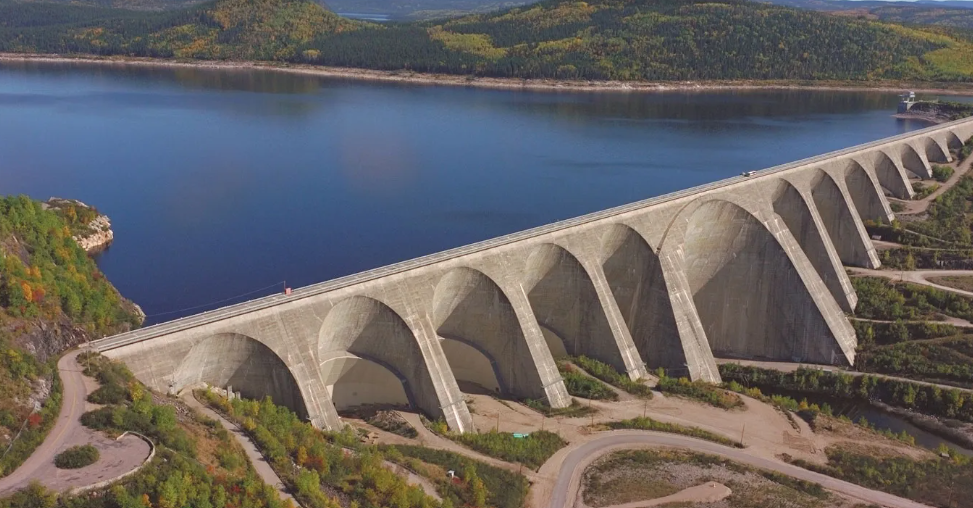
A buttress dam consists of a sloping or flat water-retaining face supported on the downstream side by a series of regularly spaced buttresses — essentially large structural fins or walls that carry the load of the water back into the foundation. This design dramatically reduces the volume of material needed compared to a solid gravity dam, making it more economical in situations where construction materials are expensive or scarce.
The buttresses transfer the water pressure downward and outward into the ground, requiring a firm foundation but allowing greater flexibility in design than a pure arch structure. Buttress dams were particularly popular in the early to mid-20th century and can be found in a variety of forms, including flat-slab, multiple-arch, and massive-head buttress configurations.
Embankment Dam
An embankment dam is built from natural materials — primarily earth, rock, gravel, and clay — compacted into a broad, sloping mound rather than constructed from concrete or masonry. It is the most common type of dam in the world, favored because the materials required are usually available locally and the design can accommodate a wide range of foundation conditions, including softer soils unsuitable for concrete dams.
The core of an embankment dam is typically made from low-permeability clay or a concrete wall to prevent water from seeping through and causing internal erosion. Despite their earthen appearance, well-engineered embankment dams are extremely strong and long-lasting, with the Tarbela Dam in Pakistan — one of the largest embankment dams in the world — holding back one of the most sediment-laden rivers on Earth.
Rockfill Dam
A rockfill dam is a type of embankment dam constructed primarily from compacted rock fragments and stone, with a central impermeable core — typically made from clay, concrete, or asphalt — to prevent water from passing through the structure. The rockfill material provides mass and stability, while the core performs the essential task of sealing the dam against leakage.
This type of dam is well-suited to remote or mountainous regions where large quantities of rock are readily available but cement and other processed materials are difficult to transport. Rockfill dams can also tolerate some degree of settlement and movement without cracking, giving them an advantage over rigid concrete structures in areas with less predictable ground conditions.
Earthfill Dam
An earthfill dam, sometimes called an earth dam, is constructed almost entirely from compacted soil and clay, built up in carefully controlled layers to form a dense, watertight embankment. It is one of the oldest forms of dam construction, with examples dating back thousands of years in ancient Sri Lanka and the Middle East, where early engineers discovered that packed earth could effectively hold back water.
The design requires a wide base relative to its height, giving earthfill dams a characteristic gentle, sloping profile quite different from the vertical face of a concrete dam. They are particularly sensitive to overtopping — when water flows over the crest — which can rapidly erode the structure, making reliable spillway design a critical safety consideration for any earthfill dam.
Concrete Face Rockfill Dam (CFRD)
A concrete face rockfill dam combines the mass and stability of a rockfill embankment with a reinforced concrete slab laid across the entire upstream face of the structure to act as the waterproofing barrier. The concrete facing prevents seepage while the compacted rockfill body behind it provides the structural weight and support needed to resist water pressure.
This design has grown increasingly popular in modern dam engineering because it is cost-effective, adaptable to a wide range of valley shapes, and can be constructed relatively quickly. CFRDs are now built at considerable heights around the world, with several exceeding 200 meters, and are particularly favored in regions prone to seismic activity because the flexible rockfill body can absorb ground movement without catastrophic cracking.
Timber Dam
A timber dam is one of the oldest and simplest types of dam, constructed from wooden logs, planks, or framed structures to hold back water for small-scale purposes such as powering mills, creating small farm ponds, or diverting streams for irrigation. While rarely used in modern large-scale infrastructure, timber dams played a vital role in the development of early agricultural and industrial economies across North America and Europe.
The main limitation of timber dams is their relatively short lifespan, as wood is susceptible to rot, insect damage, and structural weakening from prolonged water exposure without significant maintenance. Small examples can still be found in rural and forested areas, and modern engineered timber dams using treated or laminated wood have found niche applications in low-head hydropower and habitat restoration projects.
Steel Dam
A steel dam uses structural steel as its primary load-bearing material, with thin steel plates or frames forming the water-retaining surface. Steel dams are extremely rare in the modern era, as concrete and embankment alternatives are generally more durable and cost-effective, but they represented a notable chapter in the experimental phase of dam engineering in the late 19th and early 20th centuries.
The Redridge Steel Dam in Michigan, built in 1901, is one of the few surviving examples and stands as a historical curiosity in dam engineering. Steel’s vulnerability to corrosion over time and the high cost of maintenance compared to concrete eventually made steel dams impractical for most applications, though steel remains a critical material in spillway gates, penstocks, and other dam components.
Rubber Dam
A rubber dam is an inflatable structure made from synthetic rubber or reinforced fabric membranes that is anchored to a concrete foundation sill across a river or channel and inflated with water or air to form a temporary barrier. When deflated, the membrane lies flat against the riverbed, allowing water and sediment to pass freely over the sill without obstruction.
This flexibility makes rubber dams highly practical for applications where water levels need to be adjusted seasonally or in response to changing conditions, such as irrigation diversion, groundwater recharge, and tidal control. They are relatively inexpensive to install, have no mechanical moving parts to wear out, and can be deflated quickly in the event of flooding, making them a versatile and low-maintenance solution for low-head water management.
Diversion Dam
A diversion dam is a low structure built across a river not primarily to store water but to raise the water level just enough to divert flow into a canal, pipe, or channel that leads to where the water is needed — typically for irrigation, municipal water supply, or industrial use. Unlike storage dams, which impound large reservoirs, diversion dams are designed to redirect rather than retain.
Because they do not need to hold back enormous volumes of water, diversion dams can be built on a modest scale and from relatively simple materials. They are found in virtually every agricultural region of the world, quietly performing the essential function of channeling river water to fields and cities, and are often the unsung workhorses of large-scale irrigation infrastructure.
Check Dam
A check dam is a small, low barrier built across a minor stream, drainage channel, or gully to slow the flow of water, reduce erosion, and encourage water to infiltrate the soil rather than rush downstream. They are typically constructed from locally available materials such as stone, sandbags, brushwood, or even concrete blocks, and are often built in series along a waterway to create a cascading effect.
Check dams are widely used in watershed management, dryland farming, and land restoration programs, particularly in semi-arid regions where retaining every drop of rainfall is essential. Their simplicity and low cost make them accessible to rural communities and development organizations, and they have proven remarkably effective at rebuilding degraded landscapes, recharging groundwater, and reducing downstream flood peaks.
Saddle Dam
A saddle dam is an auxiliary embankment built across a low point — called a saddle — in the ridgeline surrounding a reservoir, preventing water from escaping through that natural gap when the reservoir fills to capacity. It is not a standalone structure but rather a supplementary barrier that works in conjunction with a main dam to complete the enclosure of a reservoir basin.
Saddle dams are essential in topographically complex areas where a single main dam cannot contain the full perimeter of a large reservoir. They are typically constructed as earthfill or rockfill embankments and must be engineered to the same safety standards as the main dam, since a failure in a saddle dam would be just as catastrophic as a failure in the primary structure.