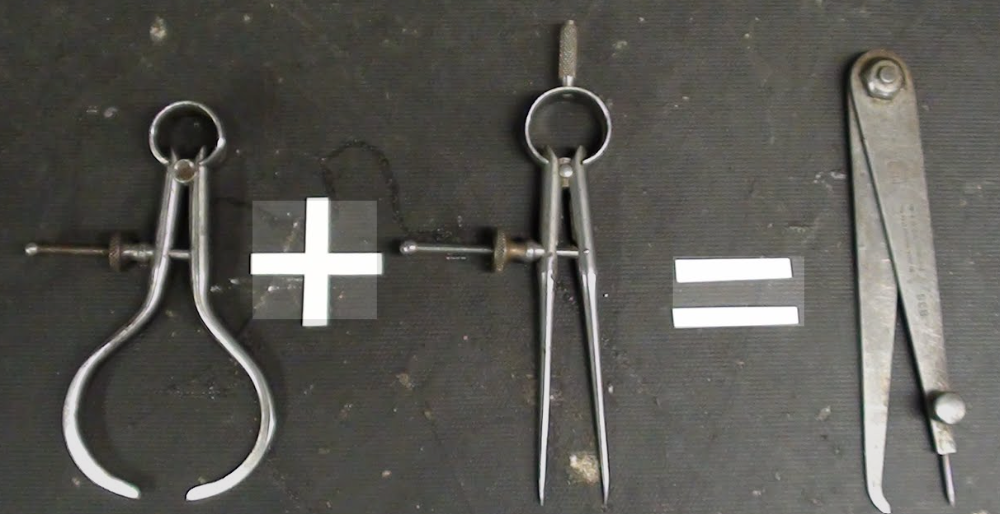
An offset vernier caliper, also known as an odd leg or hermaphrodite caliper, is a specialized measuring instrument used primarily for scribing, measuring, and transferring distances, particularly when working with irregular shapes or hard-to-reach areas. It features one straight leg and one bent or offset leg, allowing it to reach corners, edges, or recessed surfaces that standard calipers cannot access. The vernier scale on this caliper enables precise measurement of distances between points or lines, making it widely used in metalworking, engineering layout, and fabrication tasks where accurate marking or measurement in tight spaces is required.
Unlike all the other caliper types, which have matched pairs of jaws facing each other, the offset caliper has one straight jaw with a measuring face and one curved or bent jaw with a sharp point (called a scriber or divider point). This asymmetric configuration gives it a completely different set of capabilities from conventional calipers.
The primary use of the offset Vernier caliper is scribing a line parallel to a machined edge or surface. The straight jaw (or a specially shaped heel) is registered against the reference edge of the workpiece, and as the caliper is drawn along that edge, the scriber point traces a precise line at a fixed distance from the edge — that distance being set by the caliper’s jaw opening. This is invaluable in layout work: marking out where a hole should be drilled, where a cut should be made, where a shoulder should be machined, all referenced from a machined edge. The line scribed is truly parallel to the reference edge regardless of minor irregularities in the scribing motion, because the reference jaw maintains contact with the edge throughout the stroke.
The second important use of the offset caliper is finding the center of a round bar or shaft. By setting the caliper to approximately half the bar’s diameter, placing the curved jaw against the bar surface, and scribing a line across the end face, then rotating the bar 90 degrees and repeating, the intersection of the two scribed lines identifies the center of the bar with good accuracy. This technique — called center-finding — is a fundamental step in lathe work whenever a bar must be center-drilled accurately.
The offset Vernier caliper is therefore less a precision measuring instrument (its Vernier scale is used for setting the jaw distance rather than for reading component dimensions) and more a precision layout tool — one that bridges the gap between measuring and marking in the machining workflow.