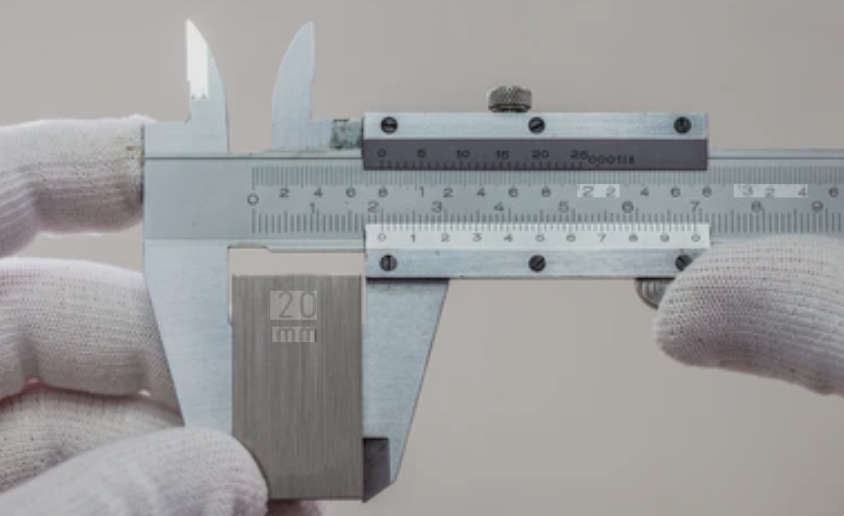
A long jaw vernier caliper is a specialized type of vernier caliper designed with extended jaws to measure the external or internal dimensions of objects that are deep, long, or difficult to reach with standard calipers. The longer jaws allow users to access recessed areas, deep holes, or long shafts while maintaining accurate and precise measurements.
The long jaw Vernier caliper is a variation of the standard caliper in which the jaws are significantly longer than normal — often two to three times the standard jaw depth. This extended jaw depth allows the caliper to reach over obstructions, into recesses, around flanges, and into locations that a standard caliper’s short jaws simply cannot access. The measurement scales and sliding mechanism are identical to a standard Vernier caliper; only the jaw geometry is different.
Consider a practical example: measuring the width of a groove or slot that is located deep inside a housing or casting, set back from the opening by 50mm or more. A standard caliper with 40mm jaws cannot reach the groove. A long jaw caliper with 80mm or 100mm jaws can reach in past the housing walls and make the measurement accurately. Similarly, measuring the distance between two parallel surfaces when there is a flange or boss between the measurement points often requires a long jaw caliper to bridge over the obstruction.
In automotive engine work, long jaw calipers are used to measure dimensions inside engine blocks, transmission housings, and differential cases. In aerospace manufacturing, they measure features inside complex structural castings where standard calipers cannot reach. In die and mold making, they access recessed features in deep pockets.
The extended jaws do introduce one consideration: the longer the jaw, the more susceptible the caliper is to deflection errors — if the jaw bends slightly under measuring pressure, the reading will be inaccurate. Quality long jaw calipers are made from thicker, more rigid jaw stock to minimize this deflection, but users must always apply consistent, light measuring pressure and be aware of the deflection limitation when making high-precision measurements with extended jaws.