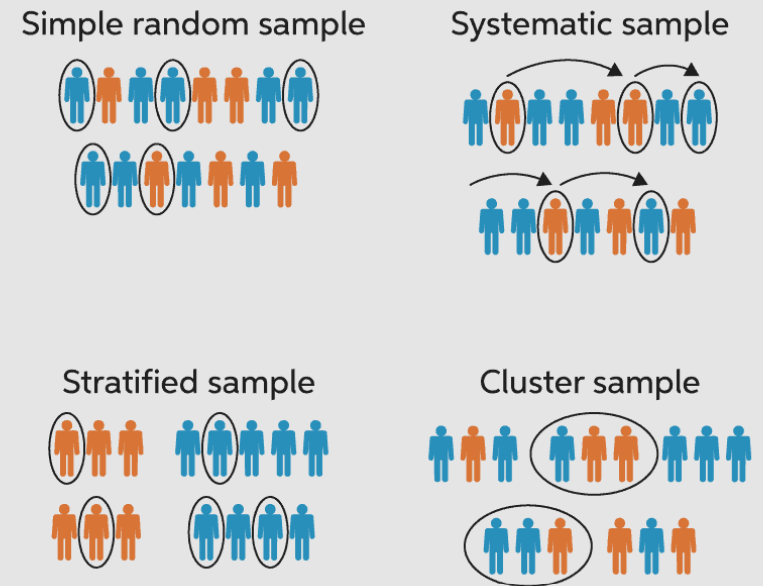
A probability sampling method is a way of selecting individuals or items from a population so that every member has a known and non-zero chance of being chosen. The selection is done using random procedures rather than personal choice or judgment, which helps reduce bias and makes the sample more representative of the whole population.
In simple terms, probability sampling means choosing participants fairly and by chance, like drawing names from a hat or using random numbers. Because the chances of selection are known, researchers can apply statistical methods to estimate results for the entire population based on the sample.
This type of sampling is widely used in surveys, scientific research, and data analysis because it improves accuracy and reliability. It allows researchers to measure sampling error and make valid generalizations about larger groups.
Probability Sampling Methods
Simple Random Sampling
Simple random sampling is a method where every member of a population has an equal chance of being selected. Selection is usually done using random numbers, drawing names from a list, or computer-generated randomization. This method reduces bias because no individual is favored over another.
Example: randomly selecting 50 students from a school register using a random number generator.
Systematic Sampling
Systematic sampling involves selecting members from a population at regular intervals after choosing a random starting point. The interval is determined by dividing the population size by the desired sample size. It is easy to apply and works well when the population list is organized.
Example: choosing every 10th customer entering a supermarket after randomly selecting the first one.
Stratified Sampling
Stratified sampling divides the population into smaller groups called strata based on shared characteristics such as age, gender, or income level. Samples are then randomly selected from each group to ensure representation. This method improves accuracy when populations are diverse.
Example: selecting students from each grade level in proportion to their population size.
Cluster Sampling
Cluster sampling divides the population into natural groups or clusters, such as schools, villages, or neighborhoods. Instead of sampling individuals from all clusters, a few clusters are randomly chosen, and all members within them are studied. It is cost-effective for large or geographically spread populations.
Example: randomly selecting several schools and surveying all students in those schools.
Multistage Sampling
Multistage sampling combines several sampling methods in stages, often starting with clusters and then applying random sampling within selected clusters. It is commonly used in large-scale surveys and national studies.
Example: selecting counties first, then schools within counties, and finally students within those schools.
Probability Proportional to Size (PPS) Sampling
In probability proportional to size sampling, the probability of selecting a unit depends on its size or importance within the population. Larger units have a higher chance of being chosen. This method is useful when population units vary greatly in size.
Example: larger cities having a higher probability of being selected in a national household survey.
Area Sampling
Area sampling is a form of cluster sampling where geographic areas are used as clusters. Researchers divide a region into areas such as districts or blocks and randomly select some of them for study. It is especially useful for field surveys covering wide regions.
Example: selecting specific neighborhoods in a city to conduct household interviews.
Double (Two-Phase) Sampling
Double sampling, also called two-phase sampling, involves collecting data in two stages. A large initial sample is gathered with basic information, followed by a smaller second sample where more detailed data is collected. This approach improves efficiency and reduces costs.
Example: surveying many households about basic demographics first, then conducting detailed interviews with a smaller selected group.