Passes in basketball are a fundamental skill that allows players to move the ball efficiently, maintain possession, and create scoring opportunities. Passing is essential because basketball is a fast-paced team sport where collaboration and quick decision-making often determine success. Accurate passes help break through defensive lines, maintain offensive flow, and support teammates in optimal positions for shooting or driving to the basket.
There are many types of passes in basketball, each suited for specific situations. Short passes like chest passes and bounce passes are effective for quick ball movement among teammates in close proximity, while longer passes such as baseball or overhead passes help cover greater distances quickly. Some passes, like lob passes or wrap-around passes, are designed to bypass defenders or set up special plays near the basket. Choosing the right type of pass depends on the distance, positioning of teammates, and defensive pressure.
The effectiveness of a pass depends on technique, timing, and awareness. Players must judge the speed, direction, and trajectory of the ball to ensure it reaches the intended teammate safely. Advanced passes, like no-look passes or behind-the-back passes, require strong spatial awareness and precise control to deceive defenders while keeping the ball in play. Coordination and understanding between teammates are crucial to execute these passes successfully.
Passing is also a key defensive and strategic tool in basketball. Quick, accurate passes help maintain possession, shift the defense, and exploit gaps in the opponent’s setup. Proper passing reduces turnovers, allows the team to dictate the pace of the game, and creates scoring opportunities by moving the ball faster than the defense can react. Teams that excel in passing often dominate possession and control the flow of the match.
Types of Passes in Basketball
Chest Pass
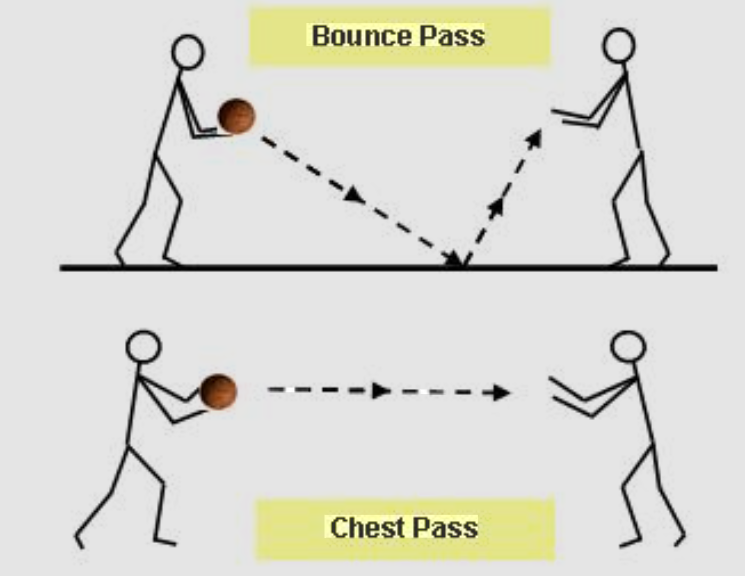
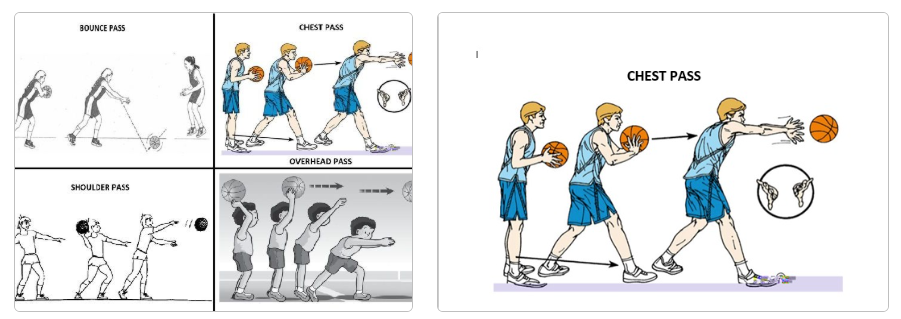
The chest pass is one of the most basic and commonly used passes in basketball. The player holds the ball at chest level and pushes it straight to a teammate using both hands. It is fast, accurate, and ideal for short to medium distances, making it effective for maintaining possession and quick ball movement.
Bounce Pass
A bounce pass involves bouncing the ball off the floor so that it reaches a teammate. It is particularly useful when defenders are blocking a direct chest pass, as the ball can travel under their arms. Timing and the correct force are important to ensure the pass reaches the intended player without being intercepted.
Overhead Pass
An overhead pass is thrown from above the head, usually using both hands. It is effective for passing over defenders and covering longer distances. This pass is often used to quickly move the ball across the court or to reach a teammate in a fast-break situation.
Baseball Pass
The baseball pass is a one-handed long-distance pass, similar to throwing a baseball. It is used to quickly cover large areas of the court, such as during fast breaks or to pass from one end to the other. Accuracy and strength are crucial for the baseball pass to avoid turnovers.
Behind-the-Back Pass
This pass is performed by passing the ball behind the passer’s back, usually to evade a defender. It is often used as a creative or deceptive move to maintain possession and surprise the opposition. Quick reflexes and precise timing are essential to execute it effectively.
No-Look Pass
A no-look pass is delivered without looking directly at the teammate, often to mislead defenders. It requires awareness of teammate positions and the court layout. No-look passes are stylish but highly effective when executed correctly, keeping the defense guessing.
One-Handed Pass
A one-handed pass, often called a push or push-pass, allows for quick releases and flexibility in tight spaces. It is commonly used when passing around defenders or when the passer wants to keep a fast pace in attack. Control and aim are essential for accuracy.
Lob Pass
The lob pass is an arcing pass, thrown high into the air to a teammate, usually near the basket. It is effective for alley-oops or passing over taller defenders. Timing between the passer and the receiver is crucial to successfully execute a lob pass.
Wrap-Around Pass
A wrap-around pass is performed by swinging the ball around a defender’s body to reach a teammate. It is often used in tight spaces or to quickly bypass a defensive screen. Precision and speed are essential for this type of pass.
Bounce Lob Pass
This pass combines elements of a bounce and a lob. The ball is thrown in an arcing motion to bounce near the receiving player. It is useful when defenders are positioned to intercept a direct lob pass, allowing the ball to reach a teammate safely.
Shovel Pass
The shovel pass is a short, underhand pass typically directed forward to a teammate in close range. It is quick and effective for penetrating defenses near the basket, especially in pick-and-roll situations or during fast attacks.
Over-the-Head Shovel Pass
This pass combines the shovel and overhead pass techniques. The ball is pushed underhand or with a flick from above toward a teammate, often in close-range situations. It is used to quickly move the ball while keeping it away from defenders.