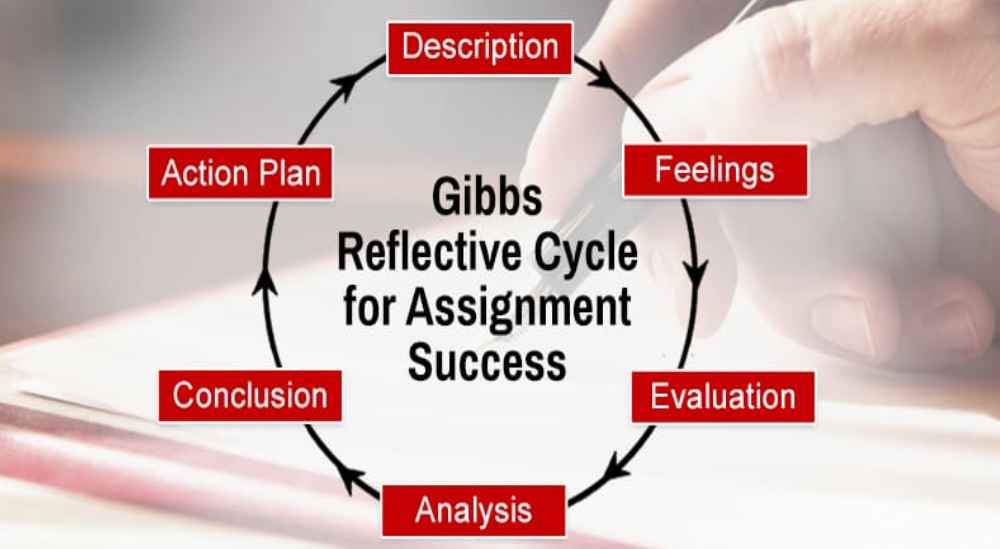
Gibbs Reflective Cycle is a structured model used to help individuals learn from experience through reflection. It was developed in 1988 by educational theorist Graham Gibbs as a practical framework for examining actions, feelings, and outcomes in order to improve future performance. The model is widely used in education, healthcare, management, and professional training.
The cycle is designed to guide people through a step-by-step process of thinking about an experience rather than simply remembering it. Reflection allows individuals to understand what happened, why it happened, and how similar situations can be handled more effectively in the future. It promotes continuous learning and personal development.
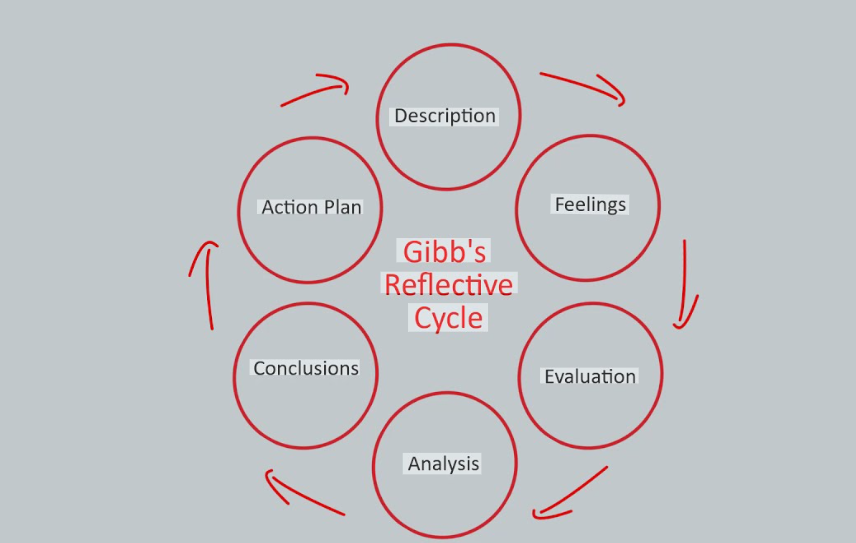
Gibbs Reflective Cycle consists of six stages: description, feelings, evaluation, analysis, conclusion, and action plan. Each stage encourages deeper thinking, moving from basic observation toward critical understanding and practical improvement. The circular structure emphasizes that learning is ongoing rather than a one-time event.
The first stage, description, focuses on objectively explaining what occurred without judgment. This helps establish a clear understanding of the situation. The second stage, feelings, explores emotional responses during the experience, recognizing that emotions influence behavior and decision-making.
In the evaluation and analysis stages, individuals consider what went well and what did not, then examine the reasons behind those outcomes. This stage encourages critical thinking by linking experiences with theory, knowledge, or past learning to gain deeper insight.
The conclusion stage involves identifying what could have been done differently, while the action plan outlines specific steps for improvement in future situations. This practical focus makes the model especially useful in professional environments where learning from experience is essential.
Overall, Gibbs Reflective Cycle supports self-awareness, problem-solving, and lifelong learning. By encouraging structured reflection, it helps individuals transform everyday experiences into meaningful lessons, improving skills, confidence, and decision-making over time.
Gibbs Reflective Cycle
Overly structured and rigid
One major criticism is that the model follows a fixed sequence of stages, which may feel restrictive. Real-life reflection is often messy and non-linear, and some users find the step-by-step format limits natural thinking processes.
Encourages superficial reflection
Critics argue that people may simply answer each stage as a checklist exercise without deeply analyzing their experiences. This can result in descriptive reflection rather than meaningful critical thinking.
Too focused on individual experience
The cycle mainly emphasizes personal thoughts and feelings, sometimes neglecting wider social, cultural, or organizational factors that may influence events and outcomes.
Time-consuming process
Completing all six stages thoroughly requires significant time and effort. In fast-paced professional environments, such as healthcare or business settings, practitioners may find it impractical to use regularly.
Limited theoretical depth
Some scholars argue that Gibbs Reflective Cycle simplifies reflection and does not strongly integrate complex psychological or learning theories. As a result, it may not support advanced critical reflection compared to other reflective models.
Overemphasis on emotions
The model gives considerable attention to feelings, which may make some users uncomfortable or lead to excessive focus on emotions rather than objective analysis and practical learning outcomes.
Assumes reflection always leads to improvement
A criticism of the model is that it assumes reflecting on an experience will automatically result in learning or better future actions. In reality, reflection does not always produce clear solutions or behavioral change. Some individuals may repeat mistakes despite reflection due to external pressures, limited resources, or lack of guidance. This makes the model somewhat idealistic in its expectations.
Not suitable for complex or emergency situations
The cycle works best for planned reflection after an event, but critics argue it is less useful in highly complex or fast-changing situations. For example, during emergencies or high-stress professional environments, individuals may not have the time or mental space to follow structured reflection stages. This limits its practical application in certain real-world contexts.
Linear progression may oversimplify learning
Gibbs’ model presents reflection as moving neatly from one stage to another. However, learning often involves going back and forth between ideas, emotions, and analysis. Critics say this linear progression may oversimplify how people actually process experiences and develop understanding over time.
Risk of repetitive responses
When used frequently, especially in academic assignments, users may begin giving predictable or repeated answers at each stage. This repetition can reduce creativity and genuine insight. Instead of encouraging deep thinking, the model may unintentionally promote formulaic responses that satisfy structure rather than learning.
Requires strong self-awareness skills
Effective use of the cycle depends on a person’s ability to honestly evaluate their own thoughts and behaviors. Individuals with limited self-awareness or critical thinking skills may struggle to analyze experiences deeply. Without proper training or support, reflection may remain shallow and incomplete.
Limited focus on collaborative reflection
The model mainly centers on individual reflection rather than shared or group learning. Critics argue that many professional experiences involve teamwork, where collective reflection could provide richer perspectives. By focusing on personal viewpoints, important insights from others may be overlooked.
May encourage overthinking
Some users find that repeatedly analyzing feelings and actions can lead to excessive rumination rather than constructive learning. Overthinking past events may increase self-criticism or anxiety instead of promoting confidence and growth. This can reduce motivation rather than improve performance.
Cultural differences in reflection styles
The reflective approach promoted by the model reflects Western educational values that emphasize personal expression and emotional discussion. In cultures where self-disclosure or emotional analysis is less common, the model may feel uncomfortable or inappropriate. This raises questions about its universal applicability across different cultural contexts.