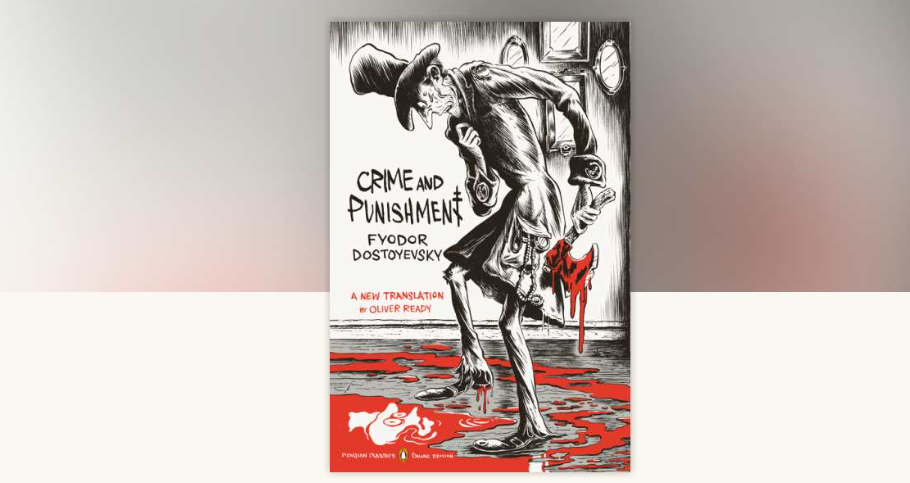
A Detailed Critical Review
Author: Fyodor Mikhailovich Dostoevsky | First Published: 1866 Genre: Psychological Fiction / Philosophical Novel / Crime Fiction Original Title: Prestupleniye i Nakazaniye (Russian) First Published In: The Russian Messenger literary journal (serialized).
I. BIOGRAPHICAL AND HISTORICAL CONTEXT
Who Was Fyodor Dostoevsky?
To read Crime and Punishment without knowing something of its author is to miss half its meaning. Fyodor Mikhailovich Dostoevsky was born in Moscow in 1821, the second of seven children of a strict, deeply religious army doctor. His early life was shaped by the twin forces of intense religious devotion and personal suffering — a combination that would define his literary vision for the rest of his life.
In 1849, at the age of twenty-seven, Dostoevsky was arrested for his involvement with the Petrashevsky Circle, a group of intellectuals who discussed utopian socialism and criticized the Tsarist regime. He was sentenced to death. On December 22, 1849, he stood before a firing squad in St. Petersburg, fully expecting to die. At the last moment — in what was later revealed to be a staged performance of mercy ordered by Tsar Nicholas I — the sentence was commuted to four years of hard labor in a Siberian prison camp, followed by compulsory military service.
This near-death experience and the four years of brutal imprisonment at Omsk Prison transformed Dostoevsky utterly. He entered prison a socialist intellectual; he emerged a deeply conservative, profoundly Christian philosopher of the human soul. He lived alongside murderers, thieves, and violent criminals in the prison barracks, and what he observed there — the complexity of guilt, the capacity for both depravity and grace in the same human being — became the raw material for his greatest novels.
Crime and Punishment was written in 1865–1866 under desperate financial pressure. Dostoevsky had gambling debts, was supporting his dead brother’s family, and was being hounded by creditors. He famously hired a young stenographer, Anna Grigoryevna Snitkina, to help him meet a brutal publisher’s deadline — and ended up marrying her. She became his devoted companion and business manager for the rest of his life, and her stability helped produce the extraordinary late flowering of his genius.
The Russia of the 1860s
Crime and Punishment is inseparable from its historical moment. The 1860s in Russia were a period of intense intellectual ferment, social anxiety, and ideological conflict. Tsar Alexander II had emancipated the serfs in 1861, but the social order remained deeply unstable. A new generation of radical intellectuals — influenced by Western nihilism, utilitarianism, and scientific materialism — was challenging traditional Russian values of religion, family, and social hierarchy.
The most influential ideological force among young Russian radicals was nihilism, as articulated by the critic Nikolai Chernyshevsky in his enormously popular novel What Is To Be Done? (1863). Nihilism held that science and reason were the only valid sources of knowledge, that traditional morality was superstition, and that rational self-interest was the proper basis for human behavior. Some nihilists went further, arguing that exceptional individuals — those with the rationality and will to see beyond conventional morality — were justified in taking whatever actions were necessary to advance human progress, even violent ones.
It is precisely this ideology — and its potential consequences when taken seriously by a brilliant, unstable young man — that Dostoevsky places under the microscope in Crime and Punishment. The novel is, among many other things, a ferocious and deeply personal rebuttal of rational nihilism and utilitarian ethics.
II. PLOT SUMMARY
Crime and Punishment follows Rodion Raskolnikov, a brilliant but impoverished former student living in a tiny, oppressive garret in St. Petersburg. Tormented by poverty, pride, and a grand but disturbing theory about human nature and morality, Raskolnikov conceives and carries out the murder of Alyona Ivanovna, a petty, miserly old pawnbroker whom he despises and regards as a social parasite.
His theory holds that extraordinary men — like Napoleon — are above conventional morality. They have the right to transgress ordinary ethical boundaries for the sake of a higher purpose. Raskolnikov believes himself to be such a man. The murder of the worthless pawnbroker, he reasons, will provide him with money to complete his education, develop his talents, and ultimately benefit humanity. He will prove, to himself above all, that he belongs to the category of extraordinary men who can “step over” moral limits without psychological consequence.
The murder goes terribly wrong. In killing the pawnbroker, Raskolnikov is surprised by her mild, innocent half-sister Lizaveta — a woman he had not intended to kill — and murders her too. He escapes but barely. From this point forward, the novel is not really about whether he will be caught — it is about his psychological disintegration under the weight of guilt, isolation, fever, and the slow, agonizing collapse of his grand theory.
The novel’s two great opposing forces — the forces of judgment and mercy — are embodied in its two central secondary characters. Porfiry Petrovich, the brilliant, psychologically astute police investigator, represents the inexorable external force of justice, playing a cat-and-mouse game with Raskolnikov that is among the most riveting sustained dialogues in all of literary fiction. Sonya Marmeladova, the young woman forced into prostitution by poverty to support her broken family, represents the force of Christian love, suffering, and redemption — the path back to humanity that Raskolnikov must ultimately choose or reject.
The novel ends with Raskolnikov’s confession, his sentencing to eight years in a Siberian prison camp, and the first fragile shoots of his spiritual resurrection through Sonya’s love.
III. MAJOR THEMES — A DETAILED ANALYSIS
Theme 1: The Psychology of Guilt
The novel’s psychological architecture is its most extraordinary achievement. Dostoevsky was one of the first novelists to portray the interior life of a criminal not as the experience of a fundamentally different kind of person but as the logical extreme of tendencies present in all human beings — pride, rationalization, the desire for power and significance.
Raskolnikov’s psychological disintegration after the murder is rendered with astonishing precision and depth. He does not suffer simple remorse; his condition is far more complex and interesting. He oscillates between grandiosity and self-loathing, between the desire to confess and the determination to outwit Porfiry, between contempt for the weakness of conscience and a desperate hunger for human connection. His illness — the fever that grips him after the murder — is both literal and symbolic: the body staging what the mind refuses to acknowledge.
Dostoevsky understood something that formal psychology would not articulate for another half-century: that guilt does not always present as guilt. It presents as irritability, paranoia, grandiosity, isolation, physical illness, and self-destructive behavior. Raskolnikov does not walk around thinking “I feel guilty for the murder.” He walks around testing his theory, provoking Porfiry, making cryptic confessions, alternately embracing and rejecting Sonya — and all of this, Dostoevsky shows us, is guilt working itself out through indirect channels. Sigmund Freud, who was deeply influenced by Dostoevsky, would later formalize many of these mechanisms in his theory of the unconscious.
Theme 2: The Theory of the Extraordinary Man
The philosophical core of the novel is Raskolnikov’s theory of extraordinary men, which he has elaborated in a journal article that Porfiry has read and which forms the intellectual battleground of their exchanges. The theory holds that all people divide into two categories:
- Ordinary people — the mass of humanity, bound by conventional morality, existing to reproduce and preserve the social order.
- Extraordinary people — rare individuals like Moses, Napoleon, and Newton who have the right — even the obligation — to transgress conventional moral limits in the service of their higher mission. These people give the world new laws, new ideas, new orders; they cannot do so without stepping over old obstacles, old people, old moralities.
Raskolnikov’s murder is, in part, a self-test: he wants to discover whether he belongs to the first or second category. Can he cross the line without psychological consequence, proving himself a Napoleon? Or will he suffer, proving himself merely ordinary?
The novel’s answer is devastating and multi-layered. Raskolnikov is intellectually brilliant, but he is not Napoleon. He suffers. His theory collapses not because it is logically refuted — Porfiry never directly argues against it — but because it is psychologically and morally unsustainable. The human connection and empathy that his theory requires him to suppress reassert themselves irresistibly, breaking him down and ultimately saving him.
This is Dostoevsky’s most fundamental argument: ideas have psychological consequences. You cannot hold certain ideas without becoming a certain kind of person, without doing certain things. The theory of the extraordinary man is not merely wrong — it is psychologically destructive to the very person who holds it. This is an extraordinarily modern and relevant argument.
Theme 3: Redemption Through Suffering
The spiritual architecture of the novel is built on the Russian Orthodox Christian concept of redemption through suffering. Dostoevsky does not present suffering as merely unfortunate; he presents it as potentially redemptive — as the necessary passage through which the proud, isolated, self-worshipping intellect must travel to reach genuine human community and spiritual wholeness.
This theme is embodied most fully in Sonya Marmeladova, who is, in many ways, the novel’s moral and spiritual center. Sonya has suffered enormously — poverty, degradation, prostitution — yet she has not become bitter, nihilistic, or self-pitying. She has maintained her faith, her compassion, and her capacity for love in the most brutal circumstances. For Dostoevsky, she represents the possibility of grace — the human capacity for spiritual survival and even flourishing in the midst of suffering, if faith is maintained.
The scene in which Raskolnikov asks Sonya to read to him from the Gospel of John — the story of the resurrection of Lazarus — is one of the most powerful and beautifully crafted scenes in the novel. Lazarus, dead four days and beginning to decay, is called back to life by Christ. The passage is not subtle in its symbolism: Raskolnikov is spiritually dead and must be called back to life. But Dostoevsky’s execution of the scene — the flickering candle, Sonya’s trembling voice, the two social outcasts (murderer and prostitute) bent over the ancient text — transforms the symbolism into something genuinely moving.
Theme 4: The Consequences of Rational Materialism
Crime and Punishment is, at one level, a direct literary assault on the rational materialist philosophy that was sweeping through Russian intellectual circles in the 1860s. Dostoevsky believed that the reduction of human beings to rational calculating machines — the idea that morality is merely social convention, that extraordinary ends justify transgressive means, that science and reason can replace religion as the foundation of human life — was not merely philosophically wrong but psychologically and socially catastrophic.
Raskolnikov is the embodiment of rational materialism taken to its logical conclusion: a brilliant young man who has systematically reasoned his way to the conviction that murder is justifiable. The novel shows what happens next. Reason, in Dostoevsky’s world, is not the master of the human soul but its servant — and when it tries to usurp the throne, the result is not liberation but disintegration.
This argument is carried further in Dostoevsky’s later masterwork The Brothers Karamazov, where Ivan Karamazov’s rationalist rejection of God leads to psychological catastrophe. In both novels, Dostoevsky insists that human beings cannot live by reason alone — that the suppression of conscience, empathy, and spiritual connection in the name of rational self-sufficiency leads not to freedom but to a kind of living death.
Theme 5: Poverty, Society, and Social Injustice
It would be a mistake to read Crime and Punishment purely as a philosophical or psychological novel and miss its powerful social dimension. St. Petersburg is not merely a backdrop; it is an oppressive presence, a character in itself. The stifling heat, the narrow streets, the cramped apartments, the taverns full of the desperate and the destitute — Dostoevsky renders the physical environment of urban poverty with documentary vividness.
The novel is full of characters crushed by poverty and social indifference: Marmeladov, Sonya’s father, who drinks himself to death in shame at his inability to provide for his family; Katerina Ivanovna, his consumptive wife, who descends into madness as her world collapses; Dunya, Raskolnikov’s sister, who is nearly destroyed by the predatory Svidrigailov; the children of the Marmeladov family, growing up in squalor with no hope of escape.
Dostoevsky does not let social injustice excuse Raskolnikov’s crime — the novel is too morally serious for that. But it insists that we understand the soil in which Raskolnikov’s theory grew: the humiliation, the helplessness, the daily grinding indignity of poverty in an indifferent city. The crime cannot be understood apart from the social conditions that nurtured it.
Theme 6: Isolation vs. Human Connection
A recurring structural theme throughout the novel is the deadly consequences of radical isolation. Raskolnikov’s theory requires him to separate himself from ordinary humanity — to see himself as standing above and apart from the common mass. This psychological isolation is the precondition for the murder and the source of his suffering afterward.
His gradual movement toward Sonya, his confession to her before his confession to the police, his willingness to accept her love and follow her to Siberia, represent the reversal of this isolation — his re-entry into human community. Dostoevsky presents this not as defeat or weakness but as the only genuine path to survival and meaning.
This theme connects to one of the deepest currents in Dostoevsky’s entire body of work: his belief that radical individualism is spiritually suicidal, that human beings are constitutively relational creatures who cannot flourish in isolation, however much the proud intellect desires self-sufficiency.
IV. CHARACTER ANALYSIS
Rodion Raskolnikov
Raskolnikov is one of the most complex and psychologically rich protagonists in the history of fiction. He is simultaneously brilliant and foolish, compassionate and callous, arrogant and self-loathing, capable of extraordinary generosity and horrifying violence. He gives his last money to the Marmeladov family at one moment and contemplates a second murder the next.
What makes him so compelling — and so recognizable — is that his contradictions are not inconsistencies in the characterization but the very point of it. He is a battleground between competing impulses: his theory, which demands coldness and superiority, and his nature, which craves connection and love. The novel is the story of which side wins.
His name is itself significant: Raskolnikov derives from the Russian word raskol, meaning schism or split — a fitting name for a man divided against himself.
Sonya Marmeladova
Sonya is the novel’s moral compass and spiritual counterweight to Raskolnikov. She has every reason, by worldly logic, to be bitter, nihilistic, or despairing — she has been reduced to prostitution to support a family she did not choose. Yet she maintains her faith, her gentleness, and her capacity for selfless love.
Some modern readers find Sonya too saintly, too passive, too perfectly good to be fully three-dimensional. This is a fair criticism. Dostoevsky’s female characters, for all their psychological interest, tend to polarize between extremes of suffering virtue and manipulative seductiveness. Sonya is undeniably idealized. But within her idealization, she serves a crucial narrative function: she represents the possibility Raskolnikov must choose — the path of humility, love, and spiritual rebirth — and her reality gives that possibility human weight.
Porfiry Petrovich
The novel’s most intellectually dazzling secondary character, Porfiry is the investigating magistrate who suspects Raskolnikov from early on and proceeds to conduct a sustained, brilliant psychological campaign against him. He does not try to trap Raskolnikov with evidence; he tries to drive him to confess through a combination of Socratic interrogation, psychological provocation, and strategic withdrawal.
Their three great dialogues are among the most electrifying scenes in the novel. Porfiry is witty, self-aware, theatrically self-deprecating, and utterly pitiless in his penetration of Raskolnikov’s psychological defenses. He is not a villain; in fact, he is oddly sympathetic to Raskolnikov, recognizing his intelligence and even his potential for redemption. But he is inexorable. He understands Raskolnikov better than Raskolnikov understands himself.
Svidrigailov
Arkady Svidrigailov is the novel’s most ambiguous and disturbing figure — and, in many ways, its most fascinating. He is what Raskolnikov’s theory, fully realized without conscience or self-deception, actually looks like: a man who has genuinely stepped beyond conventional morality, who feels no guilt, who acts entirely on self-interest, who has committed acts of exploitation and probable murder with perfect equanimity.
Yet Svidrigailov is not simply a villain. He performs acts of genuine generosity — arranging for the care of Sonya’s siblings, providing Dunya with money — for reasons that seem inexplicable by his own nihilistic logic. And he ultimately commits suicide, unable, despite everything, to find a reason to continue living. His death is the darkest comment in the novel on the endpoint of the philosophy Raskolnikov has been flirting with: not freedom, but meaninglessness; not power, but a void.
Dunya and Razumikhin
Raskolnikov’s sister Dunya is one of the novel’s stronger female characters — proud, intelligent, and morally serious. Her subplot, involving the predatory Svidrigailov and the earnest suitor Luzhin, mirrors Raskolnikov’s situation in important ways and provides the novel with some of its most tense and dramatically satisfying scenes.
Razumikhin, Raskolnikov’s loyal friend, is in many ways his opposite: practical, warm, socially engaged, and grounded. His function is partly structural — he provides information and keeps Raskolnikov connected to the world during his illness — and partly thematic: he represents the possibility of a decent, engaged life that Raskolnikov’s pride and theory have led him to disdain.
V. NARRATIVE TECHNIQUE AND STYLE
Point of View and Free Indirect Discourse
Dostoevsky’s narrative technique in Crime and Punishment is one of the novel’s supreme technical achievements. The story is told in the third person, but the perspective is almost entirely locked inside Raskolnikov’s consciousness — what literary critics call close third-person narration or free indirect discourse. We experience the world through his perceptions, his distortions, his rationalizations.
This creates a remarkable and deeply uncomfortable reading experience: we inhabit the mind of a murderer, share his logic, understand his reasoning, feel the force of his arguments — and are never entirely sure how much we should trust what we are experiencing. Dostoevsky was a pioneer of this technique, and it was enormously influential on later 20th-century novelists, particularly those interested in the unreliable narrator.
Dialogue
Crime and Punishment may contain the greatest dialogue in the history of the novel. The extended conversations between Raskolnikov and Porfiry, between Raskolnikov and Sonya, between Svidrigailov and Dunya, crackle with intellectual and dramatic energy. Dostoevsky’s characters speak in ways that reveal their entire psychology — their fears, desires, self-deceptions, and deepest convictions — without ever feeling expository. The dialogue is the psychological action.
The City as Character
St. Petersburg in Crime and Punishment is not merely a setting but an active presence — a force of oppression and disorientation. The city is presented in summer heat — airless, stenching, feverish, crowded with the desperate and the destitute. The physical environment externalizes Raskolnikov’s mental state and makes the claustrophobia of his situation palpable. Dostoevsky knew St. Petersburg intimately and hated and loved it in equal measure, and this ambivalence animates every description.
Dreams and the Unconscious
The novel makes brilliant use of dreams as windows into Raskolnikov’s suppressed psychological reality. The most famous is the dream of the horse early in the novel — in which the young Raskolnikov witnesses a crowd of drunken peasants beating an old mare to death, and is filled with helpless grief and horror. The dream is at once a childhood memory and a prophetic vision; it reveals the compassion that the adult Raskolnikov has tried to suppress and prefigures the violence he is about to commit. It is one of the great dream sequences in literature.
VI. LITERARY AND PHILOSOPHICAL INFLUENCE
The influence of Crime and Punishment on subsequent literature and thought is almost incalculable:
Friedrich Nietzsche — Nietzsche read Dostoevsky with enormous enthusiasm and clearly absorbed elements of Raskolnikov’s theory of extraordinary men into his own concept of the Übermensch (Superman). There is a fascinating and unresolved question of influence and parallel development in the relationship between these two great thinkers.
Sigmund Freud — Freud wrote a celebrated essay on Dostoevsky in 1928, arguing that the novel encodes Dostoevsky’s own Oedipal conflicts. Whatever one thinks of the specific Freudian reading, it is clear that Dostoevsky’s psychological penetration deeply influenced the founders of psychoanalysis.
Albert Camus and Jean-Paul Sartre — The existentialists found in Dostoevsky a precursor who had explored, with unparalleled depth, the consequences of a godless universe and the problem of individual freedom in the absence of transcendent moral law. Camus’s The Stranger is essentially a reworking of the Crime and Punishment scenario from a purely atheist perspective.
Franz Kafka — The atmosphere of paranoia, labyrinthine guilt, and persecution in Crime and Punishment unmistakably influenced the Kafkaesque universe — the sense of an individual trapped in a system of accusation and judgment whose rules are incomprehensible.
William Faulkner, Gabriel García Márquez, Toni Morrison — All of these writers cited Dostoevsky as a primary influence, particularly his technique of psychological interiority and his willingness to engage the deepest moral and spiritual questions through narrative.
20th-Century Crime Fiction — Crime and Punishment effectively invented the psychological crime novel — the story not of whodunit but of what the crime does to the criminal’s inner life. The entire genre of literary crime fiction, from Patricia Highsmith to Cormac McCarthy, owes a foundational debt to Dostoevsky.
VII. CRITICISMS AND LIMITATIONS
1. The Female Characters
As noted, Dostoevsky’s female characters in this novel, while not without interest, tend toward idealization (Sonya, Dunya) or caricature (Katerina Ivanovna in her later, madness-driven scenes). They function primarily in relation to Raskolnikov’s psychological journey rather than as fully autonomous characters with their own inner lives. This is a genuine limitation that feminist literary criticism has rightly identified.
2. The Epilogue
The novel’s epilogue — set in Siberia, describing Raskolnikov’s spiritual regeneration through Sonya’s love — is widely regarded as the weakest section of the book. The spiritual transformation it describes feels sudden and somewhat imposed, more asserted than dramatized. Dostoevsky himself seems to have found the ending difficult; the transformation he wanted to portray required, perhaps, a second novel to do justice to. He acknowledged as much, and The Brothers Karamazov can be read, in part, as that second novel.
3. Melodrama
At times — particularly in the Marmeladov family subplot — Dostoevsky tips from pathos into melodrama. Katerina Ivanovna’s final scenes, in which she forces her children to dance in the street as she dies of tuberculosis, are emotionally extreme in ways that some readers find powerful and others find excessive. Dostoevsky’s entire emotional register runs hotter than most Western literary traditions, and this can feel overwhelming.
4. The Ideological Argument
Some readers find the novel’s philosophical argument — that rational nihilism leads to psychological disintegration, that only Christian love and submission to suffering can redeem — too schematic and ideologically driven. Dostoevsky’s Christianity was genuine and deep, but it does shape the novel’s outcomes in ways that can feel predetermined. The atheist or agnostic reader may find the spiritual resolution less than fully convincing.
VIII. LASTING SIGNIFICANCE
Crime and Punishment endures not because it answers its questions but because it asks them with incomparable power and precision. Can rational self-interest justify transgression? What do we owe to the “ordinary” people our theories dismiss? What is the relationship between ideas and actions, between philosophy and psychology? How does guilt work? What does redemption require?
These questions are not historical curiosities. They are as alive in our world as they were in Dostoevsky’s. In an age of ideological extremism, of individuals radicalized by ideas into acts of violence, of the casual dismissal of the “ordinary” by self-appointed extraordinary men, Crime and Punishment reads not as a 19th-century Russian novel but as a living diagnosis.
Dostoevsky was, as the critic Joseph Frank argued in his monumental five-volume biography, “the first great novelist of the modern world” — the first to fully confront the psychological and spiritual consequences of life without God, without tradition, without stable moral foundations, in a world of radical individual freedom. The questions he posed in 1866 have not been answered. They have only become more urgent.
IX. FINAL VERDICT
Crime and Punishment is, without qualification, one of the greatest novels ever written. It is a work of extraordinary psychological depth, moral seriousness, and literary power. Its portrait of a brilliant young man destroyed and ultimately redeemed by the consequences of his own grand theory stands as one of the most searching and honest investigations of the human mind in the history of literature.
Its weaknesses — the idealized female characters, the occasionally melodramatic register, the somewhat hasty epilogue — are real but minor in comparison to its achievements. What it does that almost no other novel does is make philosophy visceral. It makes you feel the consequences of ideas in your bones. You do not merely understand, intellectually, why Raskolnikov’s theory is wrong; you experience its wrongness through his suffering, his fever, his isolation, his terror.
To read Crime and Punishment is to be changed by it — to emerge with a deeper understanding of guilt, freedom, suffering, and the strange, stubborn, irrational human need for connection, love, and meaning. It is a book that, once truly encountered, does not leave you.
Overall Rating: 10 / 10
Crime and Punishment is a supreme achievement of world literature — a novel that is at once a gripping psychological thriller, a profound philosophical argument, a vivid social document, and a deeply moving spiritual journey. It belongs in the small group of books that genuinely expand what we understand about what it means to be human.