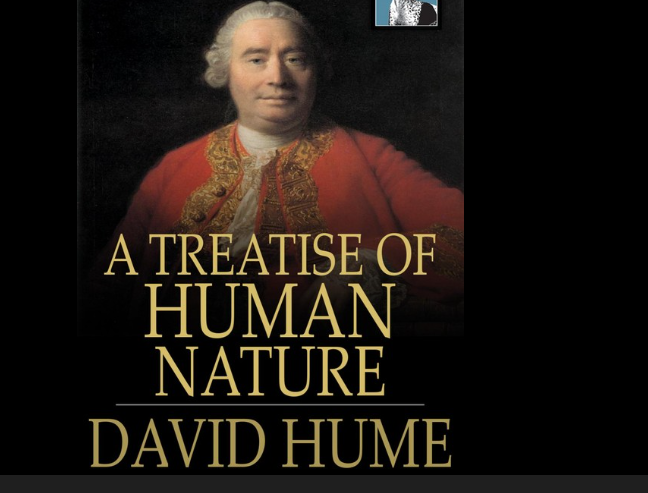
Published: 1739–1740 | Genre: Philosophy / Epistemology / Ethics
Overview
David Hume’s A Treatise of Human Nature is one of the most ambitious and consequential works in the history of Western philosophy. Written when Hume was barely in his mid-twenties, it attempts nothing less than a complete science of human nature — applying the empirical methods of Newton to the study of the mind, morality, and society. Hume himself, in a moment of famous self-deprecation, called it a work that “fell dead-born from the press.” History has proven him spectacularly wrong.
Structure
The Treatise is divided into three books:
Book I – Of the Understanding examines how humans acquire knowledge and form beliefs. Hume distinguishes between “impressions” (direct sensory experience) and “ideas” (mental copies of those impressions), arguing that all meaningful thought must trace back to sensory experience.
Book II – Of the Passions explores the emotions — pride, humility, love, hatred — and how they govern human motivation and behavior.
Book III – Of Morals investigates the foundations of ethical judgment, asking whether morality is a product of reason or sentiment.
BIOGRAPHICAL AND HISTORICAL CONTEXT
To fully appreciate the Treatise, one must understand who wrote it and when. David Hume was born in Edinburgh, Scotland, in 1711. He began drafting this monumental work while still a teenager and completed it in his mid-twenties during a period of solitary study in France, particularly at La Flèche — the very Jesuit college where René Descartes had once studied. This biographical detail is philosophically significant: Hume was, in many ways, writing in direct conversation with Cartesian rationalism, dismantling it from within using the tools of empiricism.
The intellectual climate of the early 18th century was dominated by two competing traditions. On the Continent, rationalists like Descartes, Spinoza, and Leibniz argued that reason alone could yield certain knowledge of reality. In Britain, empiricists like John Locke and George Berkeley had begun to push back, arguing that all knowledge ultimately derives from sensory experience. Hume took empiricism to its most radical and uncompromising conclusion — and in doing so, undermined not just rationalism, but the very foundations of human knowledge itself.
He was also deeply inspired by Isaac Newton’s success in explaining the physical world through observation and systematic reasoning. Hume’s stated ambition in the Treatise was to do for the human mind what Newton had done for the physical universe: to discover its fundamental laws through careful empirical observation. This is why the full title promises to “introduce the experimental method of reasoning into moral subjects.”
When it was published in 1739 (Books I and II) and 1740 (Book III), the work received an indifferent public reception. Hume lamented that it “fell dead-born from the press.” He later revised its core ideas into more accessible and polished works — the Enquiry Concerning Human Understanding (1748) and the Enquiry Concerning the Principles of Morals (1751). Ironically, the Treatise, which he came to distance himself from, is now widely regarded as his greatest and most philosophically rich achievement.
III. BOOK I — OF THE UNDERSTANDING: A DETAILED ANALYSIS
3.1 Impressions and Ideas
Hume opens with a foundational distinction that governs the entire work. All mental contents, he argues, are either impressions or ideas. Impressions are vivid, immediate experiences — the sensation of heat, the sight of red, the feeling of pain. Ideas are fainter copies of those impressions — what we think of when we recall the heat or imagine the color. This seems simple, but its implications are radical.
Hume’s Copy Principle holds that every genuine idea must be traceable back to a prior impression. If you claim to have an idea of something, you must be able to point to the sensory experience from which it derived. This becomes a powerful philosophical scalpel: any concept that cannot be traced to an impression is, Hume argues, meaningless — a mere word without content.
He applies this test ruthlessly. Concepts like “substance,” “the self,” “necessary connection,” and “God” are all put on trial. Each, he argues, fails to pass the test. This makes the Copy Principle one of the most consequential philosophical tools in Western thought — a forerunner of the logical positivists’ verification principle in the 20th century.
3.2 The Association of Ideas
Hume next asks: how do ideas connect with one another in the mind? He identifies three principles of association — resemblance (we connect things that look alike), contiguity (we connect things that are close in time and space), and cause and effect (we connect events we have seen repeatedly co-occur). This quasi-Newtonian account of mental mechanics is elegant, though later philosophers would find it oversimplified.
3.3 The Problem of Causation — Hume’s Master Argument
This is, without question, the most celebrated and influential part of the entire Treatise. Hume’s analysis of causation is a philosophical earthquake, and its tremors are still being felt today.
The common assumption — shared by virtually all philosophers before Hume — is that causation involves necessary connection: the cause must produce the effect; there is a real, binding link between them. Hume undertakes a systematic search for the impression from which this idea of “necessary connection” derives.
He observes that when we watch one billiard ball strike another, we see:
- The first ball in motion.
- Spatial contiguity between the balls.
- The second ball beginning to move after the first makes contact.
What we do not see is any force, power, or necessary connection binding these events together. We only observe constant conjunction — one event following another repeatedly. Yet our minds leap to the conclusion that the first caused the second, that it had to happen that way.
Where, then, does the idea of necessary connection come from? Hume’s answer is stunning: it comes from within us, not from the world. After repeatedly observing events in conjunction, the mind develops a customary transition — a psychological habit of expecting one event upon the occurrence of the other. The feeling of necessity is a projection of this internal habit onto the external world. There is no necessity out there; there is only expectation in here.
This has profound consequences:
- For science: We can never rationally justify inductive reasoning (inferring the future from the past), because there is no logical necessity linking observed regularities to unobserved ones. This is the Problem of Induction, and it remains unsolved.
- For metaphysics: Claims about hidden causal powers in nature are meaningless, since we have no impression of such powers.
- For theology: Arguments from cause to God (cosmological arguments) are undermined, since our concept of causation is empirically grounded and may not extend beyond experience.
Kant, upon reading Hume’s argument decades later, wrote that it “interrupted my dogmatic slumber and gave my investigations in the field of speculative philosophy a quite new direction.” The resulting Critique of Pure Reason was essentially an attempt to answer Hume.
3.4 Skepticism About the External World
Hume extends his skepticism to the question of whether an external world exists independently of our perceptions. We have no direct access to the world beyond our impressions; we only ever experience our own perceptions. Yet we naturally and irresistibly believe in the continued and independent existence of objects.
Hume’s explanation is again psychological rather than rational: we project permanence and independence onto objects because of the coherence and constancy of our perceptions. It is the mind’s nature — not reason — that produces this belief. He concedes that he cannot prove the existence of the external world and confesses that philosophical reflection on this topic leads to a kind of “skeptical doubt” that is ultimately unresolvable.
3.5 The Bundle Theory of Personal Identity
Perhaps the most psychologically provocative section of Book I concerns personal identity. The standard view — championed by Descartes and implicit in most religious thought — holds that the self is a unified, permanent, simple substance: a soul. Hume looks inward and reports that he finds no such thing.
When he introspects, he encounters only “a bundle or collection of different perceptions, which succeed each other with inconceivable rapidity, and are in perpetual flux and motion.” There is no stable “I” behind the perceptions — only the perceptions themselves, streaming and shifting. The self is not a thing; it is a process, a fiction constructed by memory and imagination.
This view has remarkable resonances:
- It anticipates Buddhist philosophy’s anatta (non-self) doctrine, which similarly denies a permanent self.
- It anticipates neuroscience — modern brain science supports a view of the self as a constructed narrative rather than a metaphysical substance.
- It influenced William James’s notion of the “stream of consciousness.”
- It was central to Derek Parfit’s 20th-century work on personal identity and ethics.
Hume himself acknowledged in an appendix to the Treatise that he was not entirely satisfied with his account of personal identity — a rare and admirable moment of intellectual honesty.
IV. BOOK II — OF THE PASSIONS: A DETAILED ANALYSIS
Book II is the least read and least celebrated part of the Treatise, yet it contains ideas of lasting importance. It is a detailed taxonomy and analysis of the human emotions — what Hume calls the “passions” — and their role in motivating behavior.
4.1 Direct and Indirect Passions
Hume distinguishes between direct passions (arising immediately from pleasure or pain — desire, aversion, grief, joy) and indirect passions (arising from the interaction of pleasure/pain with other qualities — pride, humility, love, hatred). The indirect passions are the most interesting and receive the most attention.
Pride, for instance, arises when we relate a pleasurable quality to ourselves — a beautiful house we own, a talent we possess. Humility arises from the opposite: relating something painful or defective to ourselves. Love and hatred arise similarly, but directed at others. This systematic psychological architecture is ambitious and largely persuasive, anticipating later work in social psychology.
4.2 Reason Is the Slave of the Passions
The most famous line in Book II — arguably in the entire Treatise — is Hume’s declaration:
“Reason is, and ought only to be the slave of the passions, and can never pretend to any other office than to serve and obey them.”
This is a direct assault on the rationalist tradition, which held that reason ought to govern and discipline the passions. Hume argues that reason alone cannot motivate action — it can only tell us facts about the world and relationships between ideas. What actually moves us to act is desire, emotion, passion. Reason’s role is purely instrumental: it helps us figure out the best means to ends already set by the passions.
This view is enormously influential in contemporary philosophy of action and moral psychology. It has also been broadly confirmed by neuroscience — patients with damage to the emotional centers of the brain, despite intact reasoning abilities, become incapable of making decisions, as the neuroscientist Antonio Damasio demonstrated in his famous studies.
4.3 Sympathy
One of the most important and underappreciated concepts in Book II is Hume’s notion of sympathy — the psychological mechanism by which we come to share in the feelings of others. When we observe another person’s joy or suffering, we do not merely note it intellectually; we feel a resonance of their emotion within ourselves, because we infer from their outward expressions what they must be feeling and then convert that idea into a felt impression.
Sympathy is the social glue of Hume’s psychology and the foundation of his moral theory in Book III. It is, in essence, an early philosophical account of what we today call empathy.
V. BOOK III — OF MORALS: A DETAILED ANALYSIS
5.1 Moral Rationalism vs. Moral Sentimentalism
Book III opens with a debate that remains as live today as it was in 1740: Are moral judgments the product of reason or sentiment?
Moral rationalists (like Samuel Clarke and William Wollaston) argued that moral truths are like mathematical truths — objective, necessary, discoverable by reason alone. Hume demolishes this view systematically. Reason, he argues, deals only in truths of relations of ideas (logic and mathematics) and matters of fact (empirical observations). Neither category can, by itself, produce a moral judgment. To say that murder is wrong is not to state a logical truth or an empirical fact; it is to express a feeling of disapproval.
Hume then advances moral sentimentalism: moral judgments are expressions of sentiment — specifically, feelings of approval and disapproval that arise in us when we contemplate actions and characters. When we call an action virtuous, we are reporting that it produces a particular kind of pleasurable feeling in us when we contemplate it from a general point of view (i.e., using sympathy to consider its effects on all concerned).
5.2 The Is-Ought Problem (Hume’s Guillotine)
In a brief but explosive passage, Hume makes an observation that has generated centuries of debate:
He notes that moral philosophers routinely begin their arguments with statements about what is — facts about human nature, God, or the world — and then, almost without noticing, shift to conclusions about what ought to be done. Hume demands that this transition be explained: how does one get from a factual premise to a moral conclusion?
This is the Is-Ought Problem, or Hume’s Guillotine (the blade that cuts between “is” and “ought”). It implies that moral conclusions cannot be logically derived from purely factual premises — that ethics requires its own independent foundations. This remains one of the central problems of metaethics, fiercely debated to this day. Naturalists, non-naturalists, expressivists, and error theorists are all, in different ways, responding to Hume’s challenge.
5.3 The Artificial Virtues: Justice and Its Foundations
Hume distinguishes between natural virtues (like benevolence, generosity, and compassion, which arise spontaneously from human nature) and artificial virtues (like justice and fidelity to promises, which are products of social convention).
His account of justice is subtle and important. Justice — respecting property rights, keeping contracts, obeying laws — does not arise from any natural instinct. Our natural sympathies are too narrow and partial to generate it. Instead, justice arises from a social convention: humans, recognizing through experience that stable rules of property and promise-keeping benefit everyone, gradually come to observe and enforce these rules. This is a proto-social contract theory, but without the fiction of an actual contract; the convention emerges organically through mutual recognition of common interest.
This account of justice as artificial but genuinely binding is sophisticated and influential, anticipating Rawlsian contractarianism and evolutionary accounts of the emergence of moral norms.
5.4 The Standard of Taste and General Point of View
A recurring theme in Book III is the tension between the subjectivity of moral feeling and the apparent objectivity of moral judgment. If morality is based on sentiment, does that mean it’s merely subjective — that anything goes?
Hume resists this conclusion. Moral judgments, he argues, must be made from a general point of view — one that uses sympathy to consider the effects of actions on all parties, not just oneself. This provides a standard that is intersubjective if not strictly objective: we converge in our moral judgments when we correct for personal bias and consider things from a broad, impartial perspective. This anticipates ideal observer theories of ethics and shares structural features with Adam Smith’s “impartial spectator.”
VI. LITERARY AND STYLISTIC ASSESSMENT
Hume’s prose in the Treatise is a mixed achievement. At his best, he writes with remarkable clarity and elegance for a philosopher tackling extraordinarily abstract material. His use of concrete examples — the billiard balls, the missing shade of blue, the thought experiment of the self — makes difficult ideas vivid and accessible. He has a gift for the precise, memorable formulation.
However, the Treatise also suffers stylistically. It is verbose in places, repetitive in others, and the structure of some arguments is hard to follow on a first (or second) reading. Book II in particular can feel like an exhaustive catalogue of psychological states rather than a tightly argued philosophical treatise. Compared to the lucid economy of the later Enquiries, the Treatise has the character of a brilliant but sprawling first draft — which, in a sense, it was.
The work also suffers from some internal tensions and inconsistencies that Hume himself acknowledged. His naturalistic solution to skepticism — that we simply cannot help but believe in causation and the external world, thanks to custom and habit — strikes many readers as a concession rather than a resolution. He is essentially saying: reason cannot justify our basic beliefs, but nature forces us to hold them anyway. This is honest, but it leaves a philosophical void that many have found unsatisfying.
VII. PHILOSOPHICAL INFLUENCE AND LEGACY
The Treatise is among the most influential books in the history of philosophy. Its legacy extends across multiple fields and centuries:
Immanuel Kant — Hume’s problem of causation directly motivated the Critique of Pure Reason, one of the greatest works in the philosophical canon. Kant’s entire critical project can be read as an attempt to save science and metaphysics from Humean skepticism.
Utilitarianism — Hume’s moral sentimentalism and his focus on the utility of social conventions deeply influenced Jeremy Bentham and John Stuart Mill, the founders of utilitarian ethics.
Adam Smith — Smith, who was a close friend of Hume, drew on the Treatise‘s account of sympathy and moral sentiment in The Theory of Moral Sentiments (1759) and arguably in The Wealth of Nations as well.
19th Century Positivism — Auguste Comte and later the logical positivists of the Vienna Circle drew on Hume’s empiricism and his Copy Principle to develop their verificationist theories of meaning.
William James and Pragmatism — The bundle theory and Hume’s naturalism deeply influenced James’s psychology and pragmatist philosophy.
Analytic Philosophy — Hume’s rigorous conceptual analysis, his focus on language and meaning, and his dissolution of metaphysical problems through empirical scrutiny made him a model for 20th-century analytic philosophy. Bertrand Russell, A.J. Ayer, and others explicitly acknowledged his influence.
Neuroscience and Cognitive Science — Hume’s naturalistic account of the mind, his emphasis on habit, emotion, and the constructed nature of the self, have found striking confirmation in modern brain science. Antonio Damasio’s work on emotion and reason, and contemporary research on the “narrative self,” are essentially empirical explorations of Humean themes.
Derek Parfit — Parfit’s landmark work Reasons and Persons (1984) takes Hume’s bundle theory of personal identity as its starting point and extends it into ethics and the theory of rationality.
VIII. CRITICISMS AND LIMITATIONS
No philosophical work is without its critics, and the Treatise has attracted serious objections:
1. The Induction Problem Left Unresolved Hume’s own answer to the problem of induction — custom and habit — is descriptive, not justificatory. He tells us why we reason inductively, but not why we are right to do so. Karl Popper’s falsificationism and Bayesian epistemology are among the many subsequent attempts to deal with this gap.
2. The Copy Principle Is Too Crude The claim that all ideas are copies of impressions has been widely challenged. Abstract mathematical concepts, fictional entities, and logical relations seem to be ideas that do not straightforwardly copy sensory impressions. Hume’s own famous example of the “missing shade of blue” — where we can imagine a shade we’ve never seen — is a counterexample he raises and never fully resolves.
3. Moral Sentimentalism Struggles With Moral Disagreement If morality is grounded in sentiment, it is difficult to explain the phenomenon of moral disagreement and moral progress. When we argue about whether slavery is wrong, we seem to be arguing about facts, not just trading feelings. Contemporary moral philosophers have developed more sophisticated sentimentalist and expressivist positions (like Allan Gibbard’s and Simon Blackburn’s “quasi-realism”) partly in response to this challenge.
4. The Is-Ought Gap Is Contested While Hume’s observation is profound, some philosophers (naturalists in particular) have argued that the gap between is and ought can be bridged — that facts about human flourishing, for instance, can ground moral conclusions. The debate continues.
5. The Account of Personal Identity Is Incomplete Hume himself expressed dissatisfaction with his bundle theory, particularly regarding how a mere bundle of perceptions can generate the sense of a unified self over time. He admitted in the Appendix to the Treatise that he could find no satisfactory solution, which is both admirable and philosophically unsatisfying.
IX. VERDICT: A FINAL ASSESSMENT
A Treatise of Human Nature is not a comfortable book. It is designed to unsettle — to strip away the reassuring illusions of rationalism, religion, and common sense and expose the fragile, contingent, habit-driven nature of human knowledge and belief. It does this with a combination of analytic rigor, psychological acuity, and intellectual courage that was unprecedented in its time and remains remarkable today.
Its weaknesses are real: it is uneven in quality, sometimes frustratingly inconclusive, and written with the occasional sprawl and repetition of a young mind working at the outer limits of its powers. Hume was right that it needed revision — but what he revised away in the Enquiries was often the very depth and radicalism that makes the Treatise great.
What the Treatise gives us, above all, is a profoundly honest account of the human condition: beings who cannot rationally justify their most basic beliefs, who are driven more by passion than reason, who construct a self and a world out of habit and imagination, and who must build morality and society on the shifting sands of sentiment and convention. This is not a comforting picture, but it may be a true one — and it has proven inexhaustibly fertile for every major tradition in philosophy, psychology, and social thought that came after it.
Overall Rating: 9.5 / 10
A Treatise of Human Nature is a landmark of human intellectual achievement — flawed as all great works are, but alive with ideas that have shaped the modern mind. It is essential reading for anyone who wishes to understand epistemology, ethics, the philosophy of mind, or the foundations of social science. It does not merely ask great questions; it changes how those questions are asked.