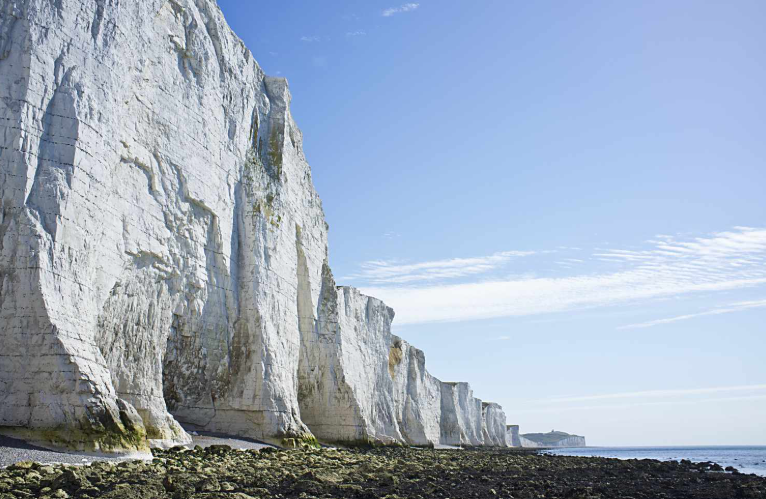
Cliffs are among the most visually arresting and geologically revealing features of the natural world — vertical or near-vertical faces of rock, soil, or ice that rise abruptly from the surrounding terrain, exposing the internal architecture of the Earth’s crust in cross-section and creating some of the most dramatic landscapes found anywhere on the planet. Defined broadly as any steep, near-vertical rock face of significant height, cliffs are found on every continent and in virtually every geological environment, from the wave-battered sea cliffs of Atlantic coastlines to the towering granite walls of mountain ranges, from the ochre sandstone escarpments of desert plateaus to the blue-white ice cliffs of polar ice sheets.
The formation of a cliff requires two fundamental conditions — rock or material strong enough to maintain a steep face without immediately collapsing, and a process capable of removing material from the base or face fast enough to prevent the gradual accumulation of debris that would otherwise bury the cliff in its own rubble. Wave action, river erosion, glacial activity, tectonic faulting, and mass wasting all serve this role in different environments, undercutting cliff bases and maintaining the steep profiles that define these landforms. The interplay between rock strength and erosional process determines the height, angle, character, and rate of change of any given cliff.
Cliffs have shaped human history and culture in profound ways. They have served as natural fortifications, their inaccessibility making clifftop sites among the most defensible in the world — from the ancient clifftop cities of the Mediterranean to the hill forts of Iron Age Britain. They have been sources of fear and inspiration in art and literature, symbols of both the sublime power of nature and the precariousness of human existence at the edge. They harbor ecosystems found nowhere else — seabird colonies of millions of individuals, specialized cliff-face plant communities, and cave systems carved into their bases by centuries of wave attack. The world’s great cliffs — the White Cliffs of Dover, El Capitan in Yosemite, the Cliffs of Moher, the Bunda Cliffs of Australia — are among the most iconic natural landmarks on Earth.
Sea Cliffs
Sea cliffs are formed by the relentless erosional attack of ocean waves on coastal rock, undercutting the base of the cliff through hydraulic action, abrasion, and chemical weathering until the unsupported rock above collapses, maintaining the steep face and causing the cliff to retreat progressively inland. They are among the most actively eroding landforms on Earth, their rate of retreat a direct reflection of the energy of the waves attacking them and the resistance of the rock from which they are carved.
The world’s sea cliffs range from modest rocky shores a few meters high to some of the tallest vertical rock faces on Earth. The Kalaupapa cliffs on the island of Molokai in Hawaii are the world’s tallest sea cliffs, rising approximately 1,010 meters directly from the Pacific Ocean — nearly twice the height of the Burj Khalifa. The Cliffs of Moher on the Atlantic coast of County Clare in Ireland, rising to 214 meters at their highest point and stretching 14 kilometers along the coast, attract approximately 1.5 million visitors annually and are among the most visited natural attractions in Europe.
Sea cliff erosion rates vary enormously with rock type. The chalk cliffs of the English Channel retreat at approximately 1 to 3 centimeters per year on average, while the soft boulder clay cliffs of Holderness on the Yorkshire coast — the fastest eroding coastline in Europe — lose up to 2 meters annually. Some 30 villages documented in the Domesday Book of 1086 along the Holderness coast have been entirely consumed by the sea.
Glacial Cliffs
Glacial cliffs, also known as ice cliffs or calving fronts, are the near-vertical faces formed where glaciers or ice sheets terminate abruptly — either at the ocean in the case of tidewater glaciers, or at the edge of a plateau or valley in the case of land-terminating glaciers. They are among the most dynamic and rapidly changing cliff types on Earth, their faces constantly being renewed as ice flows forward and broken as large blocks calve away.
The ice cliffs of Antarctica represent the most extensive glacial cliff system on Earth. The Ross Ice Shelf presents a nearly continuous ice cliff rising 30 to 50 meters above the ocean surface along a front approximately 800 kilometers long. The Thwaites Glacier in West Antarctica — sometimes called the Doomsday Glacier because of the catastrophic sea level rise its collapse could trigger — has an ice cliff front several kilometers wide that is retreating at an accelerating rate.
Glacial cliffs are of enormous scientific importance as indicators of climate change. The Jakobshavn Glacier in Greenland, one of the world’s fastest-moving glaciers, has retreated approximately 40 kilometers since the late 19th century. As the glacier retreats, it exposes new cliff faces and calves icebergs of extraordinary size — individual icebergs from Greenland’s calving glaciers have been measured at over 100 square kilometers in area.
Fault Cliffs (Fault Scarps)
Fault cliffs, also known as fault scarps, are formed by the sudden vertical displacement of the Earth’s crust along a fault line during an earthquake or by the cumulative effect of many earthquakes over geological time. When one block of crust is thrust upward or drops downward relative to the adjacent block, the resulting break in the land surface creates a steep escarpment that can range from a few meters to thousands of meters in height.
Fault scarps are among the clearest and most direct expressions of tectonic activity visible at the Earth’s surface, their fresh, unweathered faces often preserving evidence of individual earthquake events as a series of stepped scarps. The Wasatch Front in Utah, where the Wasatch Mountains rise abruptly from the Salt Lake Valley along the Wasatch Fault, is one of North America’s most dramatic fault scarps, rising approximately 2,000 meters above the valley floor.
The East African Rift System has produced some of the world’s most spectacular fault scarps, with the escarpments flanking the rift valley rising hundreds to thousands of meters above the rift floor. The Lebombo Mountains of southern Africa and the escarpment of the Arabian Peninsula are also major fault scarp features. The Dead Sea Transform fault system has produced fault scarps that contribute to the Jordan Valley’s extraordinary relief — the Dead Sea sits approximately 430 meters below sea level at the base of cliffs rising thousands of meters to the plateau surface above.
River Cliffs (River Bluffs)
River cliffs, also known as river bluffs or cut banks, are steep faces of rock or soil formed by the lateral erosion of a river cutting into the outer bank of a meander bend or undercutting a valley wall. They are the direct product of the river’s erosional work and are among the most common cliff types in humid, erosion-active landscapes worldwide.
River cliffs form on the outer bank of meander bends because the fastest-moving water in a river — which has the greatest erosional energy — is concentrated on the outside of each curve by centrifugal force. As the current attacks the outer bank, it cuts into it and maintains a steep or overhanging face that retreats progressively outward as the meander migrates across the floodplain. The opposite inner bank, by contrast, receives sediment deposited as a gently sloping point bar.
River bluffs can reach impressive heights in mature river valleys — the bluffs along the Mississippi River in Minnesota and Wisconsin rise up to 150 meters above the river, their faces exposing thick sequences of sedimentary rock laid down in ancient seas. The river canyons of the American West, including the Grand Canyon, contain river cliffs of extraordinary scale, their walls rising nearly 2,000 meters above the Colorado River and exposing nearly 2 billion years of geological history.
Desert Cliffs and Escarpments
Desert cliffs and escarpments are steep rock faces formed in arid environments primarily by the differential erosion of horizontal rock layers of varying resistance, producing stepped or vertical faces where resistant cap rocks protect underlying softer strata from erosion. In the absence of vegetation and with minimal chemical weathering, physical weathering processes — thermal expansion and contraction, salt crystallization, and wind abrasion — dominate cliff formation and modification.
The Colorado Plateau of the American Southwest contains some of the world’s most spectacular desert cliff scenery, with the sheer sandstone walls of Zion Canyon, the Vermilion Cliffs, and the cliffs of Monument Valley rising hundreds of meters from the desert floor in vivid reds, oranges, and whites. The Vermilion Cliffs in Arizona and Utah reach heights of up to 900 meters and extend for approximately 160 kilometers.
In Africa, the Bandiagara Escarpment in Mali — a sandstone cliff rising approximately 500 meters above the surrounding plains and extending for approximately 150 kilometers — has been the home of the Dogon people for centuries, who built their villages into the cliff face itself to protect against invaders. The Drakensberg Escarpment of southern Africa, stretching approximately 1,000 kilometers through South Africa, Lesotho, and eSwatini, reaches heights of over 3,400 meters and forms one of Africa’s most dramatic cliff landscapes.
Chalk Cliffs
Chalk cliffs are a specific and iconic type of sea cliff or inland escarpment carved from chalk — a soft, white, fine-grained limestone composed almost entirely of the microscopic skeletal fragments of marine organisms that lived in warm, shallow seas approximately 70 to 100 million years ago during the Late Cretaceous period. They are among the most recognizable and culturally significant cliff types in the world.
The White Cliffs of Dover on the Kent coast of England are the world’s most famous chalk cliffs, rising up to 107 meters above the English Channel and stretching approximately 16 kilometers along the coast. Their brilliant white faces have been a landmark for seafarers and a symbol of England for centuries — they were the first sight of home for generations of soldiers returning from wars in Europe and the last sight of England for countless emigrants. The chalk of the Dover cliffs was laid down between 70 and 89 million years ago when the area was covered by a warm tropical sea.
Chalk cliffs are found across northwestern Europe — the Alabaster Coast of Normandy in France presents cliffs almost identical in character and age to those of Dover, separated by the Channel that both shorelines are steadily eroding toward each other at a combined rate of a few centimeters per year. The chalk downlands of southern England are bounded by chalk escarpments including the North and South Downs, the Chilterns, and the Yorkshire Wolds.
Sandstone Cliffs
Sandstone cliffs are formed from consolidated sand grains cemented together into rock of varying hardness and resistance, producing cliff faces that range from deeply fissured and honeycomb-textured to smooth, sweeping walls of uniform color. Sandstone cliffs are found worldwide and encompass some of the most spectacular cliff scenery on Earth, their warm colors — derived from iron oxide minerals in the cement — giving them a distinctive visual character quite different from the grey of granite or the white of chalk.
The sandstone cliffs of the American Southwest are among the world’s most celebrated, their rich reds and oranges the product of iron-rich cement in the Jurassic and Triassic sandstones of the Colorado Plateau. El Morro in New Mexico — a sandstone mesa rising 60 meters from the surrounding desert — has been a landmark and message board for travelers for over 3,000 years, its base covered in inscriptions from ancestral Puebloan people, Spanish explorers, and 19th-century American settlers.
The Bungle Bungle Range in Western Australia — a UNESCO World Heritage Site — presents extraordinary beehive-shaped sandstone towers whose surfaces are banded in alternating orange and black, the colors produced by differences in the permeability of the rock layers affecting the distribution of iron oxide and algae. The sandstone cliffs of the Purnululu National Park rise up to 300 meters and were unknown to the outside world until 1983.
Granite Cliffs
Granite cliffs are formed from one of the Earth’s hardest and most durable rock types — a coarse-grained igneous rock formed by the slow cooling of magma deep within the Earth’s crust. Because granite is extremely resistant to erosion and maintains its strength even in near-vertical faces, it produces some of the tallest, most continuous, and most technically demanding cliff faces on Earth — the meccas of the world’s rock climbing community.
El Capitan in Yosemite Valley, California, is the world’s most famous granite cliff — a near-vertical face of glacially polished granite rising approximately 900 meters from the valley floor to the rim above. It is the largest exposed granite monolith on Earth by face area and the defining challenge of big wall rock climbing, first climbed in its entirety in 1958 by Warren Harding, George Whitmore, and George Harrer over 47 days. In 2017, Alex Honnold completed the first free solo ascent of El Capitan’s Freerider route — climbing the 900-meter face alone, without ropes, in 3 hours and 56 minutes.
The granite sea cliffs of Land’s End in Cornwall, the granite walls of Torres del Paine in Chilean Patagonia — rising nearly 2,500 meters — and the great granite domes of the Bugaboos in British Columbia are other iconic granite cliff landscapes. Granite cliffs tend to weather along joint planes into characteristic exfoliation sheets and rounded domes, producing the smooth, sweeping forms that define classic granite landscapes.
Limestone Cliffs
Limestone cliffs are carved from calcium carbonate rock — sedimentary rock formed primarily from the skeletal material of marine organisms — and are distinguished from other cliff types by the additional process of chemical dissolution that shapes them alongside mechanical erosion. Rainwater and groundwater dissolve the limestone along joints and bedding planes, creating caves, arches, overhangs, and honeycombed surfaces that give limestone cliffs their characteristically complex and intricate texture.
The limestone cliffs of the Dolomites in northern Italy — a UNESCO World Heritage Site — are among the world’s most spectacular mountain cliff landscapes, their pale grey and cream towers rising over 3,000 meters and glowing pink and orange at sunrise and sunset in the phenomenon known as the Enrosadira or alpenglow. The Dolomites are named after the geologist Déodat de Dolomieu, who first described the distinctive calcium magnesium carbonate rock of which they are composed.
The limestone sea cliffs of the Mediterranean — the towering white cliffs of the Amalfi Coast, the dramatic rock faces of the Calanques near Marseille, and the limestone pinnacles of the Greek islands — are among Europe’s most celebrated coastal landscapes. The limestone cliffs of Ha Long Bay in Vietnam, rising as isolated towers from the sea, and the Phi Phi Islands of Thailand represent the extraordinary karst cliff landscapes of Southeast Asia.
Volcanic Cliffs
Volcanic cliffs are formed from solidified lava flows, volcanic ash deposits, and other pyroclastic materials, often displaying distinctive columnar jointing — the regular hexagonal or pentagonal columns produced when lava cools and contracts uniformly — or the layered stratigraphy of successive eruptions that gives volcanic cliff faces their characteristic banded appearance.
The Giant’s Causeway on the north Antrim coast of Northern Ireland — a UNESCO World Heritage Site — is the world’s most famous volcanic cliff landscape, its approximately 40,000 interlocking basalt columns, most of them hexagonal, forming a series of stepped cliff faces and platforms descending to the sea. The columns were formed approximately 60 million years ago when a thick lava flow cooled slowly and contracted into regular geometric forms. Fingal’s Cave on the Scottish island of Staffa displays identical columnar basalt geology — the two sites were once part of the same lava flow before the Atlantic Ocean opened between them.
The volcanic sea cliffs of the Canary Islands, particularly the towering cliffs of Los Gigantes on Tenerife — rising vertically from the ocean to heights of 600 meters — and the calderas of the Azores expose the internal architecture of ancient volcanic edifices in dramatic cross-section. The Pali sea cliffs of Molokai, Hawaii, formed by the collapse of the northern flank of the ancient shield volcano, represent one of the world’s most dramatic examples of volcanic collapse cliff formation.
Ice Cliffs on Other Bodies
Beyond the glacial ice cliffs of Earth’s polar regions, ice cliffs are found in a variety of other settings — on high mountain peaks above the permanent snowline, on the flanks of active volcanoes where geothermal heat creates complex ice cave and cliff systems, and in permafrost environments where thawing of ice-rich frozen ground creates rapidly retreating coastal and riverbank cliffs of frozen sediment.
Permafrost cliffs are of increasing scientific and environmental concern as Arctic warming thaws the permanently frozen ground of Arctic coastlines, riverbanks, and hillsides. The permafrost cliffs of the Siberian Arctic and the Alaskan North Slope can retreat at rates of 5 to 15 meters per year as warming temperatures melt the ice that holds the frozen sediment together, releasing enormous quantities of carbon dioxide and methane — powerful greenhouse gases — stored in the permafrost into the atmosphere.
The ice cliffs of Kilimanjaro in Tanzania — the remnants of the ancient summit ice cap that once covered the entire crater rim — are retreating at an extraordinary rate, having lost approximately 85 percent of their area since 1912. The vertical ice walls of the Northern Ice Field, some rising 50 meters above the crater floor, are among the most striking and melancholy symbols of climate change in Africa, their disappearance — predicted within decades — marking the end of a glacial system that has persisted for at least 11,700 years.
Tufa and Travertine Cliffs
Tufa and travertine cliffs are a distinctive and relatively rare cliff type formed not by erosion but by the accumulation of calcium carbonate deposited by mineral-rich spring water, creating cascading formations of pale cream, white, and ochre rock that build up over centuries into terraced cliff landscapes of extraordinary beauty.
Travertine is formed when groundwater supersaturated with calcium carbonate — dissolved from limestone as the water passes through karst aquifers — emerges at springs and loses carbon dioxide to the atmosphere, causing the calcium carbonate to precipitate out of solution and accumulate around the spring outlet and along the watercourse downstream. Over centuries, these deposits build up into terraced pools, cascading falls, and cliff faces of layered travertine.
Pamukkale in southwestern Turkey — whose name means “Cotton Castle” in Turkish — is the world’s most famous travertine cliff landscape, its brilliant white terraced pools cascading down a hillside 200 meters high and extending approximately 2,700 meters across. The site has been designated a UNESCO World Heritage Site and attracts approximately 2 million visitors annually. Mammoth Hot Springs in Yellowstone National Park presents another spectacular travertine terrace landscape, with approximately 2 tons of calcium carbonate deposited daily by the hot spring waters emerging from the hillside.