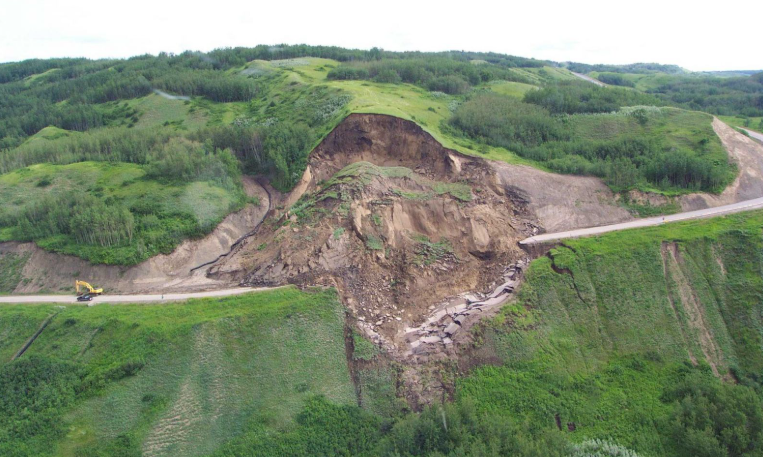
A landslide is the movement of a mass of rock, earth, or debris down a slope under the influence of gravity, representing one of the most destructive and widespread geological hazards on Earth. Landslides occur on every continent and in virtually every type of terrain, from the steep mountain ranges of the Himalayas and the Andes to the gentle coastal cliffs of temperate shorelines and the volcanic slopes of oceanic islands. They can happen with little or no warning, traveling at speeds ranging from a slow creep of millimeters per year to a catastrophic rush exceeding 300 kilometers per hour.
The human and economic toll of landslides is enormous. Each year, landslides kill thousands of people worldwide, destroy tens of thousands of homes, damage critical infrastructure including roads, bridges, pipelines, and railways, and cause billions of dollars in economic losses. In mountainous developing countries, where steep terrain, heavy seasonal rainfall, rapid urbanization on unstable slopes, and limited early warning systems combine, landslides are among the leading causes of disaster-related mortality. The deadliest single landslide events in recorded history have claimed tens of thousands of lives in a matter of minutes.
Landslides are triggered by a wide range of natural and human factors, often acting in combination. Heavy or prolonged rainfall is the most common trigger, saturating soils and increasing pore water pressure until slopes that were previously stable lose their resistance to gravitational force. Earthquakes can destabilize vast areas of terrain simultaneously, generating multiple landslides across entire mountain ranges within seconds. Volcanic activity, rapid snowmelt, river erosion undercutting valley sides, and the natural weathering of rock over time all contribute to slope instability. Human activities including deforestation, road construction, mining, reservoir filling, and unplanned construction on unstable ground have dramatically increased landslide frequency and impact in many regions.
The scientific study of landslides — their causes, mechanisms, classification, and behavior — is a discipline that draws on geology, geomorphology, geotechnical engineering, hydrology, and remote sensing. Understanding the different types of landslides is fundamental to this science, as each type moves in a distinct way, involves different materials and failure mechanisms, poses different levels of risk, and requires different approaches to assessment, monitoring, and mitigation. The classification of landslides developed by geologists David Varnes and later refined by others remains the most widely used framework, organizing landslide types by the nature of the material involved and the mechanism of movement.
Rockfall
A rockfall occurs when individual rocks or masses of rock detach from a steep cliff or slope and fall, bounce, or roll freely downhill with minimal contact with the surface beneath them. It is one of the fastest and most unpredictable types of mass movement, with individual boulders capable of reaching extraordinary speeds and traveling far from the base of the slope before coming to rest.
Rockfalls are typically triggered by freeze-thaw cycles that expand water in rock fractures, by rainfall that lubricates joint surfaces, or by earthquakes and root action that dislodge previously stable blocks. They are a particular hazard in mountainous regions with steep, jointed rock faces, along coastal cliffs, and in road and railway cuttings carved through rocky terrain.
Rock Avalanche
A rock avalanche, also known as a sturzstrom, is an extremely rapid and far-reaching flow of fragmented rock debris that results from the collapse of a very large volume of rock from a mountain face or cliff. What makes rock avalanches remarkable and scientifically puzzling is their ability to travel enormous horizontal distances — sometimes tens of kilometers across relatively flat terrain — far beyond what simple friction calculations would predict.
The mechanism behind their extraordinary mobility is still debated, with proposed explanations including air cushion lubrication, acoustic fluidization, and fragmentation-generated pressure within the moving mass. Rock avalanches are among the most destructive natural events in mountainous regions and have buried entire valleys and villages in seconds.
Debris Flow
A debris flow is a fast-moving mixture of water-saturated soil, rock fragments, organic material, and other debris that flows down steep channels or valley floors with the consistency of wet concrete, capable of transporting boulders and uprooting trees as it travels. It typically initiates on steep slopes during intense or prolonged rainfall, when the soil becomes so saturated that it loses its internal strength and begins to flow rather than slide.
Debris flows are among the most dangerous landslide types because of their speed, their ability to travel long distances from their source, and their tendency to funnel destructively through channels directly toward inhabited valley floors and alluvial fans where communities have historically settled. They deposit lobes and tongues of mixed material that can bury buildings, roads, and infrastructure under meters of mud, rock, and debris.
Debris Avalanche
A debris avalanche is a very rapid, shallow flow of unsaturated or partially saturated soil and rock material that moves down a steep slope without being confined to a channel, spreading out across the slope surface in a broad, fan-shaped deposit. It differs from a debris flow primarily in that it contains less water and tends to move across open hillsides rather than through stream channels.
Debris avalanches are common on steep volcanic flanks, where weakened and hydrothermally altered rock provides abundant unstable material, and on forested slopes where the root systems holding shallow soils in place have been destroyed by fire, logging, or disease. They can strip vegetation from entire hillsides and deliver large volumes of mixed material to stream channels, where it may subsequently mobilize as a debris flow.
Mudflow
A mudflow is a flowing mass composed predominantly of fine-grained material — silt and clay — mixed with enough water to give it a fluid, slurry-like consistency that allows it to flow rapidly down channels and across low-gradient terrain. It differs from a debris flow in that it contains a higher proportion of fine sediment and relatively little coarse rocky material, giving it a smoother texture and often a greater ability to travel long distances across gentle slopes.
Mudflows are frequently associated with volcanic eruptions, where they are known as lahars — the mixing of volcanic ash and pyroclastic material with water from crater lakes, melting glaciers, or heavy rainfall produces some of the most devastating mudflow events in geological history. Non-volcanic mudflows also occur widely in areas with easily erodible clay-rich soils, particularly following heavy rainfall or rapid snowmelt.
Lahar
A lahar is a type of mudflow specifically associated with volcanic environments, consisting of a rapidly moving slurry of volcanic debris, ash, and water that travels down river valleys and stream channels on the flanks of a volcano with enormous destructive force. The water that mobilizes a lahar can come from crater lakes, melting summit glaciers and snowfields during an eruption, or intense rainfall on freshly deposited volcanic ash.
Lahars are particularly insidious because they can occur hours, days, or even years after an eruption has ended, when rainfall remobilizes loose ash deposits long after the immediate volcanic crisis has passed and communities may have returned to the surrounding area. The 1985 eruption of Nevado del Ruiz in Colombia generated a lahar that buried the town of Armero and killed more than 23,000 people in one of the most tragic volcanic disasters in history.
Rotational Slide
A rotational slide, also called a slump, is a type of landslide in which a mass of soil or weak rock moves downslope along a curved, concave-upward failure surface, causing the sliding mass to rotate backward as it descends so that the upper surface tilts inward toward the slope rather than forward. This distinctive backward rotation is the defining characteristic that sets rotational slides apart from other failure types.
The curved failure surface tends to develop in homogeneous materials such as clays, soft shales, and deeply weathered soils, where strength is relatively uniform throughout the material and failure follows the path of least resistance. Rotational slides are common in coastal cliffs, river banks, road embankments, and natural hillsides composed of clay-rich sediments, and they tend to move more slowly than debris flows, often allowing time for observation and response before the full failure develops.
Translational Slide
A translational slide is one in which the failing mass moves along a relatively flat or planar failure surface — such as a bedding plane, a clay layer, a joint, or the boundary between soil and underlying rock — rather than the curved surface characteristic of a rotational slide. Because the failure surface is planar, the sliding mass tends to maintain its orientation rather than rotating, moving downslope as a more or less intact unit.
Translational slides are often controlled by pre-existing geological weaknesses — a layer of clay or weathered rock sandwiched between stronger materials, a bedding plane dipping in the same direction as the slope, or a discontinuity that provides a low-friction surface along which movement can occur. They can involve enormous volumes of material on very gentle slopes if the failure plane is sufficiently weak and the driving forces sufficiently large.
Block Slide
A block slide is a form of translational slide in which one or more large, relatively intact blocks of rock or stiff soil move downslope along a well-defined planar failure surface, with internal deformation within the blocks remaining minimal during movement. The blocks retain their original structure and geometry to a far greater degree than in flows or more disrupted slide types, moving essentially as rigid bodies sliding on a weak base.
Block slides are common where strong, competent rock masses are underlain by weaker materials such as clay, shale, or weathered rock that provide a low-resistance sliding plane. They can involve very large volumes of material and produce dramatic topographic disruption, but their tendency to move as coherent units can sometimes make them slightly more predictable and amenable to monitoring than more chaotic failure types.
Earth Flow
An earth flow is a slow to moderately rapid movement of water-saturated fine-grained soil — typically clay or silt — that deforms internally as it moves, behaving somewhere between a rigid slide and a true fluid flow. The moving mass typically has a source area where material is being consumed, a channel or track through which it flows, and a depositional lobe at the toe where material accumulates.
Earth flows are common in clay-rich terrain, particularly in areas with seasonally high rainfall or where agricultural or construction activity has disturbed the surface. They can be episodically active — accelerating during wet periods and slowing or stopping during dry seasons — and persist for years or decades as ongoing features of the landscape, gradually consuming the slope above and extending their depositional lobes below.
Creep
Creep is the slowest type of slope movement, involving the imperceptibly gradual downhill displacement of soil or rock over time at rates that are typically measured in millimeters to a few centimeters per year. Unlike more dramatic landslide types, creep does not involve a discrete failure event but rather a continuous, slow deformation driven by gravity, seasonal freeze-thaw cycles, wetting and drying, and the slow plastic deformation of fine-grained soils under sustained stress.
Although creep is too slow to pose an immediate physical danger to people, its cumulative effects over years and decades can cause significant damage to structures, roads, fences, retaining walls, and trees, which tilt, crack, or distort progressively as the ground beneath them moves. Curved or tilted tree trunks on hillsides, cracked walls, and displaced fence posts are among the most visible surface signs of active soil creep on a slope.
Topple
A topple occurs when a mass of rock or soil rotates forward and outward from a slope around a pivot point at or near the base of the failing block, tipping away from the hillside rather than sliding along a failure surface. The movement is driven by gravity acting on the overhanging or oversteepened mass, and it can range from the slow forward tilting of a single rock column over years to the sudden, catastrophic forward collapse of a large rock mass.
Toppling failures are most common in rock masses with steeply dipping discontinuities — joints, fractures, or bedding planes — that dip into the slope and provide the planes along which individual columns or slabs of rock tilt progressively forward until they lose stability entirely. They are a common hazard in steep rock cuttings, cliff faces, and canyon walls, and their sudden onset makes them particularly difficult to predict and defend against.
Lateral Spread
A lateral spread is a type of landslide in which a relatively intact upper layer of soil or rock extends and spreads horizontally over a weaker underlying layer that has been liquefied or remolded by earthquake shaking, rapid loading, or high pore water pressure. Rather than moving as a coherent mass sliding down a distinct failure surface, the spreading material breaks up into a series of blocks separated by extensional fissures, giving the failure zone a chaotic, fractured appearance.
Lateral spreads are particularly associated with earthquake-induced liquefaction, where saturated, loose sandy or silty soils momentarily lose their strength when shaken, allowing overlying material to flow outward toward free faces such as river banks, coastal bluffs, or excavations. They typically occur on very gentle slopes or nearly flat ground and can displace the surface layer by several meters horizontally, destroying foundations, pipelines, roads, and buildings with little vertical drop but devastating lateral movement.
Submarine Landslide
A submarine landslide occurs on the seafloor, when sediments accumulating on the continental shelf, slope, or in deep ocean basins become unstable and fail, generating mass movements that can travel hundreds of kilometers across the ocean floor and displace enormous volumes of material. Submarine landslides are among the largest mass movements on Earth, with some prehistoric examples involving volumes of sediment vastly exceeding the largest terrestrial landslides ever recorded.
Beyond their direct geological significance, submarine landslides are of critical concern because of their ability to generate tsunamis — the sudden displacement of a large volume of water by a failing submarine slope can propagate destructive waves across entire ocean basins. The Storegga Slide off the coast of Norway, which occurred approximately 8,200 years ago and involved the collapse of an area of seafloor the size of Scotland, generated a tsunami that inundated coastlines around the North Atlantic.
Snow Avalanche
A snow avalanche is the rapid, gravity-driven descent of a large mass of snow down a mountain slope, representing a distinct but related form of mass movement that shares many of the same physical principles as other landslide types while involving a uniquely volatile and seasonally variable material. Avalanches range from small sluffs of loose surface snow to massive slab avalanches in which an entire cohesive layer of compacted snow fractures along a weak internal layer and releases as a single catastrophic event.
Snow avalanches are triggered by new snowfall adding weight to unstable slopes, by warming that weakens bonds within the snowpack, by wind loading that creates unstable overhanging cornices, or by disturbance from skiers, explosives, or vibration. They are among the deadliest natural hazards in mountainous regions worldwide, threatening ski resorts, mountain villages, roads, and backcountry travelers during the winter and spring seasons.
Peat Slide
A peat slide occurs when a layer of waterlogged peat — the partially decomposed organic material that accumulates in bogs and upland moors — suddenly detaches from the underlying mineral soil and flows rapidly downslope as a dark, viscous mass. Peat slides tend to occur on gently sloping bog surfaces where the peat has become so saturated with water that it loses its shear strength and the bond between the peat layer and the substrate beneath it fails without warning.
They are most common in the upland blanket bogs of Ireland, Scotland, and Scandinavia, particularly following periods of exceptional rainfall or in areas where the surface vegetation has been damaged by burning, overgrazing, or drainage ditches that alter the hydrology of the bog. Though typically smaller in volume than rock or soil landslides, peat slides can travel considerable distances and have on occasion caused fatalities and significant damage to watercourses, which they can block or pollute with dense organic sediment.
Sensitive Clay Landslide
A sensitive clay landslide, sometimes called a quick clay landslide, occurs in deposits of marine clay that were laid down in saltwater environments during or after the last ice age and subsequently raised above sea level by post-glacial rebound, allowing fresh groundwater to gradually leach out the salt that originally stabilized the clay structure. When disturbed — by erosion, vibration, or human activity — these clays can undergo a dramatic and almost instantaneous transformation from a solid material to a liquid slurry with almost no residual strength.
The results of this transformation can be catastrophic — once triggered, sensitive clay failures tend to retrogress rapidly upslope as each successive block of clay liquefies and flows away, consuming large areas of flat terrain in a matter of minutes in a process called retrogressive failure. Scandinavia, Canada, and Alaska contain extensive deposits of sensitive marine clays, and some of the most dramatic landslide disasters in those regions — including the 1978 Rissa landslide in Norway, captured on film — have involved this sudden, liquefaction-driven failure mechanism.